Prerequisites: ch001–ch003
You will learn:
How mathematicians actually discover things: experiment first, prove second
The computational exploration loop: conjecture → test → refine → generalize
How to turn a vague observation into a precise, testable claim
Why “I wonder what happens if...” is a mathematical method, not a distraction
Environment: Python 3.x, numpy, matplotlib
1. Concept
Mathematics as taught in school presents finished results: theorems, proofs, formulas. This creates a false picture of how mathematics is actually done. Real mathematical work begins with exploration — playing with examples, noticing patterns, asking whether a pattern always holds, and only then attempting a proof.
Computational tools make this process faster and more accessible. You can test a conjecture on 10,000 cases in seconds. That does not replace a proof, but it tells you whether pursuing one is worth the effort.
The exploration loop:
Observe something in a specific case
Ask: does this hold in other cases?
Compute: test it on many cases
Refine: narrow down when it holds
Conjecture: state the pattern precisely
Prove (or find a counterexample)
This chapter focuses on steps 1–5. Step 6 comes in ch015–ch016.
Common misconception: Exploration without proof is not mathematics.
Exploration is mathematics — it is the generative phase. A proof is the verification phase. Both are necessary. Skipping exploration leads to proofs of things nobody cares about. Skipping proof leads to false conjectures treated as facts.
2. Intuition & Mental Models
Physical analogy: Think of exploration as surveying terrain before building a road. You walk the landscape, note where the hills are, where the ground is soft, where the natural paths form. Only after that survey do you commit to a specific route and invest in construction. Mathematical exploration surveys the landscape of a problem before committing to a proof strategy.
Computational analogy: Think of fuzzing in software testing. A fuzzer generates thousands of random inputs and looks for crashes. It does not prove the program is correct — but it builds confidence and finds edge cases efficiently. Mathematical exploration is mathematical fuzzing: generate many cases, look for failures, build a map of where things break.
Recall from ch003 (Abstraction and Modeling): we identified structure by testing data against candidate models. That was exploration. The R² score told us where to look; it did not constitute a proof.
3. Visualization
# --- Visualization: The Collatz conjecture — a famous unsolved exploration ---
# Rule: if n is even, divide by 2; if odd, multiply by 3 and add 1.
# Conjecture: every positive integer eventually reaches 1.
# Status: unproven after 85 years. Verified computationally for n up to ~10^20.

import numpy as np
import matplotlib.pyplot as plt
plt.style.use('seaborn-v0_8-whitegrid')

def collatz_sequence(n):
    """Generate the full Collatz sequence starting from n."""
    seq = [n]
    while n != 1:
        n = n // 2 if n % 2 == 0 else 3 * n + 1
        seq.append(n)
    return seq

def collatz_length(n):
    """Number of steps to reach 1 from n."""
    return len(collatz_sequence(n)) - 1

N_MAX = 500
ns = np.arange(1, N_MAX + 1)
lengths = np.array([collatz_length(n) for n in ns])

fig, axes = plt.subplots(1, 2, figsize=(14, 5))

# Left: steps to reach 1
axes[0].bar(ns, lengths, width=1.0, alpha=0.6, color='steelblue')
axes[0].set_xlabel('Starting value n')
axes[0].set_ylabel('Steps to reach 1')
axes[0].set_title('Collatz: Steps to Reach 1 (n = 1 to 500)')

# Right: sequences for several starting points
STARTS = [27, 97, 871, 6171]
colors = ['steelblue', 'coral', 'green', 'purple']
for start, color in zip(STARTS, colors):
    seq = collatz_sequence(start)
    axes[1].plot(seq, alpha=0.8, linewidth=1.2, label=f'n={start} ({len(seq)-1} steps)', color=color)
axes[1].set_xlabel('Step')
axes[1].set_ylabel('Value')
axes[1].set_title('Collatz Sequences: Chaotic but Always Reach 1')
axes[1].legend(fontsize=9)
axes[1].set_yscale('log')

plt.tight_layout()
plt.show()

print(f"Longest sequence for n ≤ {N_MAX}: starts at n={ns[np.argmax(lengths)]}, length={lengths.max()}")
print("No counterexample has ever been found. But no proof exists either.")
print("This is what open mathematical exploration looks like.")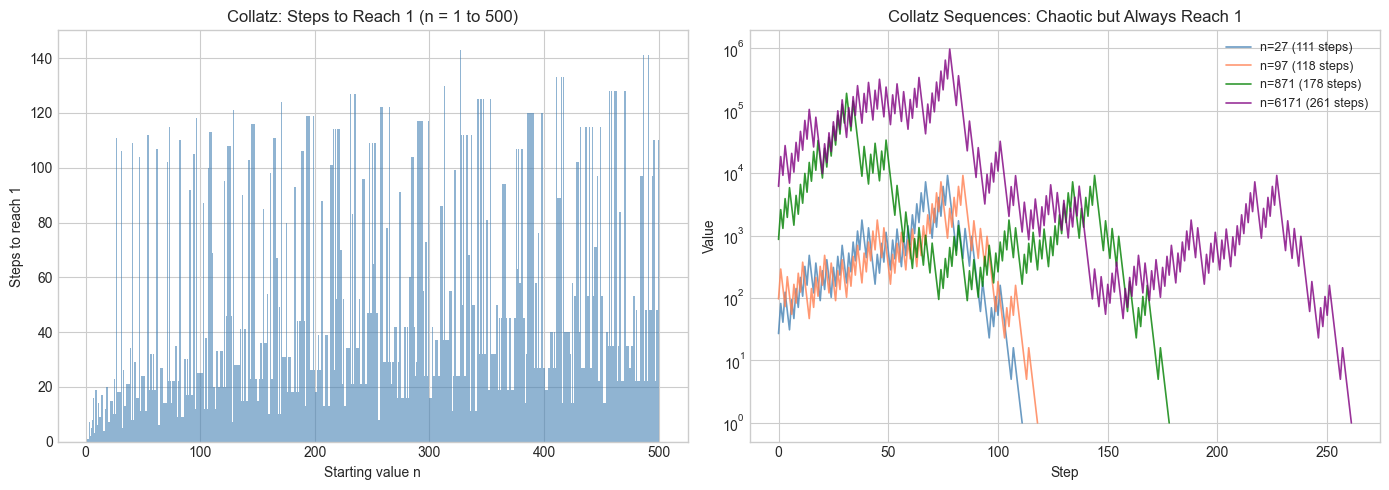
Longest sequence for n ≤ 500: starts at n=327, length=143
No counterexample has ever been found. But no proof exists either.
This is what open mathematical exploration looks like.
4. Mathematical Formulation
A conjecture is a precisely stated claim that has not yet been proved or disproved. The precision requirement is non-negotiable: a vague pattern observation is not a conjecture.
Structure of a well-formed conjecture:
For all [objects of type X] satisfying [conditions C], the property [P] holds.
Examples:
Vague: “Even numbers seem to be sums of two primes.”
Conjecture (Goldbach, 1742): For every even integer , there exist primes and such that .
The computational exploration loop tests a conjecture by:
Formalizing it as a predicate
Evaluating for
Reporting: all passed, or counterexample found at
If all pass: the conjecture is consistent with the evidence — not proved. If a counterexample is found: the conjecture is false — definitively.
This asymmetry (easy to disprove, hard to prove) is fundamental.
# --- Implementation: Conjecture tester ---
import numpy as np

def test_conjecture(predicate, domain_generator, n_tests=10000, name='unnamed'):
    """
    Test a mathematical conjecture computationally.

    Args:
        predicate:        callable(n) -> bool, the claim to test
        domain_generator: callable() -> one element of the domain
        n_tests:          number of cases to test
        name:             description of the conjecture
    Returns:
        dict with results
    """
    passed = 0
    counterexample = None
    for _ in range(n_tests):
        val = domain_generator()
        if not predicate(val):
            counterexample = val
            break
        passed += 1

    result = 'COUNTEREXAMPLE FOUND' if counterexample else f'consistent ({passed} cases)'
    print(f"Conjecture: {name}")
    print(f"  Result: {result}")
    if counterexample is not None:
        print(f"  Counterexample: {counterexample}")
    print()
    return {'passed': passed, 'counterexample': counterexample}

# --- Helper: primality test ---
def is_prime(n):
    if n < 2: return False
    if n == 2: return True
    if n % 2 == 0: return False
    for i in range(3, int(n**0.5) + 1, 2):
        if n % i == 0: return False
    return True

np.random.seed(42)

# Conjecture 1: Goldbach (every even n > 2 is sum of two primes)
def goldbach(n):
    for p in range(2, n):
        if is_prime(p) and is_prime(n - p):
            return True
    return False

test_conjecture(
    predicate=goldbach,
    domain_generator=lambda: np.random.randint(2, 500) * 2 + 2,  # even > 2
    n_tests=5000,
    name="Every even n > 2 is the sum of two primes (Goldbach)"
)

# Conjecture 2: n² + n + 41 is always prime (Euler's formula — FALSE)
def euler_prime_formula(n):
    return is_prime(n * n + n + 41)

test_conjecture(
    predicate=euler_prime_formula,
    domain_generator=lambda: np.random.randint(0, 100),
    n_tests=200,
    name="n² + n + 41 is always prime (Euler's formula — expect failure)"
)

# Conjecture 3: (your own) — modify this
# Claim: the sum of first n cubes equals (n(n+1)/2)²
def sum_of_cubes(n):
    actual = sum(k**3 for k in range(1, n + 1))
    formula = (n * (n + 1) // 2) ** 2
    return actual == formula

test_conjecture(
    predicate=sum_of_cubes,
    domain_generator=lambda: np.random.randint(1, 200),
    n_tests=500,
    name="Sum of first n cubes = (n(n+1)/2)²"
)
Conjecture: Every even n > 2 is the sum of two primes (Goldbach)
Result: consistent (5000 cases)
Conjecture: n² + n + 41 is always prime (Euler's formula — expect failure)
Result: COUNTEREXAMPLE FOUND
Counterexample: 49
Conjecture: Sum of first n cubes = (n(n+1)/2)²
Result: consistent (500 cases)
{'passed': 500, 'counterexample': None}5. Python Implementation
# --- Implementation: Exploration journal ---
# A structured record of mathematical exploration.
# Each entry: observation, conjecture, computational test, status.

class ExplorationJournal:
    """
    Records mathematical explorations in the conjecture → test → result cycle.
    """
    def __init__(self):
        self.entries = []

    def explore(self, observation, conjecture_fn, domain_gen,
                n_tests=1000, conjecture_text=''):
        """
        Record an exploration step.

        Args:
            observation:     what triggered this investigation (string)
            conjecture_fn:   predicate to test
            domain_gen:      input generator
            n_tests:         number of test cases
            conjecture_text: precise statement of the conjecture
        """
        passed = 0
        counterexample = None
        for _ in range(n_tests):
            val = domain_gen()
            if not conjecture_fn(val):
                counterexample = val
                break
            passed += 1

        entry = {
            'observation': observation,
            'conjecture': conjecture_text,
            'tests': n_tests,
            'passed': passed,
            'counterexample': counterexample,
            'status': 'REFUTED' if counterexample else 'CONSISTENT',
        }
        self.entries.append(entry)
        return entry

    def report(self):
        print("=" * 60)
        print("EXPLORATION JOURNAL")
        print("=" * 60)
        for i, e in enumerate(self.entries, 1):
            print(f"\n[{i}] Observation: {e['observation']}")
            print(f"    Conjecture:  {e['conjecture']}")
            print(f"    Tested:      {e['tests']} cases")
            print(f"    Status:      {e['status']}")
            if e['counterexample'] is not None:
                print(f"    Refuted by:  {e['counterexample']}")

# Demonstrate
journal = ExplorationJournal()
np.random.seed(99)

journal.explore(
    observation="Squaring an integer and checking divisibility by 4 gives interesting patterns",
    conjecture_fn=lambda n: (n * n) % 4 in (0, 1),
    domain_gen=lambda: np.random.randint(-1000, 1000),
    n_tests=5000,
    conjecture_text="n² mod 4 is always 0 or 1 for any integer n"
)

journal.explore(
    observation="Products of two odd numbers seem odd",
    conjecture_fn=lambda pair: (pair[0] * pair[1]) % 2 == 1,
    domain_gen=lambda: (np.random.randint(0, 500) * 2 + 1,
                        np.random.randint(0, 500) * 2 + 1),
    n_tests=5000,
    conjecture_text="Product of two odd integers is always odd"
)

journal.report()
============================================================
EXPLORATION JOURNAL
============================================================
[1] Observation: Squaring an integer and checking divisibility by 4 gives interesting patterns
Conjecture: n² mod 4 is always 0 or 1 for any integer n
Tested: 5000 cases
Status: CONSISTENT
[2] Observation: Products of two odd numbers seem odd
Conjecture: Product of two odd integers is always odd
Tested: 5000 cases
Status: CONSISTENT
6. Experiments
# --- Experiment: Pascal's triangle and hidden patterns ---
# Hypothesis: Pascal's triangle contains many non-obvious patterns.
# Try changing: N_ROWS and the modulus in the coloring

import numpy as np
import matplotlib.pyplot as plt
plt.style.use('seaborn-v0_8-whitegrid')

N_ROWS = 64     # <-- try: 32, 128
MODULUS = 2     # <-- try: 3, 5, 7 — watch different fractal patterns appear

def pascal_triangle(n):
    """Compute first n rows of Pascal's triangle."""
    triangle = []
    row = [1]
    for _ in range(n):
        triangle.append(row[:])
        row = [1] + [row[i] + row[i+1] for i in range(len(row)-1)] + [1]
    return triangle

rows = pascal_triangle(N_ROWS)

# Build a grid image: color by value mod MODULUS
grid = np.zeros((N_ROWS, 2 * N_ROWS - 1))
for i, row in enumerate(rows):
    start = N_ROWS - 1 - i
    for j, val in enumerate(row):
        grid[i, start + 2*j] = val % MODULUS

fig, ax = plt.subplots(figsize=(10, 8))
ax.imshow(grid, cmap='hot', interpolation='nearest', aspect='auto')
ax.set_title(f"Pascal's Triangle mod {MODULUS} (first {N_ROWS} rows)\n"
             f"Bright = nonzero, Dark = divisible by {MODULUS}")
ax.axis('off')
plt.tight_layout()
plt.show()

# Count patterns
print(f"Entries divisible by {MODULUS}: ", sum(1 for row in rows for v in row if v % MODULUS == 0))
print(f"Total entries: ", sum(len(row) for row in rows))
print()
print("With modulus=2: you see Sierpinski's triangle — a fractal.")
print("With prime moduli: different fractals appear.")
print("Conjecture: the pattern for prime p always produces a Sierpinski-like fractal.")
print("This is true. It follows from Lucas' theorem (ch015 territory).")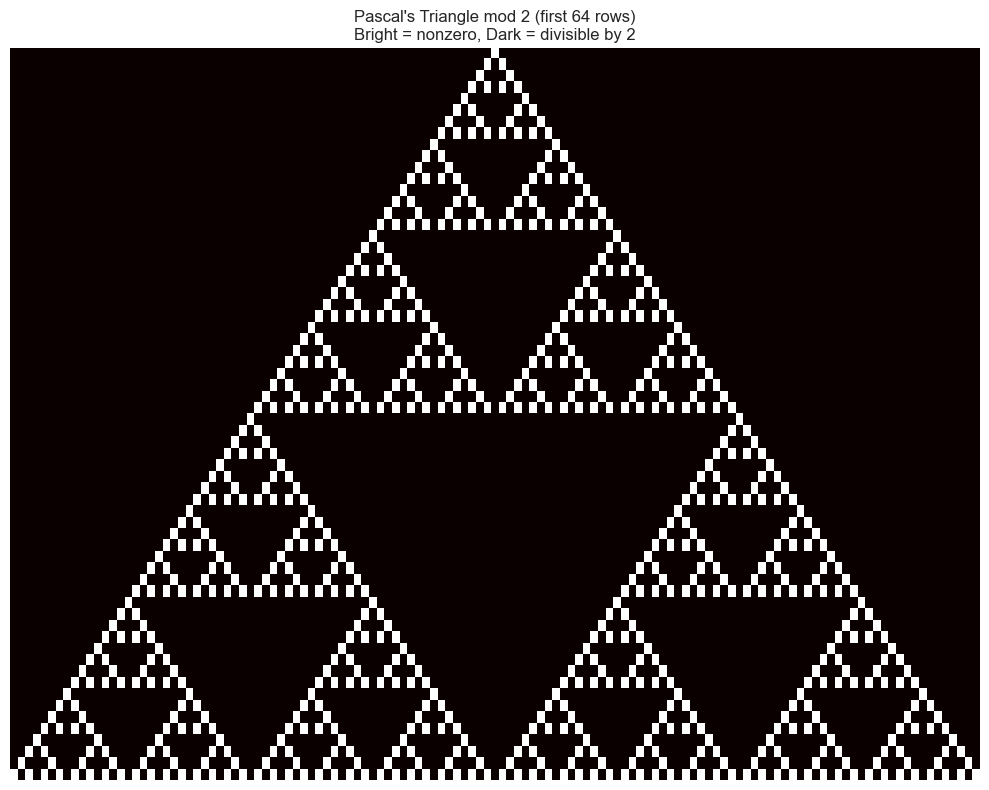
Entries divisible by 2:  1351
Total entries:  2080

With modulus=2: you see Sierpinski's triangle — a fractal.
With prime moduli: different fractals appear.
Conjecture: the pattern for prime p always produces a Sierpinski-like fractal.
This is true. It follows from Lucas' theorem (ch015 territory).
7. Exercises
Easy 1. The Collatz function is defined for positive integers. What happens if you apply it to negative integers? Modify collatz_sequence to handle negatives and explore whether sequences still eventually cycle. (Expected: observed cycle for negative inputs)
Easy 2. Use test_conjecture to test: “For any integer n, n³ - n is divisible by 6.” Test it on 5000 random integers in [-500, 500]. (Expected: consistent, zero counterexamples)
Medium 1. Explore the sequence defined by: start with any positive integer, repeatedly apply: if divisible by 3, divide by 3; else multiply by 3 and subtract 1. Does every starting point eventually cycle? Use collatz_length as a template, run it for starting values 1–200, plot the number of steps, and state a precise conjecture about what you observe.
Medium 2. Pascal’s triangle mod 2 produces Sierpinski’s triangle. Prove computationally that row n of Pascal’s triangle contains all odd entries if and only if n+1 is a power of 2. Test for the first 128 rows.
Hard. The sum-of-cubes identity says . This is remarkable: the cube sum equals the square of the ordinary sum. Explore whether an analogous identity holds for higher powers: does equal some simple expression involving for ? Test for numerically and determine what polynomial in fits the sum. (Challenge: use np.polyfit on the sequence and identify the degree)
8. Mini Project
Prime Gap Explorer
The gaps between consecutive primes (2,3,5,7,11,...) have been studied for centuries. Many patterns are known; others remain conjectural. Explore the distribution of prime gaps computationally and formulate three precise conjectures of your own.
# --- Mini Project: Prime Gap Explorer ---
import numpy as np
import matplotlib.pyplot as plt
plt.style.use('seaborn-v0_8-whitegrid')

def sieve_of_eratosthenes(limit):
    """Return all primes up to limit using the Sieve of Eratosthenes."""
    is_p = np.ones(limit + 1, dtype=bool)
    is_p[0] = is_p[1] = False
    for i in range(2, int(limit**0.5) + 1):
        if is_p[i]:
            is_p[i*i::i] = False
    return np.where(is_p)[0]

LIMIT = 100_000
primes = sieve_of_eratosthenes(LIMIT)
gaps = np.diff(primes)

fig, axes = plt.subplots(2, 2, figsize=(13, 9))

axes[0,0].hist(gaps, bins=range(1, gaps.max()+2), density=True, alpha=0.7)
axes[0,0].set_xlabel('Gap size'); axes[0,0].set_ylabel('Frequency')
axes[0,0].set_title('Distribution of Prime Gaps (primes ≤ 100,000)')

axes[0,1].plot(primes[:-1], gaps, alpha=0.3, linewidth=0.5)
axes[0,1].set_xlabel('Prime p'); axes[0,1].set_ylabel('Gap to next prime')
axes[0,1].set_title('Gap Size vs Prime Value')

# Running average gap vs log(p) — prime number theorem predicts gap ≈ ln(p)
window = 200
running_avg = np.convolve(gaps, np.ones(window)/window, mode='valid')
p_mid = primes[window//2 : window//2 + len(running_avg)]
axes[1,0].plot(p_mid, running_avg, label='Running avg gap', linewidth=1.5)
axes[1,0].plot(p_mid, np.log(p_mid), 'r--', label='ln(p) (PNT prediction)', linewidth=1.5)
axes[1,0].set_xlabel('Prime p'); axes[1,0].set_ylabel('Average gap')
axes[1,0].set_title('Average Gap vs ln(p) — Prime Number Theorem')
axes[1,0].legend()

# Even gaps dominate (twin prime territory)
even_gaps = gaps[gaps % 2 == 0]
odd_gaps  = gaps[gaps % 2 != 0]
axes[1,1].bar(['Even gaps', 'Odd gaps', 'Gap=1 (only 2→3)'],
              [len(even_gaps), len(odd_gaps), 1],
              color=['steelblue', 'coral', 'green'])
axes[1,1].set_ylabel('Count'); axes[1,1].set_title('Even vs Odd Gaps')

plt.tight_layout()
plt.show()

twin_primes = primes[:-1][gaps == 2]
print(f"Twin primes (gap=2) up to {LIMIT}: {len(twin_primes)} pairs")
print(f"Largest gap found: {gaps.max()} (after prime {primes[:-1][np.argmax(gaps)]})")
print(f"All gaps except first are even: {np.all(gaps[1:] % 2 == 0)}")
print()
print("TODO: Formulate 3 conjectures of your own based on these plots.")
print("Example format: 'For all primes p > 2, the gap after p is...'")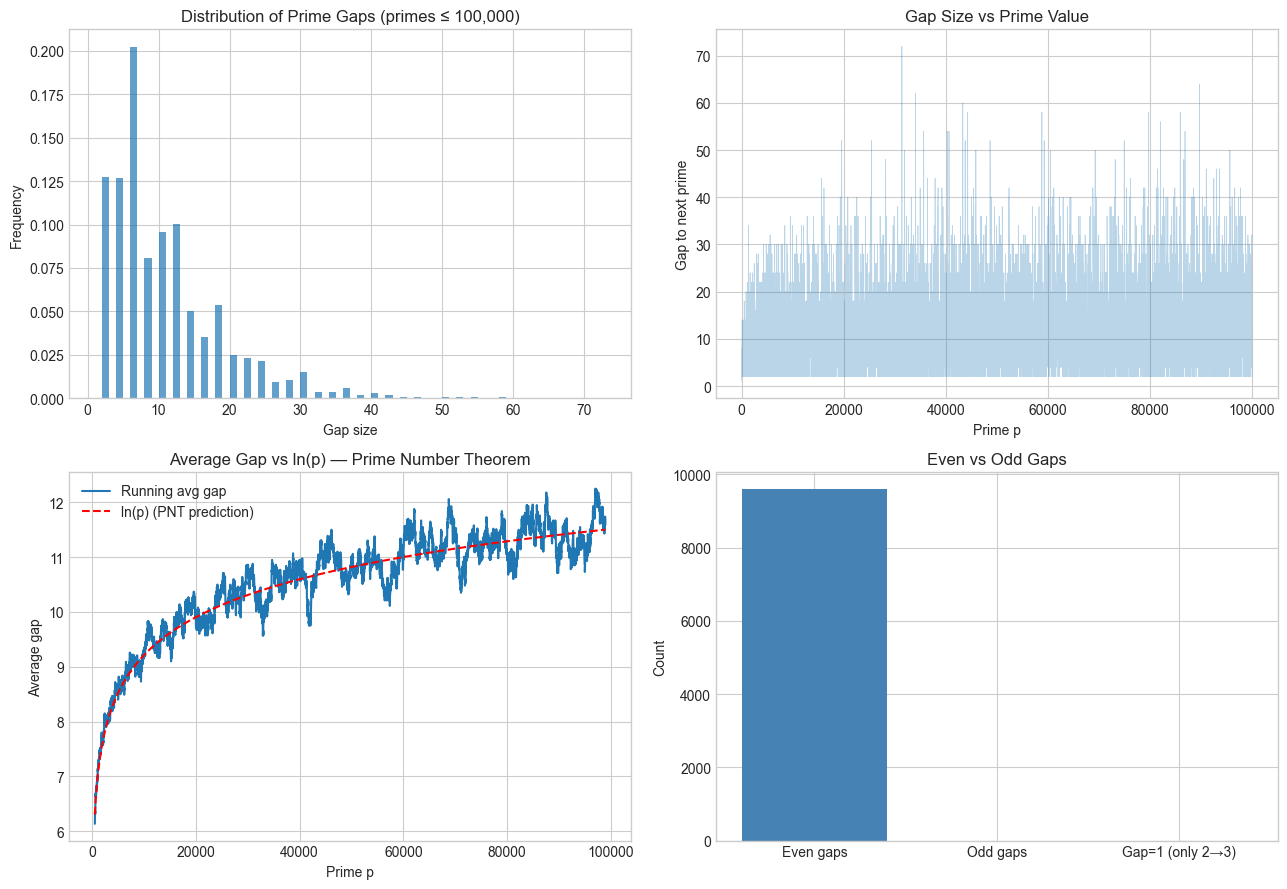
Twin primes (gap=2) up to 100000: 1224 pairs
Largest gap found: 72 (after prime 31397)
All gaps except first are even: True

TODO: Formulate 3 conjectures of your own based on these plots.
Example format: 'For all primes p > 2, the gap after p is...'
9. Chapter Summary & Connections
Mathematical discovery follows an exploration loop: observe → conjecture → test → refine — proof comes last, not first
A conjecture must be precisely stated as a universal claim with a defined domain; imprecise pattern observations are not conjectures
Computational testing is asymmetric: one counterexample definitively refutes; passing all tests only provides evidence
Exploration is a legitimate mathematical method — Gauss, Euler, and Ramanujan all worked this way
Forward: The conjecture-testing infrastructure built here reappears in ch015 — Mathematical Proof Intuition, where we turn computationally consistent conjectures into formal arguments. The prime gap patterns connect to ch045 — Exponential Growth, where the Prime Number Theorem (average gap ≈ ln(p)) is revisited as a statement about growth rates.
Backward: This chapter extends ch002’s property-based testing (ch002 — Mathematics vs Programming Thinking): we are now using random testing not to verify software but to probe mathematical truth.