Prerequisites: ch001–ch009
You will learn:
Parse complex mathematical expressions tree-by-tree
Identify operator precedence in mathematical notation
Translate nested expressions to code without errors
Recognize common expression patterns instantly
Environment: Python 3.x, numpy, matplotlib
1. Concept
Reading a mathematical expression is a parsing problem — the same skill as reading code with unfamiliar syntax. Expressions have tree structure: operators bind subexpressions at different precedence levels. The key skill is identifying the top-level operator first, then recursively parsing each subtree.
Mathematical precedence (highest to lowest): function application > exponentiation > multiplication/division > addition/subtraction. Parentheses override everything. Greek letters are just variable names.
Common misconception: Subscripts and superscripts are always indices and exponents.
Subscripts often denote sequences (), matrix entries (), or parameter labels (). Superscripts often denote exponents () but also iteration counts () or transposition (). Context determines which.
2. Intuition & Mental Models
Physical analogy: Parsing a mathematical expression is like parsing a sentence in a foreign language where you know the grammar rules but not all the vocabulary. You identify the verb (main operator) first, then parse the noun phrases (operands). The grammar is precedence; the vocabulary is the individual functions and constants.
Computational analogy: Think of an abstract syntax tree (AST). Every expression in a programming language has one. Mathematical expressions have exactly the same structure. 2*x + sin(x)^2 in math is the same tree as Add(Mul(2,x), Pow(Sin(x),2)) in code. If you can read the code AST, you can read the math.
Recall from ch009 (Mathematical Notation for Programmers): we built a notation-to-code translation dictionary. This chapter uses that dictionary to parse compound expressions, not just individual symbols.
3. Visualization
# --- Visualization: Expression tree structure ---
import matplotlib.pyplot as plt
import matplotlib.patches as mpatches
import numpy as np
plt.style.use('seaborn-v0_8-whitegrid')

# Visualize the expression tree for: (x^2 + 1) / (2*x - 3)
fig, ax = plt.subplots(figsize=(10, 6))
ax.set_xlim(0, 10)
ax.set_ylim(0, 6)
ax.axis('off')

nodes = [
    (5, 5.2, '÷',       'coral',     16),
    (2.5, 3.8, '+',     'steelblue', 14),
    (7.5, 3.8, '−',     'steelblue', 14),
    (1.2, 2.2, '^',     'green',     13),
    (3.8, 2.2, '1',     'gray',      12),
    (6.5, 2.2, '2·x',  'gray',      12),
    (8.5, 2.2, '3',     'gray',      12),
    (0.5, 0.8, 'x',     'gray',      11),
    (1.9, 0.8, '2',     'gray',      11),
]
edges = [(5,2.5),(5,7.5),(2.5,1.2),(2.5,3.8),(7.5,6.5),(7.5,8.5),(1.2,0.5),(1.2,1.9)]

for (x1,x2) in [(5,2.5),(5,7.5)]:
    ax.annotate('', xy=(x2, 4.05), xytext=(5, 5.0),
                arrowprops=dict(arrowstyle='->', color='black', lw=1.5))
for (x1,y1,x2,y2) in [(2.5,3.55,1.2,2.45),(2.5,3.55,3.8,2.45),
                       (7.5,3.55,6.5,2.45),(7.5,3.55,8.5,2.45),
                       (1.2,1.95,0.5,1.05),(1.2,1.95,1.9,1.05)]:
    ax.annotate('', xy=(x2,y2), xytext=(x1,y1),
                arrowprops=dict(arrowstyle='->', color='black', lw=1.2))

for x, y, label, color, size in nodes:
    ax.add_patch(mpatches.Circle((x,y), 0.35, color=color, alpha=0.8))
    ax.text(x, y, label, ha='center', va='center', fontsize=size, fontweight='bold', color='white')

ax.text(5, 5.8, r'$(x^2 + 1) \,/\, (2x - 3)$', ha='center', fontsize=14)
ax.text(0, 0.1, 'Top-level operator: ÷  →  parse numerator and denominator separately', fontsize=10, color='coral')
ax.set_title('Expression Tree: Parse top-level operator first, recurse into subtrees', fontsize=11)
plt.tight_layout()
plt.show()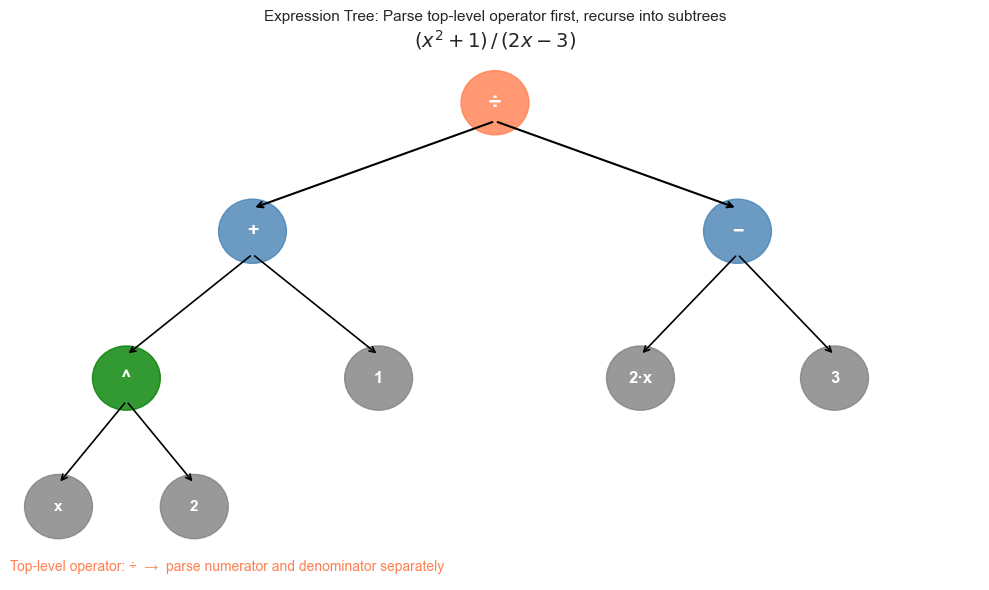
4. Mathematical Formulation
Parsing algorithm for mathematical expressions:
Find the top-level operator: the operator with lowest precedence that is not inside parentheses
Split the expression at that operator
Recursively parse each subexpression
Base case: a single number or variable
This is exactly recursive descent parsing — the same algorithm used in programming language compilers.
Key precedence rules (decreasing precedence):
Parentheses: — override everything
Function application: , — binds tightest
Exponentiation: — right-associative:
Negation:
Multiplication/division: , — left-associative
Addition/subtraction: , — left-associative
A critical special case: juxtaposition (no operator symbol) means multiplication. , .
# --- Implementation: Expression evaluator via recursive descent ---
import numpy as np

class MathExpressionEvaluator:
    """
    Evaluates simple mathematical expressions given variable bindings.
    Supports: +, -, *, /, ^, parentheses, and variables.
    This is a teaching implementation — use sympy for production use.
    """
    FUNCS = {'sin': np.sin, 'cos': np.cos, 'exp': np.exp,
             'log': np.log, 'sqrt': np.sqrt, 'abs': np.abs}

    def __init__(self, env=None):
        self.env = env or {}

    def evaluate(self, expr):
        """Evaluate expression string with current variable bindings."""
        expr = expr.replace(' ', '').replace('^', '**')
        return eval(expr, {**self.FUNCS, **self.env})

    def evaluate_at(self, expr, var, values):
        """Evaluate expression for array of values of one variable."""
        results = []
        for v in values:
            self.env[var] = v
            try:
                results.append(self.evaluate(expr))
            except:
                results.append(np.nan)
        return np.array(results)

# Demonstrate
eval_engine = MathExpressionEvaluator()

expressions = [
    ('x^2 + 2*x + 1', 'x', [-2, -1, 0, 1, 2]),
    ('sin(x) * exp(-x)', 'x', [0, 1, 2, 3]),
    ('(x^2 + 1) / (2*x - 3)', 'x', [0, 1, 2, 4]),
]

for expr, var, vals in expressions:
    results = eval_engine.evaluate_at(expr, var, vals)
    print(f"f(x) = {expr}")
    for v, r in zip(vals, results):
        print(f"  f({v}) = {r:.4f}")
    print()
f(x) = x^2 + 2*x + 1
f(-2) = 1.0000
f(-1) = 0.0000
f(0) = 1.0000
f(1) = 4.0000
f(2) = 9.0000
f(x) = sin(x) * exp(-x)
f(0) = 0.0000
f(1) = 0.3096
f(2) = 0.1231
f(3) = 0.0070
f(x) = (x^2 + 1) / (2*x - 3)
f(0) = -0.3333
f(1) = -2.0000
f(2) = 5.0000
f(4) = 3.4000
6. Experiments
# --- Experiment: Parsing errors from wrong precedence assumptions ---
# Hypothesis: Wrong precedence assumptions cause systematic computation errors.
import numpy as np

X = 3.0

# Expression: 2*x^2  -- does ^ bind tighter than *?
math_correct = 2 * (X**2)  # 2*(x^2) — math convention
math_wrong   = (2*X)**2    # (2*x)^2 — wrong parsing
print(f"2*x^2 at x={X}:")
print(f"  Correct (2*(x^2)): {math_correct}")
print(f"  Wrong ((2x)^2):   {math_wrong}")
print()

# Expression: -x^2 -- does - bind tighter than ^?
math_correct2 = -(X**2)  # -(x^2) — math convention
math_wrong2   = (-X)**2  # (-x)^2 — wrong parsing
print(f"-x^2 at x={X}:")
print(f"  Correct (-(x^2)): {math_correct2}")
print(f"  Wrong ((-x)^2):   {math_wrong2}")
print()
print("Rule: ^ binds tighter than * or unary -, always.")
2*x^2 at x=3.0:
Correct (2*(x^2)): 18.0
Wrong ((2x)^2): 36.0
-x^2 at x=3.0:
Correct (-(x^2)): -9.0
Wrong ((-x)^2): 9.0
Rule: ^ binds tighter than * or unary -, always.
7. Exercises
Easy 1. What is the value of ? Compute it by hand following precedence rules, then verify with Python. (Expected: 34)
Easy 2. Translate these to Python: (a) , (b) , (c) . (Expected: 63, 5.0, {0,1,4,9})
Medium 1. The expression means “the derivative of the composition with respect to .” Using the chain rule , implement a function chain_rule_deriv(f, g, f_prime, g_prime, x) and verify it against the central difference approximation for , at .
Medium 2. Parse these expressions by drawing their tree structure (text-art is fine): (a) , (b) , (c) . For each, identify the top-level operator and the number of tree levels.
Hard. Implement a full recursive-descent parser for mathematical expressions with variables. It should handle: +, -, *, /, ^ (right-associative), unary minus, parentheses, sin, cos, exp, log. Return an AST as nested Python dicts. Then write an evaluate(ast, env) function. Test on at least 10 complex expressions.
# --- Mini Project: Expression Complexity Analyzer ---
# Given a mathematical expression, measure its computational complexity:
# operation count, tree depth, and identify the dominant cost.
import numpy as np

def count_operations(expr_str):
    """
    Count operations in a mathematical expression string.
    Simple heuristic counter.
    """
    expr = expr_str.replace(' ', '')
    counts = {
        'add_sub': expr.count('+') + max(0, expr.count('-') - expr.startswith('-')),
        'mul_div': expr.count('*') + expr.count('/'),
        'power':   expr.count('^') + expr.count('**'),
        'func_calls': sum(expr.count(f+'(') for f in ['sin','cos','exp','log','sqrt']),
    }
    counts['total'] = sum(counts.values())
    return counts

expressions = [
    'x^2 + 2*x + 1',
    'sin(x)*cos(x) + exp(-x^2)',
    '(x^3 - 3*x^2 + 3*x - 1)',
    '1/(1 + exp(-x))',  # sigmoid
]

print(f"{'Expression':<40} {'Add/Sub':>8} {'Mul/Div':>8} {'Powers':>7} {'Funcs':>6} {'Total':>6}")
print('-'*80)
for expr in expressions:
    c = count_operations(expr)
    print(f"{expr:<40} {c['add_sub']:>8} {c['mul_div']:>8} {c['power']:>7} {c['func_calls']:>6} {c['total']:>6}")
Expression Add/Sub Mul/Div Powers Funcs Total
--------------------------------------------------------------------------------
x^2 + 2*x + 1 2 1 1 0 4
sin(x)*cos(x) + exp(-x^2) 2 1 1 3 7
(x^3 - 3*x^2 + 3*x - 1) 3 2 2 0 7
1/(1 + exp(-x)) 2 1 0 1 4
9. Chapter Summary & Connections
Mathematical expression parsing follows operator precedence exactly like programming language parsing — the AST approach makes this systematic
Key precedence: parentheses > function application > exponentiation > multiplication/division > addition/subtraction
Juxtaposition means multiplication; subscripts and superscripts have multiple meanings determined by context
Recursive descent parsing is the correct algorithm for reading complex nested expressions
Forward: Expression parsing is used throughout the book. The chain rule expression is central to ch215 — Chain Rule. Einstein summation notation () is the basis of ch154 — Matrix Multiplication.
Backward: This chapter is a direct application of ch009 (Mathematical Notation for Programmers) — we now parse compound expressions built from the atomic symbols catalogued there.