Prerequisites: ch001-ch015
You will learn:
Why one counterexample suffices to disprove any universal claim
How existence proofs differ from universal proofs
The constructive vs non-constructive distinction
How to systematically search for counterexamples
Environment: Python 3.x, numpy, matplotlib
1. Concept
Two asymmetric proof techniques govern existence and universality:
To prove for-all x P(x): You cannot use examples -- you need a general argument. No finite set of examples suffices.
To disprove for-all x P(x): One counterexample is sufficient and definitive.
To prove there-exists x P(x): One example (construction) is sufficient.
To disprove there-exists x P(x): You need to prove for-all x NOT-P(x). A general argument is required.
This asymmetry shapes strategy: when trying to disprove, look for a counterexample. When proving existence, construct one specific object.
Common misconception: If a pattern holds for many cases, it is probably always true.
Euler’s formula n^2+n+41 produces primes for n=0 through 39 (forty consecutive cases) then fails at n=40. No threshold of examples guarantees universal truth.
2. Intuition & Mental Models
Physical analogy: Quality testing. To prove every component is non-defective, you must test them all. To prove at least one is defective, find just one. The asymmetry of inspection burden is the same as the asymmetry of proof burden.
Computational analogy: Program correctness. To prove a program correct for all inputs, you need a proof or exhaustive test. To prove it has a bug, you need one failing test case. A fuzzer is a counterexample-finding machine.
Recall from ch004 (Mathematical Curiosity and Exploration): test_conjecture found that Euler’s formula failed at n=40. That was counterexample finding. This chapter formalizes the method.
# --- Visualization: Euler's formula -- 40 successes then failure ---
import numpy as np
import matplotlib.pyplot as plt
plt.style.use('seaborn-v0_8-whitegrid')

def is_prime(n):
    if n < 2: return False
    if n == 2: return True
    if n % 2 == 0: return False
    return all(n % i != 0 for i in range(3, int(n**0.5)+1, 2))

ns = np.arange(0, 50)
vals = ns**2 + ns + 41
prime_flags = [is_prime(int(v)) for v in vals]

fig, axes = plt.subplots(1, 2, figsize=(13, 5))

colors = ['green' if p else 'red' for p in prime_flags]
axes[0].bar(ns, [1]*len(ns), color=colors, alpha=0.8)
axes[0].set_xlabel('n')
axes[0].set_title('n^2 + n + 41: green=prime, red=composite')
axes[0].set_yticks([])
ce = next(n for n in ns if not prime_flags[n])
axes[0].axvline(ce, color='black', linestyle='--', linewidth=2,
                label=f'First failure: n={ce}')
axes[0].legend()

axes[1].scatter(ns[prime_flags], vals[prime_flags], color='green', s=40, label='Prime', zorder=5)
axes[1].scatter(ns[~np.array(prime_flags)], vals[~np.array(prime_flags)],
                color='red', s=80, marker='X', label='Composite', zorder=5)
axes[1].set_xlabel('n'); axes[1].set_ylabel('n^2 + n + 41')
axes[1].set_title(f'Fails at n={ce}: {ce}^2+{ce}+41 = {ce**2+ce+41} = 41x41')
axes[1].legend()

plt.tight_layout()
plt.show()
print(f"n=40: 40^2+40+41 = {40**2+40+41} = 41 x 41")
print("40 examples do not establish universal truth.")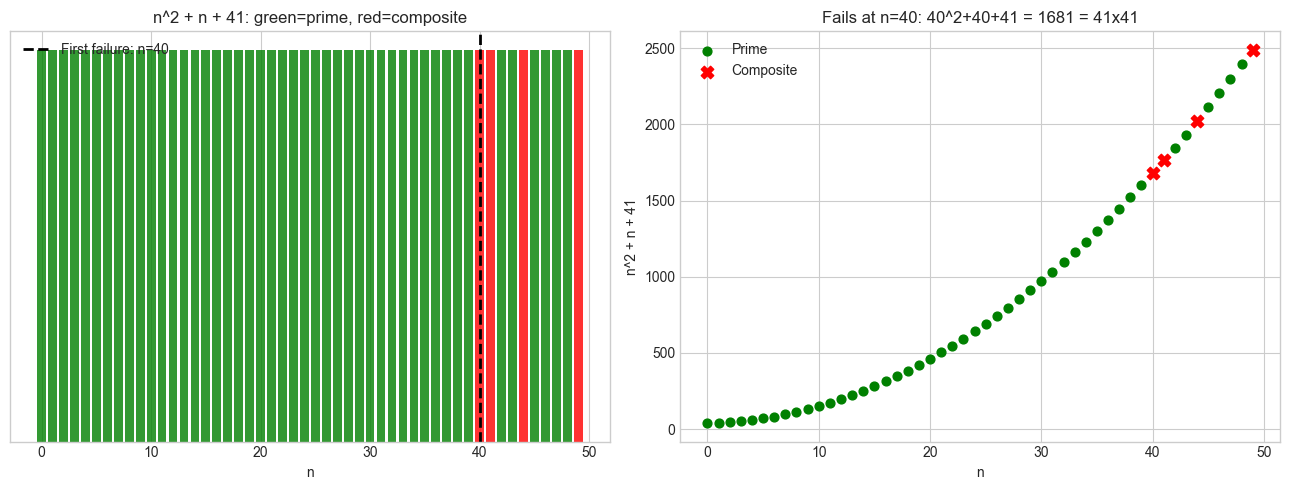
n=40: 40^2+40+41 = 1681 = 41 x 41
40 examples do not establish universal truth.
4. Mathematical Formulation
Logical structure:
for-all x in D: P(x) disproved by a single x0 in D with NOT-P(x0)
there-exists x in D: P(x) proved by exhibiting x0 in D with P(x0)
Existence proofs -- two types:
Constructive: Explicitly exhibit the object. Preferred.
Non-constructive: Prove something exists without identifying it. Valid but unsatisfying.
Counterexample strategy:
Test boundary cases (smallest values, edge cases)
Test adversarial cases (designed to fail)
Test cases that satisfy related but weaker conditions
# --- Implementation: Systematic counterexample finder ---
import numpy as np

def find_counterexample(predicate, domain, max_found=5, verbose=True):
    """Systematically search for counterexamples to predicate(x)."""
    counterexamples = []
    tested = 0
    for x in domain:
        tested += 1
        if not predicate(x):
            counterexamples.append(x)
            if verbose:
                print(f"  Counterexample #{len(counterexamples)}: x = {x}")
            if len(counterexamples) >= max_found:
                break
    if verbose:
        if counterexamples:
            print(f"  Found {len(counterexamples)} in {tested} tests.")
        else:
            print(f"  No counterexample in {tested} tests.")
    return counterexamples

def is_prime(n):
    if n < 2: return False
    if n == 2: return True
    if n % 2 == 0: return False
    return all(n % i != 0 for i in range(3, int(n**0.5)+1, 2))

print("=== Conjecture: n^2+n+41 always prime ===")
find_counterexample(lambda n: is_prime(n**2+n+41), range(0, 50))

print("\n=== Conjecture: a^2 + b^2 = c^2 has no positive integer solution (FALSE) ===")
print("  Searching for Pythagorean triples up to 20:")
for a in range(1, 20):
    for b in range(a, 20):
        c2 = a**2 + b**2
        c = int(c2**0.5)
        if c*c == c2:
            print(f"  Found: {a}^2 + {b}^2 = {c}^2 -- conjecture is FALSE.")
            break
    else: continue
    break

print("\n=== Conjecture: sum(k, k=1..n) is always even (FALSE) ===")
find_counterexample(lambda n: n*(n+1)//2 % 2 == 0, range(1, 20))
=== Conjecture: n^2+n+41 always prime ===
Counterexample #1: x = 40
Counterexample #2: x = 41
Counterexample #3: x = 44
Counterexample #4: x = 49
Found 4 in 50 tests.
=== Conjecture: a^2 + b^2 = c^2 has no positive integer solution (FALSE) ===
Searching for Pythagorean triples up to 20:
Found: 3^2 + 4^2 = 5^2 -- conjecture is FALSE.
=== Conjecture: sum(k, k=1..n) is always even (FALSE) ===
Counterexample #1: x = 1
Counterexample #2: x = 2
Counterexample #3: x = 5
Counterexample #4: x = 6
Counterexample #5: x = 9
Found 5 in 9 tests.
[1, 2, 5, 6, 9]# --- Experiment: How long until a pattern breaks? ---
import numpy as np
import matplotlib.pyplot as plt
plt.style.use('seaborn-v0_8-whitegrid')
def is_prime(n):
if n < 2: return False
if n == 2: return True
if n % 2 == 0: return False
return all(n % i != 0 for i in range(3, int(n**0.5)+1, 2))
late_breaking = [
("n^2+n+41 prime", lambda n: is_prime(n**2+n+41), list(range(0, 50))),
("2^n - 1 prime", lambda n: is_prime(2**n - 1), list(range(2, 25))),
("n^2+1 not div 3",lambda n: (n**2+1)%3 != 0, list(range(1, 30))),
]
fig, axes = plt.subplots(1, 3, figsize=(14, 4))
for ax, (name, pred, domain) in zip(axes, late_breaking):
results = [(x, pred(x)) for x in domain]
colors = ['green' if v else 'red' for _,v in results]
first_fail = next((x for x,v in results if not v), None)
ax.bar([r[0] for r in results], [1]*len(results), color=colors, alpha=0.7, width=0.8)
ax.set_title(f'{name}\nFirst failure: {first_fail}')
ax.set_yticks([]); ax.set_xlabel('n')
if first_fail is not None:
ax.axvline(first_fail, color='black', linestyle='--', lw=2)
plt.suptitle('Long Success Streaks Do Not Guarantee Universal Truth', fontsize=11)
plt.tight_layout(); plt.show()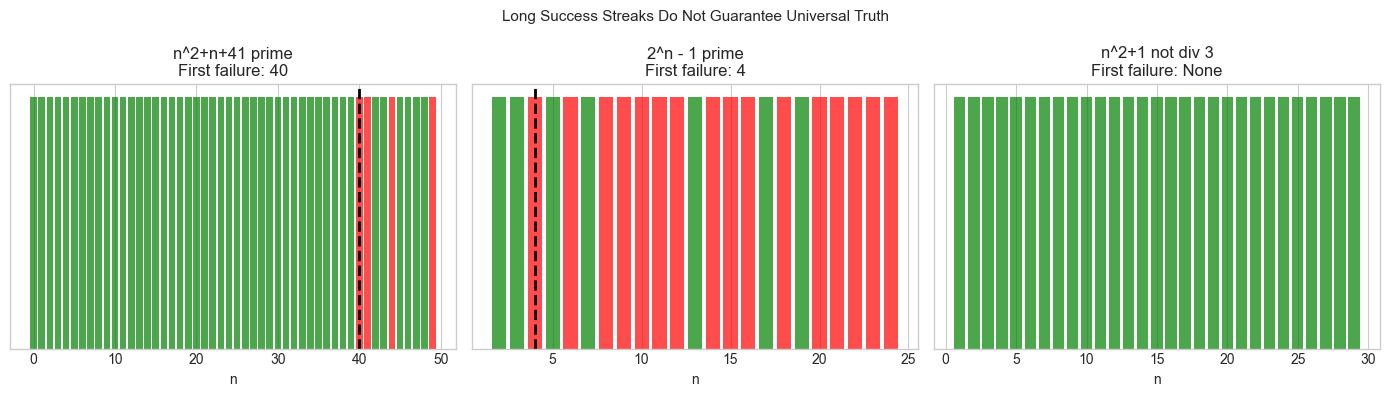
7. Exercises
Easy 1. Disprove: “For all integers n, n^2 + n + 1 is odd.” Find the smallest n where it is even. Hint: try n divisible by 2.
Easy 2. Prove by construction: there exist two irrational numbers whose sum is rational. Exhibit a specific pair and verify both are irrational.
Medium 1. Goldbach’s conjecture: every even integer > 2 is the sum of two primes. For all even n from 4 to 1000, find at least one Goldbach decomposition n = p + q. Report the largest n that required searching the most pairs.
Medium 2. The intermediate value theorem guarantees: if f(a) < 0 and f(b) > 0 and f is continuous, there exists c in (a,b) with f(c)=0. Implement bisection to constructively find the zero of x^3 - 2x - 5 in [2, 3] to 10 decimal places.
Hard. Prove computationally that the sum n(n+1)/2 is divisible by 4 iff n is congruent to 0 or 3 mod 4. Verify for all n from 1 to 10000. Then generalize: for what n is n(n+1)/2 divisible by k, for k in {3, 5, 6, 8}?
# --- Mini Project: Counterexample database ---
def is_prime(n):
    if n < 2: return False
    if n == 2: return True
    if n % 2 == 0: return False
    return all(n % i != 0 for i in range(3, int(n**0.5)+1, 2))

conjectures = [
    {
        'name': "Euler prime formula: n^2+n+41",
        'claim': "n^2+n+41 is prime for all n >= 0",
        'first_ce': 40,
        'ce_value': f'40^2+40+41 = {40**2+40+41} = 41 * 41',
        'streak': 40,
    },
    {
        'name': "Fermat conjecture: 2^(2^n)+1 always prime",
        'claim': "All F_n = 2^(2^n)+1 are prime",
        'first_ce': 5,
        'ce_value': f'F_5 = {2**32+1} = 641 * {(2**32+1)//641}',
        'streak': 5,
    },
    {
        'name': "Sum of angles in any polygon = 180 * (n-2)",
        'claim': "True -- this actually holds (not a counterexample)",
        'first_ce': None,
        'ce_value': "Holds for all convex polygons",
        'streak': None,
    },
]

print("Famous counterexamples in mathematics:")
print("=" * 60)
for c in conjectures:
    print(f"\nConjecture: {c['name']}")
    print(f"  Claim:   {c['claim']}")
    if c['first_ce'] is not None:
        print(f"  Failed at: n = {c['first_ce']} after {c['streak']}-case streak")
        print(f"  Value:   {c['ce_value']}")
    else:
        print(f"  Status:  {c['ce_value']}")

print("\nLesson: examples build intuition. One counterexample destroys a conjecture.")
Famous counterexamples in mathematics:
============================================================
Conjecture: Euler prime formula: n^2+n+41
Claim: n^2+n+41 is prime for all n >= 0
Failed at: n = 40 after 40-case streak
Value: 40^2+40+41 = 1681 = 41 * 41
Conjecture: Fermat conjecture: 2^(2^n)+1 always prime
Claim: All F_n = 2^(2^n)+1 are prime
Failed at: n = 5 after 5-case streak
Value: F_5 = 4294967297 = 641 * 6700417
Conjecture: Sum of angles in any polygon = 180 * (n-2)
Claim: True -- this actually holds (not a counterexample)
Status: Holds for all convex polygons
Lesson: examples build intuition. One counterexample destroys a conjecture.
9. Chapter Summary & Connections
Universal claims require proof for all cases; one counterexample destroys them permanently
Existence claims require one construction; disproving them requires a universal argument
The Euler prime formula held for 40 consecutive cases before failing; no success streak guarantees universal truth
Constructive proofs are preferred over non-constructive ones when possible
Forward: Counterexample search is formalized in ch278 -- Hypothesis Testing. The existence/construction distinction reappears in ch218 -- Monte Carlo Integration.
Backward: This chapter complements ch015 (Mathematical Proof Intuition): ch015 explains how to prove universal claims; this chapter explains how to disprove them and prove existence.