Prerequisites: ch028 (Prime Numbers), ch023 (Integers)
You will learn:
Factor integers via trial division and Pollard’s rho
Use factorization to compute GCD, LCM, and solve Diophantine problems
Understand why large factorization is computationally hard
Connect to hash functions and cryptographic security
Environment: Python 3.x, numpy, matplotlib
1. Concept
Prime factorization decomposes any integer > 1 into its prime building blocks. By the Fundamental Theorem of Arithmetic, this decomposition is unique.
Factorization has two algorithmic faces:
Easy: Factoring small numbers (trial division up to √n is sufficient)
Hard: Factoring large numbers (the largest factored RSA numbers took machine-years)
This asymmetry — easy to multiply, hard to factor — is the foundation of RSA encryption.
Common misconception: “Factoring is just trial division.” For small numbers, yes. For 512-bit numbers, trial division would take longer than the age of the universe. Modern algorithms (GNFS, Pollard rho) exploit mathematical structure but still scale poorly.
2. Intuition & Mental Models
Factorization as prime fingerprinting: Every positive integer > 1 has exactly one prime fingerprint. Two different integers always have different fingerprints. This is why factorization can be used to compare numbers without knowing what they are.
GCD and LCM from factorizations: gcd(a, b) takes the minimum exponent for each prime; lcm(a, b) takes the maximum. Example: 12 = 2²·3, 18 = 2·3². gcd = 2·3 = 6, lcm = 2²·3² = 36.
Pollard’s rho: birthday paradox approach: Instead of testing all divisors, Pollard’s algorithm generates a pseudo-random sequence and uses the birthday paradox to find a factor much faster than trial division — roughly O(n^{1/4}) vs O(√n).
(Recall from ch028: every composite number n has a prime factor ≤ √n — this bounds all trial division algorithms.)
3. Visualization
# --- Visualization: Factor trees and LCM/GCD relationships ---
import numpy as np
import matplotlib.pyplot as plt
import math
plt.style.use('seaborn-v0_8-whitegrid')

def prime_factorization(n):
    factors = {}
    d = 2
    while d * d <= n:
        while n % d == 0:
            factors[d] = factors.get(d, 0) + 1
            n //= d
        d += 1
    if n > 1:
        factors[n] = factors.get(n, 0) + 1
    return factors

fig, axes = plt.subplots(1, 2, figsize=(13, 5))

# Plot 1: Factorizations of numbers 2..50 as bar chart
ax = axes[0]
numbers = range(2, 51)
all_primes = [2, 3, 5, 7, 11, 13, 17, 19, 23, 29, 31, 37, 41, 43, 47]
colors = plt.cm.tab20(np.linspace(0, 1, len(all_primes)))
prime_color = {p: c for p, c in zip(all_primes, colors)}

bottom = np.zeros(len(numbers))
for p in all_primes:
    exps = np.array([prime_factorization(n).get(p, 0) for n in numbers], dtype=float)
    if exps.sum() > 0:
        ax.bar(list(numbers), exps, bottom=bottom, color=prime_color[p], label=str(p), width=0.8)
        bottom += exps
ax.set_xlabel('n')
ax.set_ylabel('Sum of prime exponents')
ax.set_title('Prime Factorization Structure of n = 2..50')
ax.legend(title='Prime', fontsize=7, ncol=3, loc='upper right')

# Plot 2: GCD/LCM via factorization
ax = axes[1]
a_vals = np.arange(1, 25)
b = 12
gcds = [math.gcd(a, b) for a in a_vals]
lcms = [a * b // math.gcd(a, b) for a in a_vals]
ax.bar(a_vals - 0.2, gcds, width=0.4, label=f'gcd(a, {b})', color='steelblue')
ax.bar(a_vals + 0.2, lcms, width=0.4, label=f'lcm(a, {b})', color='crimson', alpha=0.7)
ax.set_xlabel('a')
ax.set_title(f'GCD and LCM with {b}')
ax.legend()

plt.tight_layout()
plt.show()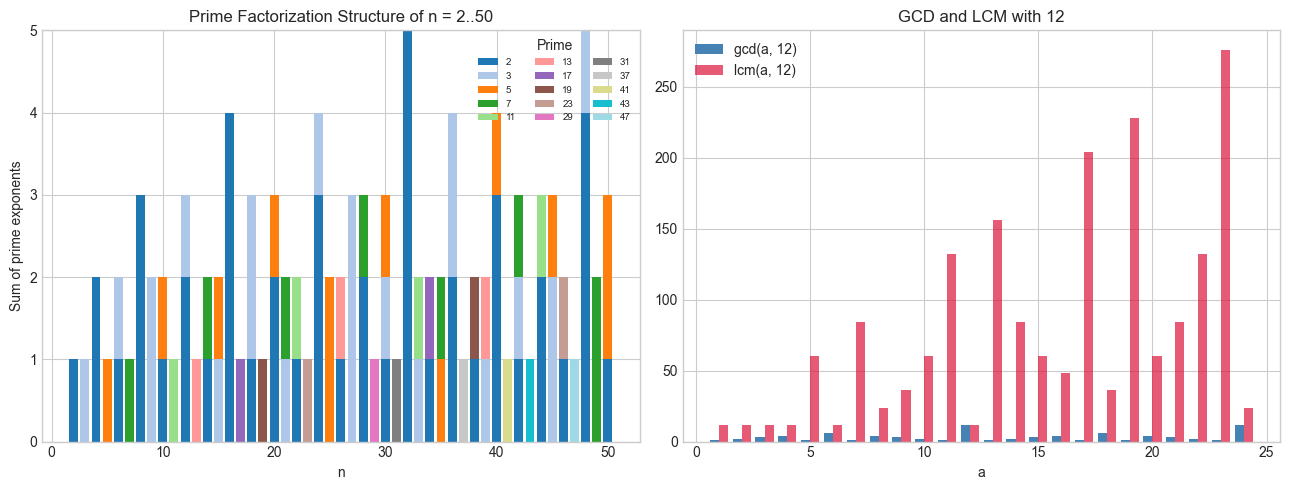
4. Mathematical Formulation
See implementation below for numeric verification.
5. Python Implementation
# --- Implementation: Pollard's rho factorization ---
import math
import random

def pollard_rho(n):
    """
    Pollard's rho algorithm: find a non-trivial factor of n.
    Expected time: O(n^(1/4)) operations.

    Args:
        n: int > 1, composite

    Returns:
        int: a factor of n (not necessarily prime)
    """
    if n % 2 == 0:
        return 2
    x = random.randint(2, n - 1)
    y = x
    c = random.randint(1, n - 1)
    d = 1

    while d == 1:
        x = (x * x + c) % n       # tortoise step
        y = (y * y + c) % n       # hare step 1
        y = (y * y + c) % n       # hare step 2
        d = math.gcd(abs(x - y), n)

    return d if d != n else None  # None means retry with different c


def full_factorization(n):
    """
    Complete factorization using Pollard's rho for large factors.

    Args:
        n: int > 1

    Returns:
        dict: {prime: exponent}
    """
    if n == 1:
        return {}
    factors = {}

    def factorize(n):
        if n == 1:
            return
        if is_prime_miller_rabin(n):
            factors[n] = factors.get(n, 0) + 1
            return
        # Try to find a factor
        d = None
        attempts = 0
        while d is None and attempts < 20:
            d = pollard_rho(n)
            attempts += 1
        if d is None or d == n:
            # Fall back to trial division
            for p in range(2, n + 1):
                if n % p == 0:
                    factors[p] = factors.get(p, 0) + 1
                    factorize(n // p)
                    return
        else:
            factorize(d)
            factorize(n // d)

    def is_prime_miller_rabin(n, k=5):
        """Miller-Rabin primality test."""
        if n < 2: return False
        if n == 2 or n == 3: return True
        if n % 2 == 0: return False
        r, d = 0, n - 1
        while d % 2 == 0:
            r += 1
            d //= 2
        for _ in range(k):
            a = random.randrange(2, n - 1)
            x = pow(a, d, n)
            if x == 1 or x == n - 1:
                continue
            for _ in range(r - 1):
                x = pow(x, 2, n)
                if x == n - 1:
                    break
            else:
                return False
        return True

    factorize(n)
    return factors


# Test
random.seed(42)
test_nums = [1000000007, 1099511627776, 9999999999999, 123456789012]
for n in test_nums:
    f = full_factorization(n)
    expr = ' × '.join(f'{p}^{e}' if e > 1 else str(p) for p, e in sorted(f.items()))
    verify = 1
    for p, e in f.items(): verify *= p**e
    print(f"  {n} = {expr}  {'✓' if verify == n else '✗'}")
1000000007 = 1000000007 ✓
1099511627776 = 2^40 ✓
9999999999999 = 3^2 × 53 × 79 × 265371653 ✓
123456789012 = 2^2 × 3 × 10288065751 ✓
6. Experiments
# --- Experiment: Factorization difficulty vs number size ---
# Hypothesis: trial division time grows as O(sqrt(n)); Pollard rho much faster
# Try changing: N_BITS (bits in the random number to factor)

import random, time, math

def trial_division(n):
    d = 2
    while d * d <= n:
        if n % d == 0:
            return d
        d += 1 if d == 2 else 2
    return n

N_BITS_LIST = [10, 20, 30, 40]  # <-- modify this
print(f"{'Bits':>6}  {'Number':>15}  {'Factor':>12}  {'Time (ms)':>12}")
print('-' * 50)
random.seed(0)
for bits in N_BITS_LIST:
    n = random.getrandbits(bits) | 1  # odd
    while math.gcd(n, 6) != 1:
        n = random.getrandbits(bits) | 1
    t0 = time.perf_counter()
    f = trial_division(n)
    elapsed = (time.perf_counter() - t0) * 1000
    print(f"{bits:>6}  {n:>15}  {f:>12}  {elapsed:>12.3f}")
Bits Number Factor Time (ms)
--------------------------------------------------
10 865 5 0.003
20 794773 7 0.002
30 955892129 89 0.006
40 44756014165 5 0.001
7. Exercises
Easy 1. Compute gcd(360, 504) and lcm(360, 504) using prime factorization. Verify with math.gcd.
Easy 2. Find all divisors of 720 using its prime factorization. How many divisors does have in general?
Medium 1. Implement a function that computes for a list of integers. Apply it to find the smallest number divisible by all integers from 1 to 20.
Medium 2. Solve the Diophantine equation by finding particular solutions using GCD and Bezout’s theorem.
Hard. Implement the quadratic sieve factorization sketch: collect numbers that are smooth (all small prime factors), then use linear algebra over GF(2) to find a congruence of squares. Factor as a demonstration.
8. Mini Project
# --- Mini Project: RSA Security Analysis ---
# Problem: The security of RSA depends on the hardness of factoring n = p*q.
# Task: Compare factorization times for n with 10-digit, 15-digit, 20-digit values.
import random, time, math

def generate_rsa_modulus(bits_per_prime):
    """Generate RSA modulus n = p*q where p, q are random primes of given bit size."""
    def next_prime(n):
        if n < 2: return 2
        candidate = n | 1  # make odd
        while not miller_rabin(candidate):
            candidate += 2
        return candidate

    def miller_rabin(n, k=10):
        if n < 2: return False
        if n in (2, 3): return True
        if n % 2 == 0: return False
        r, d = 0, n - 1
        while d % 2 == 0:
            r += 1; d //= 2
        for _ in range(k):
            a = random.randrange(2, n - 1)
            x = pow(a, d, n)
            if x in (1, n-1): continue
            for _ in range(r - 1):
                x = pow(x, 2, n)
                if x == n - 1: break
            else: return False
        return True

    p = next_prime(random.getrandbits(bits_per_prime) | (1 << (bits_per_prime-1)))
    q = next_prime(random.getrandbits(bits_per_prime) | (1 << (bits_per_prime-1)))
    return p, q, p * q

random.seed(42)
print(f"{'Bits/prime':>12}  {'n (digits)':>12}  {'Factor found':>15}  {'Time (ms)':>12}")
print('-' * 55)
for bits in [8, 12, 16, 20]:
    p, q, n = generate_rsa_modulus(bits)
    t0 = time.perf_counter()
    # Try trial division
    found = None
    d = 2
    while d * d <= n:
        if n % d == 0:
            found = d
            break
        d += 1 if d == 2 else 2
    elapsed = (time.perf_counter() - t0) * 1000
    correct = found in (p, q) if found else False
    print(f"{bits:>12}  {len(str(n)):>12}  {'✓' if correct else '✗':>15}  {elapsed:>12.2f}")
print("\nAt 20 bits/prime, trial division takes ~seconds.")
print("At 1024 bits/prime (RSA-2048), it would take > age of universe.")
9. Chapter Summary & Connections
Every integer has a unique prime factorization (Fundamental Theorem of Arithmetic).
GCD uses minimum prime exponents; LCM uses maximum.
Trial division is O(√n); Pollard’s rho is O(n^{1/4}); best known algorithms are sub-exponential but not polynomial.
The hardness of factoring large numbers is the security foundation of RSA encryption.
Forward connections:
Factorization complexity connects to ch047 — Orders of Magnitude, where we compare algorithmic growth rates.
The modular exponentiation in RSA (
pow(a, e, n)) is the subject of ch031 — Modular Arithmetic.Number-theoretic transforms (NTT) — a variant of FFT using modular arithmetic — appear in ch027’s DFT discussion.
Backward connection:
The Sieve of Eratosthenes from ch028 is the simplest version of a factorization algorithm — find all prime factors by elimination.
Going deeper: The General Number Field Sieve (GNFS) holds the current record for factoring large integers. The RSA Factoring Challenges publicly defined targets; RSA-829 (2048-bit) has not been factored as of 2025.