Prerequisites: ch031 (Modular Arithmetic), ch032 (Cycles and Remainders), ch028 (Prime Numbers)
You will learn:
Hash tables: mapping keys to fixed-size arrays with mod
RSA encryption: the full algorithm from key generation to decryption
Circular buffers: implementing ring buffers with mod indexing
Error detection: CRC and polynomial codes
Why modular arithmetic is not optional knowledge for programmers
Environment: Python 3.x, numpy, matplotlib
1. Concept
Modular arithmetic is not a mathematical curiosity — it is embedded in the infrastructure of computing:
Every hash table uses
key % table_sizeto map keys to bucketsEvery ring buffer uses
index % capacityto wrap aroundRSA encryption is entirely modular exponentiation over large primes
CRC checksums in Ethernet, USB, ZIP, and PNG use polynomial division mod 2
Calendar calculations (day of week, leap years) are modular
Color cycling in graphics is modular
This chapter is applied — we build real implementations of each use case from scratch.
The unifying pattern:
In each application, mod converts an unbounded quantity (an arbitrary integer key, an advancing time index, an enormous exponent) into a bounded, cyclically stable one. The wrapping is the feature, not a limitation.
2. Intuition & Mental Models
Hash tables — pigeonhole and uniformity:
Think of mod as a slot machine that always produces a number in [0, SIZE-1]. If your hash function distributes keys uniformly, hash(key) % SIZE spreads them evenly across slots. Collision rate depends on how well the hash approximates uniform distribution before the mod.
RSA — trapdoor and asymmetry:
Think of RSA as a lock that anyone can close (encrypt) but only the key holder can open (decrypt). The lock is y = x^e mod n. Opening it requires knowing the factorization of n — without that, reversing the lock is computationally infeasible.
Ring buffers — the infinite tape made finite:
A ring buffer simulates an infinite tape using finite memory. The mod operation folds the infinite index space onto a fixed-length circle. The newest element always overwrites the oldest — a natural sliding window.
Recall from ch031–032: The modular inverse and Euler’s theorem (ch032) are what make RSA decryption correct — specifically, the relationship e·d ≡ 1 (mod φ(n)).
3. Visualization
# --- Visualization: Hash table load distribution ---
import numpy as np
import matplotlib.pyplot as plt
import hashlib

plt.style.use('seaborn-v0_8-whitegrid')

TABLE_SIZE = 16  # <-- try prime (17) vs composite (16) sizes
N_KEYS = 200

# Generate keys: sequential integers vs random strings
seq_keys = list(range(N_KEYS))
str_keys = [f"user_{i}" for i in range(N_KEYS)]

def hash_int(k, size):
    """Naive hash: identity mod size."""
    return k % size

def hash_string(s, size):
    """Better hash: use SHA-256 truncated to int."""
    h = int(hashlib.sha256(s.encode()).hexdigest(), 16)
    return h % size

seq_buckets = np.zeros(TABLE_SIZE, dtype=int)
str_buckets = np.zeros(TABLE_SIZE, dtype=int)

for k in seq_keys:
    seq_buckets[hash_int(k, TABLE_SIZE)] += 1
for s in str_keys:
    str_buckets[hash_string(s, TABLE_SIZE)] += 1

fig, axes = plt.subplots(1, 2, figsize=(13, 5))

expected = N_KEYS / TABLE_SIZE

for ax, buckets, title in zip(axes,
    [seq_buckets, str_buckets],
    [f'Sequential int keys mod {TABLE_SIZE}',
     f'SHA-256 string hash mod {TABLE_SIZE}']):
    ax.bar(range(TABLE_SIZE), buckets, color='steelblue', edgecolor='white')
    ax.axhline(expected, color='red', linestyle='--', label=f'Expected: {expected:.1f}')
    ax.set_xlabel('Bucket index', fontsize=11)
    ax.set_ylabel('Keys in bucket', fontsize=11)
    ax.set_title(title, fontsize=12)
    ax.legend()

plt.tight_layout()
plt.show()
print("Sequential integers already distribute perfectly — they're uniform by construction.")
print("Real-world keys (strings, IDs) require a proper hash function before the mod.")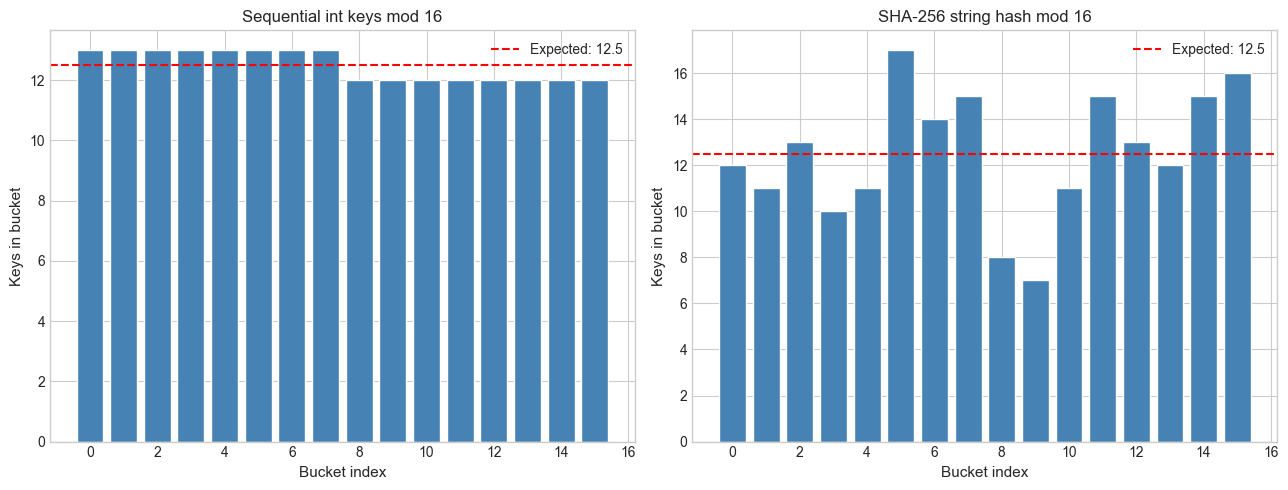
Sequential integers already distribute perfectly — they're uniform by construction.
Real-world keys (strings, IDs) require a proper hash function before the mod.
4. Mathematical Formulation
RSA Algorithm
Key generation:
Choose two distinct primes
pandqCompute
n = p · q(the modulus)Compute
φ(n) = (p−1)(q−1)Choose public exponent
ewith1 < e < φ(n)andgcd(e, φ(n)) = 1Compute private exponent
dsuch thate · d ≡ 1 (mod φ(n))Public key:
(e, n), Private key:(d, n)
Encryption (given message m < n):
c = m^e mod nDecryption (given ciphertext c):
m = c^d mod nWhy does decryption recover m?
c^d = (m^e)^d = m^(ed) mod nSince ed ≡ 1 (mod φ(n)), we have ed = 1 + k·φ(n) for some integer k. By Euler’s theorem:
m^(ed) = m^(1 + k·φ(n)) = m · (m^φ(n))^k ≡ m · 1^k = m (mod n)This is the core mathematical guarantee of RSA.
Ring Buffer
A ring buffer of capacity C maintains head pointer h and tail pointer t, both advancing modulo C:
h = (h + 1) % C   (after each read)
t = (t + 1) % C   (after each write)
Buffer is empty when h == t. Full when (t + 1) % C == h.
5. Python Implementation
# --- Implementation 1: Minimal RSA from scratch ---
import math
import random

def extended_gcd(a, b):
    if b == 0:
        return a, 1, 0
    g, x1, y1 = extended_gcd(b, a % b)
    return g, y1, x1 - (a // b) * y1

def mod_inverse(a, n):
    g, x, _ = extended_gcd(a % n, n)
    if g != 1:
        raise ValueError(f"Inverse of {a} mod {n} does not exist")
    return x % n

def rsa_keygen(p, q, e=None):
    """
    Generate RSA key pair from primes p and q.

    Args:
        p, q: distinct primes
        e: public exponent (default: 65537)

    Returns:
        (public_key, private_key) where each is (exponent, modulus)
    """
    n = p * q
    phi_n = (p - 1) * (q - 1)
    if e is None:
        e = 65537  # standard choice: prime, has efficient binary repr
    assert 1 < e < phi_n
    assert math.gcd(e, phi_n) == 1, f"e={e} must be coprime to φ(n)={phi_n}"
    d = mod_inverse(e, phi_n)
    return (e, n), (d, n)

def rsa_encrypt(m, public_key):
    """
    Encrypt message integer m with public key (e, n).
    Requires 0 <= m < n.
    """
    e, n = public_key
    assert 0 <= m < n, "Message must be in [0, n-1]"
    return pow(m, e, n)  # Python's built-in fast modular exponentiation

def rsa_decrypt(c, private_key):
    """
    Decrypt ciphertext c with private key (d, n).
    """
    d, n = private_key
    return pow(c, d, n)


# Demo with small primes (educational — real RSA uses 1024+ bit primes)
p, q = 61, 53
pub, priv = rsa_keygen(p, q, e=17)

print(f"Primes: p={p}, q={q}")
print(f"n = {pub[1]},  φ(n) = {(p-1)*(q-1)}")
print(f"Public key:  (e={pub[0]}, n={pub[1]})")
print(f"Private key: (d={priv[0]}, n={priv[1]})")

message = 42
ciphertext = rsa_encrypt(message, pub)
recovered  = rsa_decrypt(ciphertext, priv)

print(f"\nMessage:    {message}")
print(f"Ciphertext: {ciphertext}")
print(f"Decrypted:  {recovered}")
print(f"Correct:    {message == recovered}")
Primes: p=61, q=53
n = 3233, φ(n) = 3120
Public key: (e=17, n=3233)
Private key: (d=2753, n=3233)
Message: 42
Ciphertext: 2557
Decrypted: 42
Correct: True
# --- Implementation 2: Ring Buffer ---

class RingBuffer:
    """
    Fixed-capacity ring buffer (circular queue).
    Uses modular indexing to wrap head and tail pointers.

    Args:
        capacity: maximum number of elements
    """
    def __init__(self, capacity):
        self.capacity = capacity
        self.buffer = [None] * capacity
        self.head = 0   # next read position
        self.tail = 0   # next write position
        self.size = 0

    def enqueue(self, value):
        """Write value. Overwrites oldest if full."""
        self.buffer[self.tail] = value
        self.tail = (self.tail + 1) % self.capacity  # mod wrap!
        if self.size == self.capacity:
            # Overwrite mode: advance head past overwritten slot
            self.head = (self.head + 1) % self.capacity
        else:
            self.size += 1

    def dequeue(self):
        """Read and remove oldest value. Raises if empty."""
        if self.size == 0:
            raise IndexError("Buffer is empty")
        value = self.buffer[self.head]
        self.head = (self.head + 1) % self.capacity  # mod wrap!
        self.size -= 1
        return value

    def to_list(self):
        """Return contents in FIFO order."""
        return [self.buffer[(self.head + i) % self.capacity]
                for i in range(self.size)]


# Demo: streaming sensor data with sliding window
rb = RingBuffer(capacity=5)
sensor_readings = [10, 20, 30, 40, 50, 60, 70]  # more data than buffer size

print("Streaming into ring buffer (capacity=5):")
for val in sensor_readings:
    rb.enqueue(val)
    print(f"  Wrote {val:3d} → buffer: {rb.to_list()}")

print(f"\nFinal buffer (last 5 readings): {rb.to_list()}")
Streaming into ring buffer (capacity=5):
Wrote 10 → buffer: [10]
Wrote 20 → buffer: [10, 20]
Wrote 30 → buffer: [10, 20, 30]
Wrote 40 → buffer: [10, 20, 30, 40]
Wrote 50 → buffer: [10, 20, 30, 40, 50]
Wrote 60 → buffer: [20, 30, 40, 50, 60]
Wrote 70 → buffer: [30, 40, 50, 60, 70]
Final buffer (last 5 readings): [30, 40, 50, 60, 70]
6. Experiments
# --- Experiment 1: RSA correctness across all valid messages ---
# Hypothesis: RSA decryption recovers every message m in [0, n-1].
# Try changing: the primes p and q.

p, q = 61, 53   # <-- modify with other small primes
e = 17
pub, priv = rsa_keygen(p, q, e)
n = pub[1]

failures = []
for m in range(n):
    c = rsa_encrypt(m, pub)
    m2 = rsa_decrypt(c, priv)
    if m2 != m:
        failures.append(m)

print(f"n = {n}, tested all {n} messages")
print(f"Failures: {failures if failures else 'none — RSA is correct for all m'}")

# Note: for m = 0, 1, p, q, n-1: these are edge cases worth checking
edge_cases = [0, 1, p, q, n-1]
print("\nEdge cases:")
for m in edge_cases:
    if 0 <= m < n:
        c = rsa_encrypt(m, pub)
        m2 = rsa_decrypt(c, priv)
        print(f"  m={m}: encrypt={c}, decrypt={m2}, ok={m==m2}")
n = 3233, tested all 3233 messages
Failures: none — RSA is correct for all m
Edge cases:
m=0: encrypt=0, decrypt=0, ok=True
m=1: encrypt=1, decrypt=1, ok=True
m=61: encrypt=610, decrypt=61, ok=True
m=53: encrypt=1802, decrypt=53, ok=True
m=3232: encrypt=3232, decrypt=3232, ok=True
# --- Experiment 2: Hash table collision rate vs table size ---
# Hypothesis: using a prime table size reduces collisions compared to a power of 2,
#             especially for keys that are multiples of common factors.
# Try changing: KEY_PATTERN and sizes.

import matplotlib.pyplot as plt
import hashlib

N_KEYS = 100
KEY_PATTERN = 'multiples_of_8'  # <-- try 'random', 'sequential', 'multiples_of_8'

if KEY_PATTERN == 'random':
    import random
    keys = [random.randint(0, 10000) for _ in range(N_KEYS)]
elif KEY_PATTERN == 'sequential':
    keys = list(range(N_KEYS))
elif KEY_PATTERN == 'multiples_of_8':
    keys = [8 * i for i in range(N_KEYS)]

sizes = list(range(50, 200, 5))
collision_counts = []

for size in sizes:
    buckets = {}
    collisions = 0
    for k in keys:
        slot = k % size
        if slot in buckets:
            collisions += 1
        buckets[slot] = k
    collision_counts.append(collisions)

# Identify prime sizes in the range
def is_prime(n):
    if n < 2: return False
    for i in range(2, int(n**0.5) + 1):
        if n % i == 0: return False
    return True

prime_sizes = [s for s in sizes if is_prime(s)]
prime_collisions = [collision_counts[sizes.index(s)] for s in prime_sizes]

plt.figure(figsize=(11, 5))
plt.plot(sizes, collision_counts, 'steelblue', linewidth=1.5, label='All sizes')
plt.scatter(prime_sizes, prime_collisions, color='crimson', s=40, zorder=4, label='Prime sizes')
plt.xlabel('Table size', fontsize=11)
plt.ylabel('Collisions', fontsize=11)
plt.title(f'Collision count vs table size ({KEY_PATTERN} keys)', fontsize=12)
plt.legend()
plt.tight_layout()
plt.show()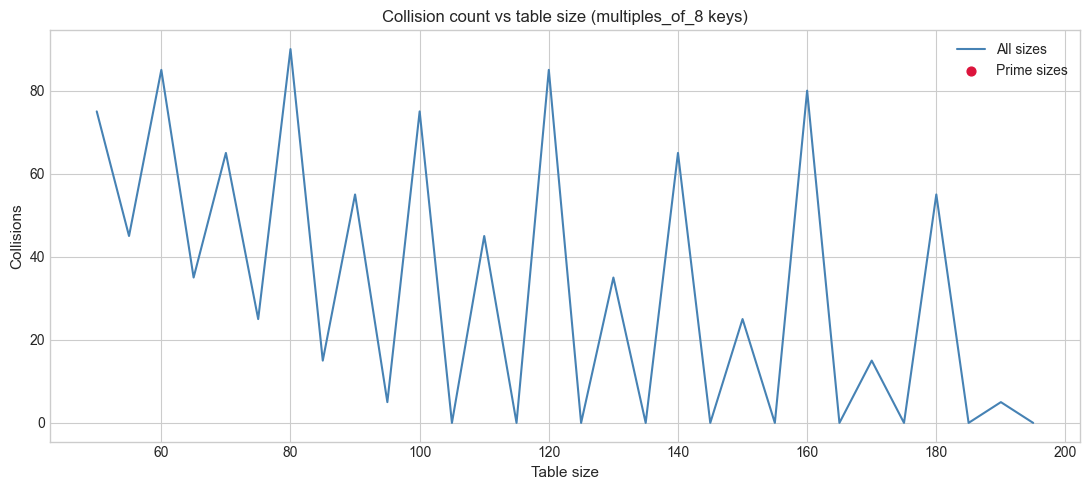
7. Exercises
Easy 1. What day of the week is January 1, 2030? Use Zeller’s formula (look it up) — it is entirely modular arithmetic. Verify with Python’s datetime module.
(Expected: a day name)
Easy 2. Implement a circular_array_max(arr, start, window) function that computes the max of window elements starting at start, wrapping around if needed, using only modular indexing.
Medium 1. Break toy RSA: given public key (e=17, n=3233), factor n, recover φ(n), compute d, and decrypt the ciphertext c=2790. Show each step.
(Hint: n=3233=61×53 — but write code that finds the factors by trial division)
Medium 2. Implement a simple polynomial rolling hash function poly_hash(s, p=31, m=10^9+7) that computes sum(s[i] * p^i) mod m. Verify that a single character change always produces a different hash for strings up to length 20.
Hard. Implement RSA with padding: real RSA never encrypts raw numbers but pads the message to make the scheme semantically secure (OAEP). Implement a simplified version: before encrypting, XOR the message bytes with a random mask derived from the hash of a random seed; include the seed in the ciphertext. Show that encrypting the same message twice gives different ciphertexts.
8. Mini Project — Polynomial Rolling Hash for Substring Search
Problem: The Rabin-Karp algorithm finds all occurrences of a pattern in a text in O(n+m) expected time using a rolling hash. The rolling hash updates in O(1) by removing the leftmost character’s contribution and adding the new rightmost character — all via modular arithmetic.
Task: Implement Rabin-Karp substring search from scratch. Measure its speed against naive O(nm) search on a large text.
# --- Mini Project: Rabin-Karp Substring Search ---
# Problem: Find all occurrences of a pattern in a text using rolling hash.
# Dataset: generated text string + pattern to search.
# Task: implement the rolling hash update, complete the search, benchmark.

import time

PRIME_BASE = 31          # polynomial base
MOD = (1 << 61) - 1     # Mersenne prime — large, efficient mod

def poly_hash(s, base=PRIME_BASE, mod=MOD):
    """
    Compute polynomial hash of string s.
    hash = sum(ord(s[i]) * base^i) mod mod
    """
    h = 0
    power = 1
    for ch in s:
        h = (h + ord(ch) * power) % mod
        power = (power * base) % mod
    return h


def rabin_karp(text, pattern, base=PRIME_BASE, mod=MOD):
    """
    Find all start indices where pattern occurs in text.
    Uses rolling hash: O(n + m) expected time.

    Args:
        text: haystack string
        pattern: needle string

    Returns:
        list of start indices
    """
    n, m = len(text), len(pattern)
    if m > n:
        return []

    pattern_hash = poly_hash(pattern, base, mod)

    # Precompute base^m mod mod (the leading power to subtract)
    leading_power = pow(base, m, mod)

    # TODO: compute initial window hash for text[0:m]
    window_hash = poly_hash(text[:m], base, mod)

    matches = []
    if window_hash == pattern_hash and text[:m] == pattern:
        matches.append(0)

    for i in range(1, n - m + 1):
        # TODO: update window_hash by:
        #   1. Remove contribution of text[i-1] (subtract ord(text[i-1]) * base^0, then divide by base)
        #   2. This is equivalent to: h_new = (h_old - ord(text[i-1])) * inv(base) mod mod
        #   OR equivalently (simpler):
        #   window_hash = (window_hash - ord(text[i-1])) / base + ord(text[i+m-1]) * base^(m-1)
        # Here we use the additive form with the leading_power trick:
        window_hash = (window_hash - ord(text[i - 1])) % mod
        window_hash = (window_hash * pow(base, mod - 2, mod)) % mod  # multiply by base^(-1)
        window_hash = (window_hash + ord(text[i + m - 1]) * pow(base, m - 1, mod)) % mod

        if window_hash == pattern_hash:
            if text[i:i+m] == pattern:  # verify to handle hash collisions
                matches.append(i)

    return matches


def naive_search(text, pattern):
    """O(n*m) naive substring search for comparison."""
    n, m = len(text), len(pattern)
    return [i for i in range(n - m + 1) if text[i:i+m] == pattern]


# Generate test data
import random, string
random.seed(42)
TEXT = ''.join(random.choices('ACGT', k=100_000))  # DNA-like sequence
PATTERN = 'ACGTACGT'

# Benchmark
t0 = time.perf_counter()
rk_matches = rabin_karp(TEXT, PATTERN)
t1 = time.perf_counter()
naive_matches = naive_search(TEXT, PATTERN)
t2 = time.perf_counter()

print(f"Text length: {len(TEXT)}, Pattern: '{PATTERN}'")
print(f"Matches found: {len(rk_matches)}")
print(f"Results agree: {rk_matches == naive_matches}")
print(f"\nRabin-Karp: {(t1-t0)*1000:.2f} ms")
print(f"Naive:      {(t2-t1)*1000:.2f} ms")
print(f"Speedup:    {(t2-t1)/(t1-t0):.1f}x")
9. Chapter Summary & Connections
What we covered:
Hash tables use
hash(key) % size; prime table sizes reduce collision clusteringRSA relies entirely on modular exponentiation; correctness follows from Euler’s theorem
Ring buffers implement infinite-tape semantics with finite memory via mod indexing
Rolling hashes enable O(n) substring search by updating hash in O(1) using mod arithmetic
All of these are the same mathematical operation applied to different problems
Backward connection:
RSA decryption correctness relies on Euler’s theorem and modular inverses (ch031–ch032). Without those, the algorithm is a magic trick without an explanation.
Forward connections:
Polynomial hashing (this chapter) reappears in ch246 — Random Variables, where we analyze the expected number of collisions formally
The ring buffer pattern reappears in ch086 — Discrete Dynamical Systems as a computational structure for storing system history
RSA’s reliance on large prime products connects directly to ch028 — Prime Numbers and sets the stage for the full cryptographic treatment in number theory courses beyond this book
Going deeper: Study the birthday paradox (ch243) to understand why hash collision probability grows quadratically in load factor, and why prime table sizes matter less than you’d expect with a good hash function.