Part VIII: Probability | Computational Mathematics for Programmers
1. From Outcomes to Events
You rarely care about a specific outcome. You care about classes of outcomes: “did I roll an even number?”, “did the model classify correctly?”, “is the reading above a threshold?”.
An event is a subset of the sample space Ω. Formally: E ⊆ Ω.
(Subsets and set operations were introduced in ch011 — Sets and Basic Set Operations.)
Examples for Ω = {1, 2, 3, 4, 5, 6}:
| Event | Subset |
|---|---|
| Roll an even number | {2, 4, 6} |
| Roll a number > 4 | {5, 6} |
| Roll a prime | {2, 3, 5} |
| Roll any number | Ω (the certain event) |
| Roll a 7 | ∅ (the impossible event) |
import numpy as np

Omega = {1, 2, 3, 4, 5, 6}

# Define events as sets
E_even = {x for x in Omega if x % 2 == 0}
E_gt4  = {x for x in Omega if x > 4}
E_prime = {x for x in Omega if x in {2, 3, 5}}

print(f"Ω = {sorted(Omega)}")
print(f"E_even  = {sorted(E_even)}")
print(f"E_gt4   = {sorted(E_gt4)}")
print(f"E_prime = {sorted(E_prime)}")
Ω = [1, 2, 3, 4, 5, 6]
E_even = [2, 4, 6]
E_gt4 = [5, 6]
E_prime = [2, 3, 5]
2. Set Operations on Events
Because events are sets, all set operations apply — and each has a direct probabilistic interpretation:
| Set operation | Probabilistic meaning |
|---|---|
| E ∪ F | E or F (at least one occurs) |
| E ∩ F | E and F (both occur) |
| Eᶜ = Ω \ E | E does not occur |
| E \ F | E occurs but F does not |
E = E_even
F = E_prime

E_union_F = E | F           # E or F
E_inter_F = E & F           # E and F
E_complement = Omega - E    # not E
E_minus_F = E - F           # E but not F

print(f"E (even) = {sorted(E)}")
print(f"F (prime) = {sorted(F)}")
print(f"E ∪ F = {sorted(E_union_F)}  (even OR prime)")
print(f"E ∩ F = {sorted(E_inter_F)}  (even AND prime — only 2)")
print(f"Eᶜ    = {sorted(E_complement)}  (not even = odd)")
print(f"E \ F  = {sorted(E_minus_F)}  (even but not prime)")
E (even) = [2, 4, 6]
F (prime) = [2, 3, 5]
E ∪ F = [2, 3, 4, 5, 6] (even OR prime)
E ∩ F = [2] (even AND prime — only 2)
Eᶜ = [1, 3, 5] (not even = odd)
E \ F = [4, 6] (even but not prime)
<>:14: SyntaxWarning: invalid escape sequence '\ '
<>:14: SyntaxWarning: invalid escape sequence '\ '
C:\Users\user\AppData\Local\Temp\ipykernel_25344\1960121485.py:14: SyntaxWarning: invalid escape sequence '\ '
  print(f"E \ F  = {sorted(E_minus_F)}  (even but not prime)")
3. Mutually Exclusive Events
Two events are mutually exclusive (disjoint) if they cannot both occur:
For a single die roll, “roll a 1” and “roll a 6” are mutually exclusive. “Roll an even” and “roll a prime” are not (the outcome 2 is both).
def are_mutually_exclusive(E, F):
    return len(E & F) == 0

E_one = {1}
E_six = {6}

print(f"E_one ∩ E_six = {E_one & E_six} → mutually exclusive: {are_mutually_exclusive(E_one, E_six)}")
print(f"E_even ∩ E_prime = {E_even & E_prime} → mutually exclusive: {are_mutually_exclusive(E_even, E_prime)}")
E_one ∩ E_six = set() → mutually exclusive: True
E_even ∩ E_prime = {2} → mutually exclusive: False
4. Counting Events
For finite uniform sample spaces, the probability of an event is the count of favorable outcomes divided by the total:
This only holds when all outcomes are equally likely.
def uniform_prob(event, sample_space):
    """P(E) under uniform distribution."""
    return len(event) / len(sample_space)

print(f"P(even)  = {uniform_prob(E_even, Omega):.4f}")
print(f"P(prime) = {uniform_prob(E_prime, Omega):.4f}")
print(f"P(even ∪ prime) = {uniform_prob(E_even | E_prime, Omega):.4f}")
print(f"P(even ∩ prime) = {uniform_prob(E_even & E_prime, Omega):.4f}")

# Verify empirically
rng = np.random.default_rng(seed=0)
n = 100_000
rolls = rng.integers(1, 7, size=n)

p_even_empirical = np.mean(rolls % 2 == 0)
print(f"\nEmpirical P(even) over {n:,} rolls: {p_even_empirical:.4f}")
P(even) = 0.5000
P(prime) = 0.5000
P(even ∪ prime) = 0.8333
P(even ∩ prime) = 0.1667
Empirical P(even) over 100,000 rolls: 0.4976
5. Compound Events: Two-Dice Example
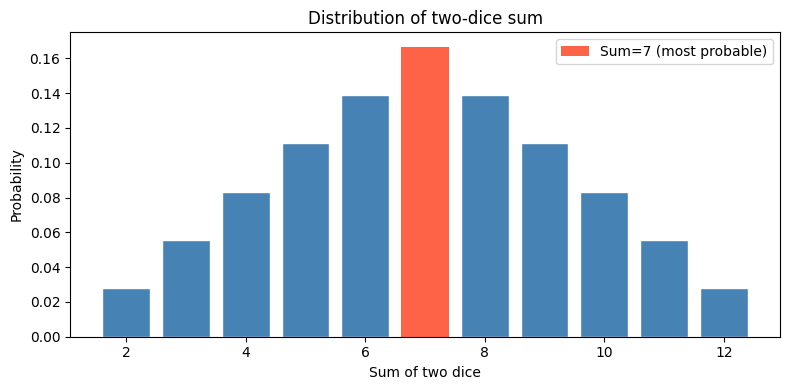
With two dice, the sample space has 36 outcomes. Compound events involve both dice.
import matplotlib.pyplot as plt
from itertools import product

Omega2 = list(product(range(1, 7), range(1, 7)))

# Event: sum equals 7
E_sum7 = [(d1, d2) for d1, d2 in Omega2 if d1 + d2 == 7]

# Event: sum >= 10
E_sum_ge10 = [(d1, d2) for d1, d2 in Omega2 if d1 + d2 >= 10]

print(f"|Ω| = {len(Omega2)}")
print(f"P(sum=7) = {len(E_sum7)}/{len(Omega2)} = {len(E_sum7)/len(Omega2):.4f}")
print(f"  Outcomes: {E_sum7}")
print(f"P(sum≥10) = {len(E_sum_ge10)}/{len(Omega2)} = {len(E_sum_ge10)/len(Omega2):.4f}")

# Visualize distribution of sums
sums = [d1 + d2 for d1, d2 in Omega2]
sum_values, sum_counts = np.unique(sums, return_counts=True)

fig, ax = plt.subplots(figsize=(8, 4))
ax.bar(sum_values, sum_counts / len(Omega2), color='steelblue', edgecolor='white')
ax.bar(7, 6 / 36, color='tomato', label='Sum=7 (most probable)')
ax.set_xlabel('Sum of two dice')
ax.set_ylabel('Probability')
ax.set_title('Distribution of two-dice sum')
ax.legend()
plt.tight_layout()
plt.show()
|Ω| = 36
P(sum=7) = 6/36 = 0.1667
Outcomes: [(1, 6), (2, 5), (3, 4), (4, 3), (5, 2), (6, 1)]
P(sum≥10) = 6/36 = 0.1667
6. Summary
An event is any subset of the sample space.
Set operations (union, intersection, complement) map directly to probabilistic concepts (or, and, not).
Mutually exclusive events have no outcomes in common; their probabilities add directly.
Under uniform distributions, P(E) = |E| / |Ω|.
7. Forward References
The rules for combining probabilities of events — including how union and intersection interact — are formalized in ch244 (Probability Rules). The special case of events conditioned on other events appears in ch245 (Conditional Probability), which is the gateway to Bayesian reasoning in ch246.