Prerequisites: ch001–ch011
You will learn:
The six logical connectives and their truth-functional meaning
How Boolean algebra formalizes the logic already in your code
The connection between Boolean algebra, set theory, and circuit design
How to simplify logical expressions to their minimal form
Environment: Python 3.x, numpy, matplotlib
1. Concept
Boolean algebra is the algebra of truth values. It has exactly two elements — True and False — and operations that mirror set operations and circuit gates.
The six connectives:
AND (,
and, ): true iff both operands are trueOR (,
or, ): true iff at least one operand is trueNOT (,
not, overline): negates the truth valueIMPLIES (): is false only when A is true and B is false
IFF (): true iff both sides have the same truth value
XOR (): true iff exactly one operand is true
Boolean algebra is isomorphic to set algebra with AND ↔ ∩, OR ↔ ∪, NOT ↔ complement. Every theorem in one system has a counterpart in the other.
Common misconception: if A implies B means A causes B.
Implication in logic is purely truth-functional. is true whenever A is false, regardless of what B says. This seems counterintuitive but is the correct formal definition.
2. Intuition & Mental Models
Physical analogy: Electrical circuits. AND is two switches in series (current flows only if both are closed). OR is two switches in parallel (current flows if either is closed). NOT is a relay that inverts. This is not metaphor — Boolean algebra was invented precisely to model switching circuits.
Computational analogy: Every conditional in your code is Boolean algebra. if x > 0 and not is_empty(lst) is . De Morgan’s law tells you how to simplify: not (A and B) == (not A) or (not B). Knowing Boolean identities lets you rewrite conditionals into simpler, more readable, or more efficient forms.
Recall from ch011 (Sets and Basic Set Operations): De Morgan’s laws appeared there too. Logic and set theory are two faces of the same algebraic structure.
# --- Visualization: Truth tables for all six connectives ---
import numpy as np
import matplotlib.pyplot as plt
import matplotlib.colors as mcolors
plt.style.use('seaborn-v0_8-whitegrid')

# Generate all (A, B) combinations
vals = [(False, False), (False, True), (True, False), (True, True)]
A_vals = [v[0] for v in vals]
B_vals = [v[1] for v in vals]

connectives = {
    'A AND B':    [a and b  for a,b in vals],
    'A OR B':     [a or b   for a,b in vals],
    'NOT A':      [not a    for a,b in vals],
    'A → B':      [not a or b for a,b in vals],
    'A ↔ B':      [a == b   for a,b in vals],
    'A XOR B':    [a != b   for a,b in vals],
}

fig, ax = plt.subplots(figsize=(12, 3))
ax.axis('off')

headers = ['A', 'B'] + list(connectives.keys())
table_data = [[str(a)[0], str(b)[0]] + [str(v)[0] for v in col]
              for (a,b), *col in zip(vals, *[list(zip(v)) for v in connectives.values()])]

# Reconstruct properly
rows = []
for i, (a, b) in enumerate(vals):
    row = [str(a)[0], str(b)[0]] + [str(list(v)[i])[0] for v in connectives.values()]
    rows.append(row)

cell_colors = []
for row in rows:
    row_colors = []
    for j, val in enumerate(row):
        if j < 2:
            row_colors.append('#e8e8e8')
        elif val == 'T':
            row_colors.append('#c8f0c8')
        else:
            row_colors.append('#f0c8c8')
    cell_colors.append(row_colors)

table = ax.table(cellText=rows, colLabels=headers,
                  cellLoc='center', loc='center',
                  cellColours=cell_colors)
table.auto_set_font_size(False)
table.set_fontsize(11)
table.scale(1.2, 1.8)
ax.set_title('Truth Tables: All Six Logical Connectives', fontsize=12, pad=15)
plt.tight_layout()
plt.show()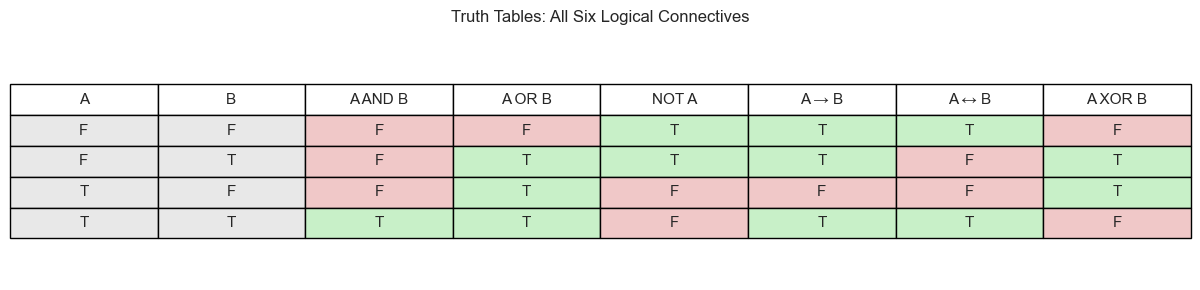
4. Mathematical Formulation
Boolean algebra is defined by a set with operations (OR), (AND), and (NOT), satisfying:
Identities:
;
;
; (idempotence)
; (complement)
(double negation)
De Morgan’s Laws:
Implication in terms of basic connectives:
This identity is non-obvious but crucial: it says that is equivalent to being true whenever is true (or A is false).
# --- Implementation: Boolean expression simplifier (basic) ---
# Uses truth-table equivalence to verify Boolean identities.

def truth_table(fn, n_vars=2):
    """
    Generate the truth table for a Boolean function of n_vars variables.
    Returns list of (inputs, output) tuples.
    """
    from itertools import product
    results = []
    for combo in product([False, True], repeat=n_vars):
        output = fn(*combo)
        results.append((combo, output))
    return results

def are_equivalent(fn1, fn2, n_vars=2):
    """Check if two Boolean functions are logically equivalent (same truth table)."""
    tt1 = truth_table(fn1, n_vars)
    tt2 = truth_table(fn2, n_vars)
    return all(o1 == o2 for (_, o1), (_, o2) in zip(tt1, tt2))

# Verify Boolean identities
identities = [
    ('De Morgan: not(A and B) == (not A) or (not B)',
     lambda A,B: not (A and B),
     lambda A,B: (not A) or (not B)),
    ('De Morgan: not(A or B) == (not A) and (not B)',
     lambda A,B: not (A or B),
     lambda A,B: (not A) and (not B)),
    ('Implication: A->B == (not A) or B',
     lambda A,B: (not A) or B,
     lambda A,B: not A or B),
    ('Distributivity: A and (B or C)',
     lambda A,B,C=False: A and (B or C),  # simplified for 2-var test
     lambda A,B,C=False: (A and B) or (A and C)),
    ('Double negation: not(not A) == A',
     lambda A,B: not(not A),
     lambda A,B: A),
    ('Absorption: A or (A and B) == A',
     lambda A,B: A or (A and B),
     lambda A,B: A),
]

print('Boolean identity verification:')
for name, fn1, fn2 in identities:
    result = are_equivalent(fn1, fn2)
    print(f'  {"✓" if result else "✗"}  {name}')
Boolean identity verification:
✓ De Morgan: not(A and B) == (not A) or (not B)
✓ De Morgan: not(A or B) == (not A) and (not B)
✓ Implication: A->B == (not A) or B
✓ Distributivity: A and (B or C)
✓ Double negation: not(not A) == A
✓ Absorption: A or (A and B) == A
# --- Experiment: Boolean expression minimization ---
# Hypothesis: Many Boolean expressions used in code are redundant.
# We find the simplest equivalent expression via truth-table matching.

from itertools import product

# ✅ DEFINE FIRST
T, F = True, False

# Count distinct Boolean functions of 2 variables
two_var_fns = {}
for output_pattern in product([False, True], repeat=4):
    key = tuple(output_pattern)
    two_var_fns[key] = output_pattern

print(f'Number of distinct 2-variable Boolean functions: {len(two_var_fns)}')
print('(Should be 2^4 = 16 — one for each possible truth table)')
print()

# Name the standard ones
named = {
    (F,F,F,F): 'FALSE (constant)',
    (T,T,T,T): 'TRUE (constant)',
    (F,F,T,T): 'A (identity)',
    (F,T,F,T): 'B (identity)',
    (F,F,F,T): 'A AND B',
    (F,T,T,T): 'A OR B',
    (T,F,T,F): 'NOT A',
    (T,T,F,T): 'A IMPLIES B',
    (T,F,F,T): 'A IFF B (XNOR)',
    (F,T,T,F): 'A XOR B',
}

for pattern, name in named.items():
    print(f'  Truth table {[int(x) for x in pattern]} → {name}')
Number of distinct 2-variable Boolean functions: 16
(Should be 2^4 = 16 — one for each possible truth table)
Truth table [0, 0, 0, 0] → FALSE (constant)
Truth table [1, 1, 1, 1] → TRUE (constant)
Truth table [0, 0, 1, 1] → A (identity)
Truth table [0, 1, 0, 1] → B (identity)
Truth table [0, 0, 0, 1] → A AND B
Truth table [0, 1, 1, 1] → A OR B
Truth table [1, 0, 1, 0] → NOT A
Truth table [1, 1, 0, 1] → A IMPLIES B
Truth table [1, 0, 0, 1] → A IFF B (XNOR)
Truth table [0, 1, 1, 0] → A XOR B
7. Exercises
Easy 1. Simplify not (x > 0 and y < 10) using De Morgan’s law. Write both the original and simplified form, then verify they are equivalent using are_equivalent. (Expected: x <= 0 or y >= 10)
Easy 2. The exclusive-or (XOR) operation satisfies (identity). Verify this and three other XOR identities computationally: , , .
Medium 1. A password validator requires: length ≥ 8 AND (has_upper OR has_digit) AND NOT (all_same_char). Express this as a Boolean formula, build its truth table for all 8 combinations of the three Boolean predicates, and identify which combinations are valid passwords.
Medium 2. Prove computationally that implication is not commutative (i.e., in general) but is transitive: if and , then . Verify transitivity using truth tables.
Hard. A satisfiability problem asks: given a Boolean formula, does any assignment of True/False to variables make it true? This is the SAT problem (NP-complete for general formulas). Implement a brute-force SAT solver for formulas of up to 20 variables (2²⁰ = 1M assignments) and test it on: (a) , (b) (unsatisfiable).
# --- Mini Project: Logic-based decision system ---
# Build a rule-based decision system using Boolean algebra.
# Application: automated code review rule checker.

def check_code_rules(code_str):
    """
    Check a code snippet against a set of logical rules.
    Returns (passes, violations).
    """
    has_docstring = '"""' in code_str or "'''" in code_str
    has_type_hints = '->' in code_str or ': int' in code_str or ': str' in code_str
    has_print_debug = 'print(' in code_str and 'debug' in code_str.lower()
    has_bare_except = 'except:' in code_str
    has_global = 'global ' in code_str
    line_count = len(code_str.strip().split('\n'))

    rules = {
        'Has docstring':                has_docstring,
        'Has type hints':               has_type_hints,
        'No debug prints':              not has_print_debug,
        'No bare except':               not has_bare_except,
        'No global variables':          not has_global,
        'Function length < 50 lines':   line_count < 50,
        # Compound rule: type hints IMPLIES docstring (if typed, must be documented)
        'Typed → documented':           not has_type_hints or has_docstring,
    }

    violations = [name for name, passed in rules.items() if not passed]
    return len(violations) == 0, violations

# Test on sample code snippets
good_code = '''
def compute_mean(values: list) -> float:
    """Compute arithmetic mean of a list of numbers."""
    return sum(values) / len(values)
'''

bad_code = '''
def process(x):
    global counter
    try:
        result = x * 2
        print(f"debug: result={result}")
        return result
    except:
        return None
'''

for label, snippet in [('Good code', good_code), ('Bad code', bad_code)]:
    passes, violations = check_code_rules(snippet)
    print(f'{label}: {"PASS" if passes else "FAIL"}')
    if violations:
        for v in violations:
            print(f'  ✗ {v}')
    print()
Good code: PASS
Bad code: FAIL
✗ Has docstring
✗ Has type hints
✗ No debug prints
✗ No bare except
✗ No global variables
9. Chapter Summary & Connections
Boolean algebra has exactly two values and six operations; every truth-functional connective is definable in terms of AND, OR, NOT
De Morgan’s laws are the key simplification identities: they let you push negations inward
Boolean algebra is isomorphic to set algebra (AND↔∩, OR↔∪, NOT↔complement) and circuit logic (AND gate, OR gate, NOT gate)
Truth tables provide a complete decision procedure for Boolean equivalence
Forward: Boolean logic is the foundation of ch013 — Truth Tables and Logical Reasoning, where we systematically enumerate truth assignments. In ch015 — Mathematical Proof Intuition, we use propositional logic to construct formal arguments. The SAT problem connects to combinatorial search, revisited in the context of optimization in ch212 — Gradient Descent.
Backward: This chapter applies set theory from ch011 (Sets and Basic Set Operations): the algebraic laws of Boolean algebra and set algebra are the same laws stated in two different notations.