Prerequisites: ch001–ch013
You will learn:
The four forms of a conditional and their logical relationships
Why converse and inverse are not equivalent to the original
How to construct and verify logical arguments from conditionals
The role of conditions in mathematical definitions and theorems
Environment: Python 3.x, numpy, matplotlib
1. Concept
A conditional statement has the form if P then Q (written ). It is the workhorse of mathematical reasoning: theorems, definitions, and algorithms are all conditional in structure.
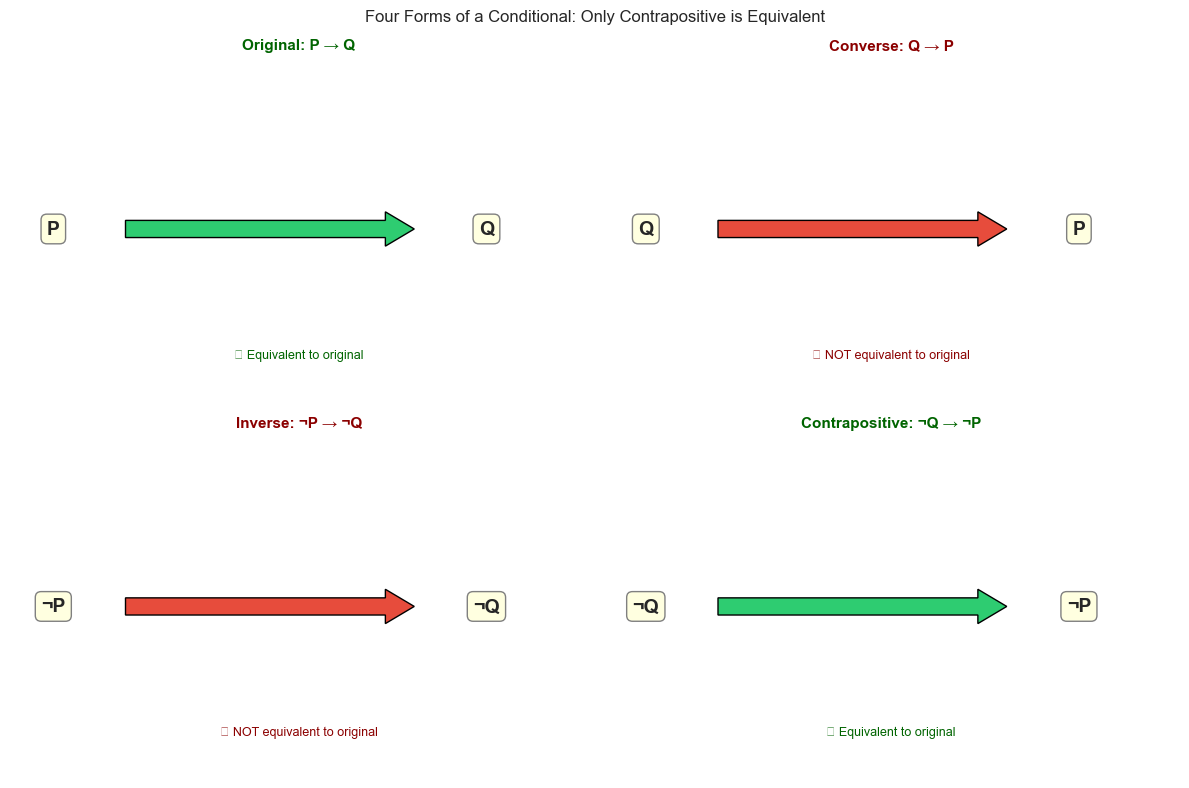
From , four related statements are often considered:
| Name | Form | Logically equivalent to original? |
|---|---|---|
| Original | — | |
| Converse | NO | |
| Inverse | NO | |
| Contrapositive | YES |
This is a common source of logical errors: “if it rains, the ground is wet” does NOT mean “if the ground is wet, it rained” (the converse). But it DOES mean “if the ground is not wet, it didn’t rain” (the contrapositive).
Common misconception: The converse of a true statement is always true.
This is one of the most common errors in mathematical reasoning. The original and converse are independent — knowing one tells you nothing about the other.
2. Intuition & Mental Models
Physical analogy: If the power is on, the screen lights up. The converse — if the screen is lit, the power is on — is not guaranteed (the screen might have a battery). The contrapositive — if the screen is not lit, the power is off — follows directly. The asymmetry is physically real.
Computational analogy: Preconditions and postconditions in Hoare logic. {P} code {Q} means: if precondition P holds before running code, then postcondition Q holds after. This is exactly (conditioned on what the code does). The contrapositive is: if Q doesn’t hold after, then P didn’t hold before (or the code is buggy). The converse () would mean: if Q holds after, then P held before — which is NOT guaranteed.
Recall from ch013 (Truth Tables and Logical Reasoning): we verified that is a tautology. That is the contrapositive equivalence proven.
# --- Visualization: Four forms of a conditional ---
import matplotlib.pyplot as plt
import matplotlib.patches as patches
import numpy as np
plt.style.use('seaborn-v0_8-whitegrid')

fig, axes = plt.subplots(2, 2, figsize=(12, 8))

forms = [
    ('Original: P → Q', 'P', 'Q', '→', True, True),
    ('Converse: Q → P', 'Q', 'P', '→', True, False),
    ('Inverse: ¬P → ¬Q', '¬P', '¬Q', '→', True, False),
    ('Contrapositive: ¬Q → ¬P', '¬Q', '¬P', '→', True, True),
]

from itertools import product as iproduct

for ax, (title, ant, con, op, _, equiv) in zip(axes.flat, forms):
    ax.set_xlim(0, 4); ax.set_ylim(0, 3)
    ax.axis('off')
    ax.set_title(title, fontsize=11, color='darkgreen' if equiv else 'darkred',
                  fontweight='bold')

    # Draw the conditional as arrow
    color = '#2ecc71' if equiv else '#e74c3c'
    ax.add_patch(patches.FancyArrow(0.8, 1.5, 1.8, 0, width=0.15,
                                     head_width=0.3, head_length=0.2,
                                     facecolor=color, edgecolor='black'))
    ax.text(0.3, 1.5, ant, ha='center', va='center', fontsize=14, fontweight='bold',
             bbox=dict(boxstyle='round', facecolor='lightyellow', edgecolor='gray'))
    ax.text(3.3, 1.5, con, ha='center', va='center', fontsize=14, fontweight='bold',
             bbox=dict(boxstyle='round', facecolor='lightyellow', edgecolor='gray'))

    equiv_text = '✓ Equivalent to original' if equiv else '✗ NOT equivalent to original'
    ax.text(2.0, 0.4, equiv_text, ha='center', va='center', fontsize=9,
             color='darkgreen' if equiv else 'darkred')

plt.suptitle('Four Forms of a Conditional: Only Contrapositive is Equivalent', fontsize=12)
plt.tight_layout()
plt.show()
C:\Users\user\AppData\Local\Temp\ipykernel_16836\3943724078.py:39: UserWarning: Glyph 10003 (\N{CHECK MARK}) missing from font(s) Arial.
plt.tight_layout()
C:\Users\user\AppData\Local\Temp\ipykernel_16836\3943724078.py:39: UserWarning: Glyph 10007 (\N{BALLOT X}) missing from font(s) Arial.
plt.tight_layout()
c:\Users\user\OneDrive\Documents\book\.venv\Lib\site-packages\IPython\core\pylabtools.py:170: UserWarning: Glyph 10003 (\N{CHECK MARK}) missing from font(s) Arial.
fig.canvas.print_figure(bytes_io, **kw)
c:\Users\user\OneDrive\Documents\book\.venv\Lib\site-packages\IPython\core\pylabtools.py:170: UserWarning: Glyph 10007 (\N{BALLOT X}) missing from font(s) Arial.
fig.canvas.print_figure(bytes_io, **kw)
4. Mathematical Formulation
Conditional : False only when P is true and Q is false.
Truth table:
| P | Q | P→Q | Q→P (converse) | ¬P→¬Q (inverse) | ¬Q→¬P (contrapositive) |
|---|---|---|---|---|---|
| F | F | T | T | T | T |
| F | T | T | F | T | T |
| T | F | F | T | F | F |
| T | T | T | T | T | T |
The original and contrapositive always agree. The converse and inverse always agree with each other but not with the original.
Biconditional (): True iff P and Q have the same truth value. This is — both the conditional and its converse hold. When mathematicians say “P if and only if Q”, they mean the biconditional.
Necessary and sufficient conditions:
P is sufficient for Q means: (P being true is enough to guarantee Q)
P is necessary for Q means: (Q cannot be true unless P is true)
P is necessary and sufficient for Q means:
# --- Implementation: Conditional analyzer ---
from itertools import product

def analyze_conditional(P_fn, Q_fn, var_names=['A', 'B']):
    """
    Given Boolean functions P and Q over the same variables,
    analyze the relationship between P and Q.
    """
    n = len(var_names)
    assignments = list(product([False, True], repeat=n))

    p_implies_q = all((not P_fn(*a) or Q_fn(*a)) for a in assignments)
    q_implies_p = all((not Q_fn(*a) or P_fn(*a)) for a in assignments)

    result = {
        'P → Q (P sufficient for Q)': p_implies_q,
        'Q → P (P necessary for Q)': q_implies_p,
        'P ↔ Q (equivalent)': p_implies_q and q_implies_p,
    }

    # Find counterexamples if not holding
    if not p_implies_q:
        ce = next(a for a in assignments if P_fn(*a) and not Q_fn(*a))
        result['Counterexample (P true, Q false)'] = dict(zip(var_names, ce))
    if not q_implies_p:
        ce = next(a for a in assignments if Q_fn(*a) and not P_fn(*a))
        result['Counterexample (Q true, P false)'] = dict(zip(var_names, ce))

    return result

# Example 1: P = 'divisible by 4', Q = 'divisible by 2'
# P ⊂ Q: every multiple of 4 is a multiple of 2, but not vice versa
print('Example: divisible by 4 vs divisible by 2 (over integers 1-30)')
P = lambda n: n % 4 == 0
Q = lambda n: n % 2 == 0
domain = range(1, 31)
p_imp_q = all(not P(n) or Q(n) for n in domain)
q_imp_p = all(not Q(n) or P(n) for n in domain)
print(f'  P→Q (mult of 4 → mult of 2): {p_imp_q}  (4 is sufficient for 2)')
print(f'  Q→P (mult of 2 → mult of 4): {q_imp_p}  (2 is NOT sufficient for 4)')
print(f'  Counterexample: n=2 is divisible by 2 but not 4')
print()

# Example 2: Two Boolean conditions
print('Example 2: P = (A and B), Q = (A or B)')
result = analyze_conditional(
    P_fn=lambda A,B: A and B,
    Q_fn=lambda A,B: A or B,
)
for k, v in result.items():
    print(f'  {k}: {v}')
Example: divisible by 4 vs divisible by 2 (over integers 1-30)
P→Q (mult of 4 → mult of 2): True (4 is sufficient for 2)
Q→P (mult of 2 → mult of 4): False (2 is NOT sufficient for 4)
Counterexample: n=2 is divisible by 2 but not 4
Example 2: P = (A and B), Q = (A or B)
P → Q (P sufficient for Q): True
Q → P (P necessary for Q): False
P ↔ Q (equivalent): False
Counterexample (Q true, P false): {'A': False, 'B': True}
# --- Experiment: Common logical errors in code ---
# Hypothesis: Conditional logic errors (converse/inverse confusion) are common
# in real conditions. Demonstrate with typical programming scenarios.

def test_condition_logic():
    # Bug pattern: asserting converse when original was intended

    # WRONG: if sorted, then valid (converse of 'if valid, then sorted')
    def is_sorted(lst):
        return all(lst[i] <= lst[i+1] for i in range(len(lst)-1))

    def is_valid_data(lst):
        """A list is 'valid' if it has no negative numbers and is sorted."""
        return all(x >= 0 for x in lst) and is_sorted(lst)

    test_cases = [
        [1, 2, 3, 4],      # valid AND sorted
        [1, 3, 2, 4],      # valid but NOT sorted
        [-1, 0, 1, 2],     # sorted but NOT valid (negative)
        [3, 1, 4, 1, 5],   # neither
    ]

    print('Condition analysis for list validation:')
    print(f'{"List":<25} {"valid":>7} {"sorted":>8} {"valid→sorted":>14} {"sorted→valid":>14}')
    print('-'*72)
    for lst in test_cases:
        v = is_valid_data(lst)
        s = is_sorted(lst)
        v_imp_s = not v or s
        s_imp_v = not s or v
        print(f'{str(lst):<25} {str(v):>7} {str(s):>8} {str(v_imp_s):>14} {str(s_imp_v):>14}')

    print()
    print('Conclusion: valid→sorted always holds (valid implies sorted by definition)')
    print('But sorted→valid does NOT (a sorted list can have negatives)')

test_condition_logic()
Condition analysis for list validation:
List valid sorted valid→sorted sorted→valid
------------------------------------------------------------------------
[1, 2, 3, 4] True True True True
[1, 3, 2, 4] False False True True
[-1, 0, 1, 2] False True True False
[3, 1, 4, 1, 5] False False True True
Conclusion: valid→sorted always holds (valid implies sorted by definition)
But sorted→valid does NOT (a sorted list can have negatives)
7. Exercises
Easy 1. State the contrapositive of: “If a number is divisible by 6, then it is divisible by both 2 and 3.” Verify computationally that the original and contrapositive are equivalent for integers 1–100. (Expected: both hold or both fail on every test case)
Easy 2. For the conditional “If it is a square, then it is a rectangle,” determine whether the converse, inverse, and contrapositive are true or false. Test computationally using area/perimeter properties. (Hint: define shapes by a single parameter and test the geometric properties)
Medium 1. The statement “P is necessary and sufficient for Q” means . Find a mathematical example where P is sufficient but not necessary, and one where P is necessary but not sufficient, using divisibility relations on integers 1–50.
Medium 2. In type theory, the conditional corresponds to a function from proofs of P to proofs of Q. Implement this correspondence: write a Python function that takes a “proof” (any object) of P and transforms it to a “proof” of Q for the specific conditional: “If n is even, then n² is even.” The function should take an integer n (the proof that n is even, i.e., n must be even) and return n² (demonstrating n² is even).
Hard. Prove computationally that the following argument form is valid (hypothetical syllogism): from and , conclude . Then extend: given n conditionals , , ..., , prove using induction. Implement a function that chains n conditionals and verifies the result is valid for n=2,3,4,5.
# --- Mini Project: Theorem structure analyzer ---
# Many mathematical theorems are conditionals: IF [conditions] THEN [conclusion].
# Build a tool that decomposes theorem statements and checks their logical structure.

class TheoremAnalyzer:
    """
    Analyzes the logical structure of theorem-like statements.
    Stores hypotheses and conclusion, checks consistency.
    """
    def __init__(self, name):
        self.name = name
        self.hypotheses = []
        self.conclusion = None

    def add_hypothesis(self, desc, pred):
        self.hypotheses.append((desc, pred))
        return self

    def set_conclusion(self, desc, pred):
        self.conclusion = (desc, pred)
        return self

    def verify(self, domain, verbose=True):
        """Check if theorem holds on given domain."""
        if self.conclusion is None:
            raise ValueError('No conclusion set')

        conc_desc, conc_pred = self.conclusion

        counterexamples = []
        for x in domain:
            hyps_hold = all(pred(x) for _, pred in self.hypotheses)
            if hyps_hold and not conc_pred(x):
                counterexamples.append(x)

        if verbose:
            print(f'Theorem: {self.name}')
            print(f'  Hypotheses: {[h for h,_ in self.hypotheses]}')
            print(f'  Conclusion: {conc_desc}')
            if counterexamples:
                print(f'  FAILS: counterexamples = {counterexamples[:5]}')
            else:
                print(f'  HOLDS on all {len(list(domain))} domain elements')
        return len(counterexamples) == 0

# Example: Theorem about even squares
t = TheoremAnalyzer('Square of even integer is divisible by 4')
t.add_hypothesis('n is even', lambda n: n % 2 == 0)
t.set_conclusion('n² is divisible by 4', lambda n: (n*n) % 4 == 0)
t.verify(range(-50, 51))
print()

# Example: A false theorem
t2 = TheoremAnalyzer('Square of odd integer is odd (true) then also prime?')
t2.add_hypothesis('n is odd', lambda n: n % 2 == 1)
t2.set_conclusion('n² is prime', lambda n: all(n*n % i != 0 for i in range(2, n*n)) and n*n > 1)
t2.verify(range(1, 30))
Theorem: Square of even integer is divisible by 4
Hypotheses: ['n is even']
Conclusion: n² is divisible by 4
HOLDS on all 101 domain elements
Theorem: Square of odd integer is odd (true) then also prime?
Hypotheses: ['n is odd']
Conclusion: n² is prime
FAILS: counterexamples = [1, 3, 5, 7, 9]
False9. Chapter Summary & Connections
A conditional has four forms: the original, converse, inverse, and contrapositive; only the last is logically equivalent to the original
Necessary and sufficient conditions correspond precisely to direction of implication: sufficient = , necessary =
The biconditional requires both directions: it says P and Q are logically interchangeable
Most mathematical theorems are conditionals; decomposing them into hypotheses and conclusion is the first step in understanding or proving them
Forward: The conditional structure of theorems is what we will prove in ch015 — Mathematical Proof Intuition. Necessary and sufficient conditions become the core of mathematical definitions throughout the book. The contrapositive proof technique is used in ch016 — Proof by Example and Counterexample.
Backward: This chapter applies ch013 (Truth Tables and Logical Reasoning): we use truth tables to verify the equivalence of original and contrapositive, and the non-equivalence of original and converse.