1. Why the learning rate must change
A fixed learning rate faces a fundamental tradeoff:
Too large: oscillates around the minimum, never converges.
Too small: converges, but painfully slowly.
The solution: start high (to explore quickly) and decay (to converge precisely). Learning rate schedules formalise this.
(Gradient descent: ch212. SGD: ch307. Adam: ch312.)
2. Common schedules
import numpy as np
import matplotlib.pyplot as plt


def step_decay(epoch, lr0, drop, epochs_drop):
    return lr0 * (drop ** (epoch // epochs_drop))

def exponential_decay(epoch, lr0, decay):
    return lr0 * np.exp(-decay * epoch)

def cosine_annealing(epoch, lr0, lr_min, T_max):
    return lr_min + 0.5*(lr0 - lr_min)*(1 + np.cos(np.pi * epoch / T_max))

def warmup_cosine(epoch, lr0, T_warmup, T_total, lr_min=0):
    if epoch < T_warmup:
        return lr0 * epoch / T_warmup
    progress = (epoch - T_warmup) / (T_total - T_warmup)
    return lr_min + 0.5*(lr0 - lr_min)*(1 + np.cos(np.pi * progress))

def one_cycle(epoch, lr_max, T_total):
    """1-cycle policy: warm up, peak, decay."""
    if epoch < T_total // 2:
        return lr_max * 2 * epoch / T_total
    return lr_max * 2 * (1 - epoch / T_total)


epochs = np.arange(0, 200)
schedules = [
    (np.array([step_decay(e, 0.1, 0.5, 40) for e in epochs]), 'Step decay (drop=0.5, every 40)'),
    (np.array([exponential_decay(e, 0.1, 0.02) for e in epochs]), 'Exponential decay'),
    (np.array([cosine_annealing(e, 0.1, 1e-5, 200) for e in epochs]), 'Cosine annealing'),
    (np.array([warmup_cosine(e, 0.1, 20, 200) for e in epochs]), 'Warmup + cosine (Transformers)'),
    (np.array([one_cycle(e, 0.1, 200) for e in epochs]), '1-cycle policy'),
]

fig, ax = plt.subplots(figsize=(12, 5))
colors = ['#e74c3c','#f39c12','#3498db','#9b59b6','#2ecc71']
for (lrs, name), color in zip(schedules, colors):
    ax.plot(epochs, lrs, label=name, lw=2, color=color)

ax.set_xlabel('Epoch')
ax.set_ylabel('Learning rate')
ax.set_title('Learning rate schedule comparison')
ax.legend(fontsize=9)
ax.set_yscale('log')
plt.tight_layout()
plt.savefig('ch313_lr_schedules.png', dpi=120)
plt.show()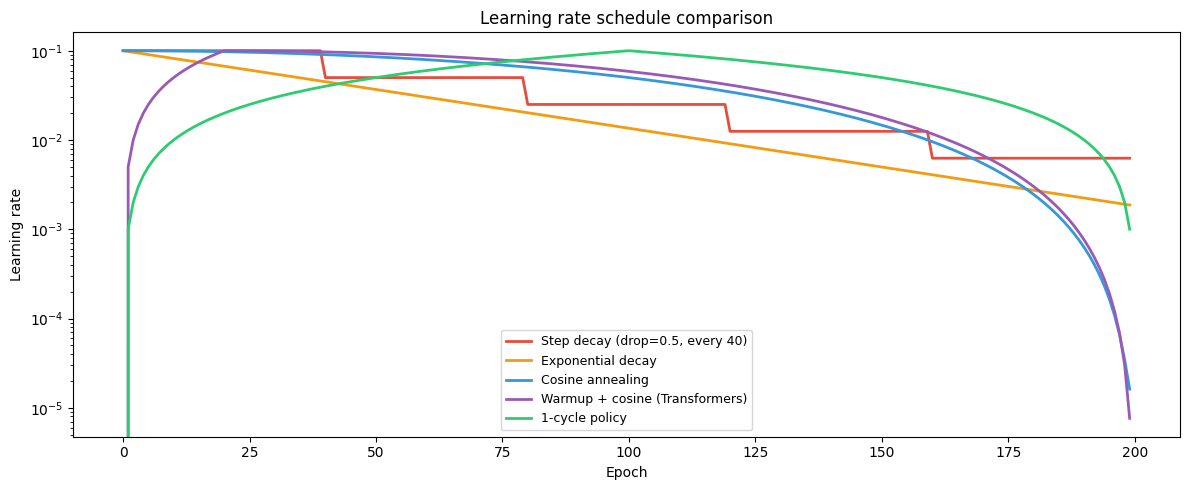
3. Warmup
Starting with a high learning rate when weights are random causes instability — the gradient estimate is noisy and the model’s activations are not yet calibrated.
Linear warmup: increase from 0 to over the first steps. This is standard for Transformer training (ch322).
For Adam specifically, warmup helps because the second moment estimate is initialised to 0 and needs a few hundred steps to converge — before that, the effective LR is artificially high. Warmup buys time for this stabilisation.
4. Cosine annealing
Decays smoothly, spending more time at moderate LR than step decay. Can be combined with warm restarts (SGDR): after reaching , reset to and repeat. Warm restarts help escape local minima and explore multiple convergence basins.
5. The 1-cycle policy (Super-Convergence)
Smith & Touvron (2018): briefly go above the maximum useful LR, then decay aggressively.
This “super-convergence” can achieve similar accuracy in 10× fewer steps.
Widely used for CNNs: max_lr found by LR range test (increase LR until loss diverges,
use 10% below that).
6. Practical recipe
Default: cosine annealing with linear warmup.
CNNs: 1-cycle policy or step decay with SGD+Momentum.
Transformers: warmup for 4–10% of steps, then inverse sqrt decay or cosine.
Fine-tuning pretrained models: very small LR (1e-5 to 5e-5), no warmup usually needed.
7. Summary
Fixed LR forces a tradeoff: too large oscillates, too small stalls.
Schedules: step decay (simple), exponential decay, cosine annealing (smooth), warmup+cosine (Transformers).
Warmup stabilises Adam’s second moment and prevents early instability.
1-cycle policy achieves fast convergence with proper LR range test.
8. Forward and backward references
Used here: gradient descent (ch212), Adam optimiser (ch312), SGD (ch307).
This will reappear in ch322 — Transformers, where the Vaswani et al. original schedule () is derived and implemented.