1. The problem with vanilla SGD
SGD uses the same learning rate for all parameters. But gradients have very different scales across parameters: weights in a sparse input layer update rarely (small gradient), weights in a dense hidden layer update every batch (large gradient).
Adaptive optimisers maintain per-parameter learning rates that automatically scale with the history of each parameter’s gradients.
(SGD and momentum: ch307.)
2. AdaGrad
accumulates squared gradients. Parameters with large historical gradients get small effective LR; sparse parameters get large effective LR. Problem: only grows → LR monotonically decreases → learning stops.
3. RMSProp
Replace the accumulation with an exponential moving average:
. The decay prevents from growing without bound.
4. Adam (Adaptive Moment Estimation)
Adam (Kingma & Ba, 2014) combines RMSProp (second moment) with momentum (first moment):
Bias correction (important at when and are near zero):
Defaults: , , , .
Adam is the standard default for most deep learning tasks.
import numpy as np
import matplotlib.pyplot as plt


class SGDMomentum:
    def __init__(self, params, lr=0.01, momentum=0.9):
        self.params = params; self.lr = lr; self.mu = momentum
        self.v = {k: np.zeros_like(v) for k, v in params.items()}
    def step(self, grads):
        for k in self.params:
            self.v[k] = self.mu*self.v[k] - self.lr*grads[k]
            self.params[k] += self.v[k]

class RMSProp:
    def __init__(self, params, lr=0.01, rho=0.9, eps=1e-8):
        self.params = params; self.lr = lr; self.rho = rho; self.eps = eps
        self.v = {k: np.zeros_like(v) for k, v in params.items()}
    def step(self, grads):
        for k in self.params:
            self.v[k] = self.rho*self.v[k] + (1-self.rho)*grads[k]**2
            self.params[k] -= self.lr / (np.sqrt(self.v[k]) + self.eps) * grads[k]

class Adam:
    def __init__(self, params, lr=0.001, beta1=0.9, beta2=0.999, eps=1e-8):
        self.params = params; self.lr = lr
        self.b1 = beta1; self.b2 = beta2; self.eps = eps; self.t = 0
        self.m = {k: np.zeros_like(v) for k, v in params.items()}
        self.v = {k: np.zeros_like(v) for k, v in params.items()}
    def step(self, grads):
        self.t += 1
        for k in self.params:
            self.m[k] = self.b1*self.m[k] + (1-self.b1)*grads[k]
            self.v[k] = self.b2*self.v[k] + (1-self.b2)*grads[k]**2
            m_hat = self.m[k] / (1 - self.b1**self.t)
            v_hat = self.v[k] / (1 - self.b2**self.t)
            self.params[k] -= self.lr / (np.sqrt(v_hat) + self.eps) * m_hat


def rosenbrock(p): return (1-p[0])**2 + 100*(p[1]-p[0]**2)**2
def rosenbrock_grad(p):
    return np.array([-2*(1-p[0]) - 400*p[0]*(p[1]-p[0]**2),
                     200*(p[1]-p[0]**2)])


def run_optimiser(opt_cls, opt_kwargs, n_steps=2000, seed=0):
    rng = np.random.default_rng(seed)
    params = {'w': np.array([-1.0, 0.5])}
    opt = opt_cls(params, **opt_kwargs)
    hist = [params['w'].copy()]
    for _ in range(n_steps):
        g = rosenbrock_grad(params['w']) + rng.normal(0, 0.3, 2)
        opt.step({'w': g})
        hist.append(params['w'].copy())
    return np.array(hist)

configs = [
    (SGDMomentum, {'lr': 0.001, 'momentum': 0.9}, 'SGD+Momentum', '#e74c3c'),
    (RMSProp, {'lr': 0.005, 'rho': 0.9}, 'RMSProp', '#f39c12'),
    (Adam, {'lr': 0.01}, 'Adam', '#3498db'),
]

xs = np.linspace(-1.5, 1.5, 400); ys = np.linspace(-0.5, 1.5, 400)
X, Y = np.meshgrid(xs, ys)
Z = np.log1p((1-X)**2 + 100*(Y-X**2)**2)

fig, axes = plt.subplots(1, 3, figsize=(15, 5))
for ax, (opt_cls, kwargs, name, color) in zip(axes, configs):
    hist = run_optimiser(opt_cls, kwargs)
    ax.contourf(X, Y, Z, levels=40, cmap='gray_r', alpha=0.8)
    ax.plot(hist[:,0], hist[:,1], color=color, lw=1.5, alpha=0.85, label=name)
    ax.scatter(-1, 0.5, color='black', s=80, zorder=5, label='Start')
    ax.scatter(1, 1, color='gold', s=120, marker='*', zorder=5, label='Min')
    final = rosenbrock(hist[-1])
    ax.set_title(f'{name}\nfinal f={final:.4f}')
    ax.set_xlim(-1.5,1.5); ax.set_ylim(-0.5,1.5)
    ax.legend(fontsize=8)

plt.suptitle('Optimiser comparison on Rosenbrock (noisy gradients)', fontsize=12)
plt.tight_layout()
plt.savefig('ch312_optimisers.png', dpi=120)
plt.show()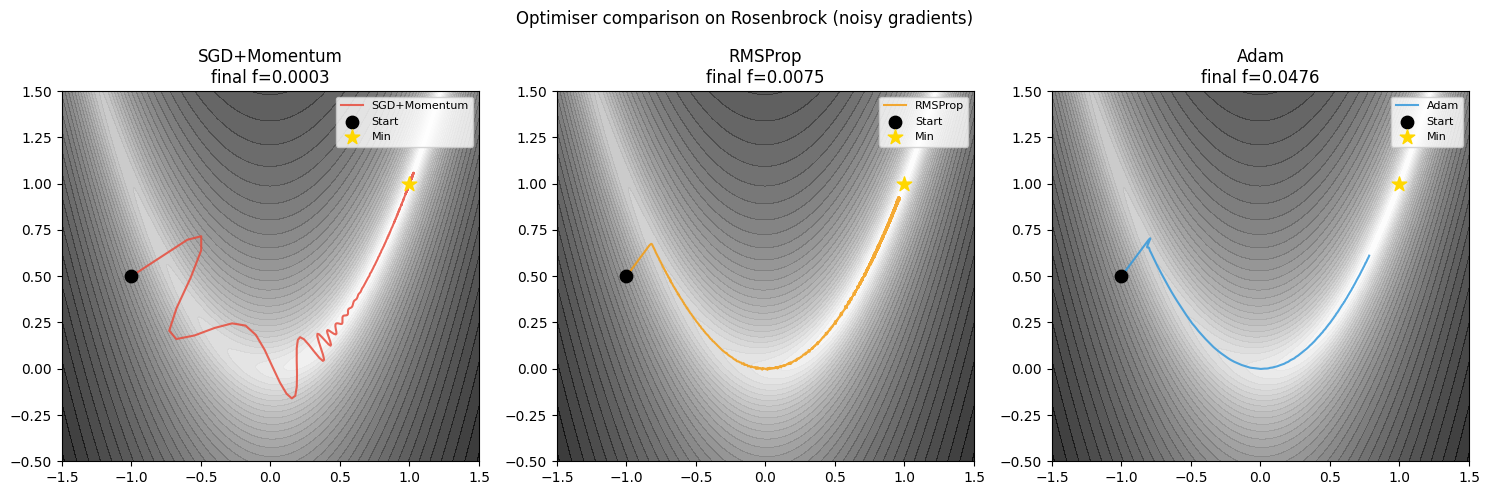
5. AdamW: fixing Adam’s L2 regularisation
Standard Adam with L2 penalty mixes gradient adaption and weight decay, causing inconsistent effective regularisation. AdamW (Loshchilov & Hutter, 2019) decouples them:
Weight decay applied directly to parameters, not via the gradient. AdamW is the default optimiser for Transformers and language models.
6. Practical guidelines
| Task | Recommended optimiser |
|---|---|
| Quick prototyping | Adam (lr=1e-3) |
| CNNs for vision | SGD+Momentum (lr=0.01–0.1, μ=0.9) |
| Transformers/LLMs | AdamW (lr=1e-4 to 3e-4, weight_decay=0.01) |
| RNNs | Adam or RMSProp with gradient clipping |
| Reinforcement Learning | Adam or RMSProp |
7. Summary
Adaptive optimisers scale LR per-parameter based on gradient history.
RMSProp: EMA of squared gradients; Adam: RMSProp + momentum + bias correction.
Adam defaults work surprisingly well across tasks; AdamW fixes L2 coupling.
SGD+Momentum often beats Adam on final test accuracy for CNNs, given more tuning.
8. Forward and backward references
Used here: gradient descent (ch212), momentum (ch307), expectation (ch249), L2 regularisation (ch311).
This will reappear in ch322 — Transformers, where AdamW with linear warmup and cosine decay is the universal training recipe for language models.