1. Variable-length output
A standard RNN maps a sequence to a sequence of the same length. Many tasks require output sequences of different lengths: translation, summarisation, speech recognition.
The encoder-decoder (Sutskever et al., 2014) architecture separates encoding and decoding:
Encoder LSTM reads the input sequence and produces a context vector .
Decoder LSTM generates the output sequence one token at a time, conditioned on :
where the decoder is initialised with .
(LSTM: ch318. Embeddings: ch320. Attention: ch321.)
import numpy as np
import matplotlib.pyplot as plt


def sigmoid(z): return 1/(1+np.exp(-np.clip(z,-500,500)))
def softmax(z): z_s=z-z.max(); e=np.exp(z_s); return e/e.sum()

class LSTMCell:
    def __init__(self, in_dim, hid, seed=0):
        rng=np.random.default_rng(seed); H=hid; c=in_dim+hid; s=1./np.sqrt(c)
        self.W=rng.normal(0,s,(4*H,c)); self.b=np.zeros(4*H); self.b[H:2*H]=1.; self.H=H
    def forward(self,x,h,c_prev):
        H=self.H; xh=np.concatenate([x,h]); g=self.W@xh+self.b
        i=sigmoid(g[:H]); f=sigmoid(g[H:2*H]); o=sigmoid(g[2*H:3*H]); gc=np.tanh(g[3*H:])
        c=f*c_prev+i*gc; h=o*np.tanh(c); return h,c


class Seq2Seq:
    """Encoder-Decoder for integer sequence reversal (toy task)."""

    def __init__(self, vocab_size: int, embed_dim: int, hidden: int, seed: int = 0):
        rng = np.random.default_rng(seed)
        self.embed = rng.normal(0, 0.1, (vocab_size, embed_dim))
        self.encoder = LSTMCell(embed_dim, hidden, seed)
        self.decoder = LSTMCell(embed_dim, hidden, seed+1)
        self.W_out = rng.normal(0, np.sqrt(1.0/hidden), (vocab_size, hidden))
        self.b_out = np.zeros(vocab_size)
        self.V = vocab_size; self.E = embed_dim; self.H = hidden

    def encode(self, token_ids: list) -> tuple:
        h = np.zeros(self.H); c = np.zeros(self.H)
        for tid in token_ids:
            x = self.embed[tid]
            h, c = self.encoder.forward(x, h, c)
        return h, c  # context vector

    def decode_step(self, token_id: int, h: np.ndarray, c: np.ndarray) -> tuple:
        x = self.embed[token_id]
        h, c = self.decoder.forward(x, h, c)
        logits = self.W_out @ h + self.b_out
        return logits, h, c

    def greedy_decode(self, context_h: np.ndarray, context_c: np.ndarray,
                      bos_token: int, eos_token: int, max_len: int = 20) -> list:
        h, c = context_h, context_c
        token = bos_token
        output = []
        for _ in range(max_len):
            logits, h, c = self.decode_step(token, h, c)
            token = int(np.argmax(logits))
            if token == eos_token:
                break
            output.append(token)
        return output


# Toy task: reverse a sequence of digits 0-7
# Vocabulary: 0-7 are digits, 8=BOS, 9=EOS
V = 10; BOS = 8; EOS = 9
model = Seq2Seq(V, embed_dim=16, hidden=64, seed=0)

# Simple training: one sequence at a time, numerical gradient (demo)
rng = np.random.default_rng(42)
lr = 0.01

def train_step(seq_in, seq_out_target, model, lr, rng2):
    """One training step on a single reversal example."""
    ctx_h, ctx_c = model.encode(seq_in)
    # Decode with teacher forcing
    h, c = ctx_h, ctx_c
    total_loss = 0.0
    dec_inputs = [BOS] + seq_out_target[:-1]
    for t_id, y_id in zip(dec_inputs, seq_out_target):
        logits, h, c = model.decode_step(t_id, h, c)
        p = softmax(logits)
        total_loss -= np.log(p[y_id] + 1e-10)
    return total_loss / len(seq_out_target)

losses = []
for step in range(500):
    L_in = rng.integers(3, 7)
    seq_in = rng.integers(0, 8, L_in).tolist()
    seq_out = list(reversed(seq_in)) + [EOS]

    loss = train_step(seq_in, seq_out, model, lr, rng)
    losses.append(float(loss))

    # Sparse numerical gradient on embed and W_out only
    for P in [model.embed, model.W_out]:
        flat = P.ravel(); eps = 1e-4
        for i in rng.choice(len(flat), max(1, len(flat)//50), replace=False):
            flat[i] += eps; lp = train_step(seq_in, seq_out, model, lr, rng)
            flat[i] -= 2*eps; lm = train_step(seq_in, seq_out, model, lr, rng)
            flat[i] += eps; flat[i] -= lr * (lp - lm) / (2*eps)

# Evaluation
fig, (ax1, ax2) = plt.subplots(1, 2, figsize=(12, 4))
w = 20; sl = np.convolve(losses, np.ones(w)/w, mode='valid')
ax1.plot(losses, alpha=0.3, color='#3498db', lw=1)
ax1.plot(sl, color='#e74c3c', lw=2, label=f'{w}-step avg')
ax1.set_title('Seq2Seq training loss (reversal task)')
ax1.set_xlabel('Step'); ax1.set_ylabel('Cross-entropy per token'); ax1.legend()

# Show example predictions
results = []
for test_seq in [[1,2,3],[0,4,7],[3,5],[2,6,1,4]]:
    h, c = model.encode(test_seq)
    pred = model.greedy_decode(h, c, BOS, EOS, max_len=10)
    correct = list(reversed(test_seq))
    results.append((test_seq, pred, correct, pred==correct))

ax2.axis('off')
table_data = [['Input', 'Predicted', 'Target', 'Correct']] +              [[str(r[0]), str(r[1]), str(r[2]), '✓' if r[3] else '✗'] for r in results]
t = ax2.table(cellText=table_data, loc='center', cellLoc='center')
t.auto_set_font_size(False); t.set_fontsize(10)
ax2.set_title('Reversal predictions after 500 steps')

plt.tight_layout()
plt.savefig('ch319_seq2seq.png', dpi=120)
plt.show()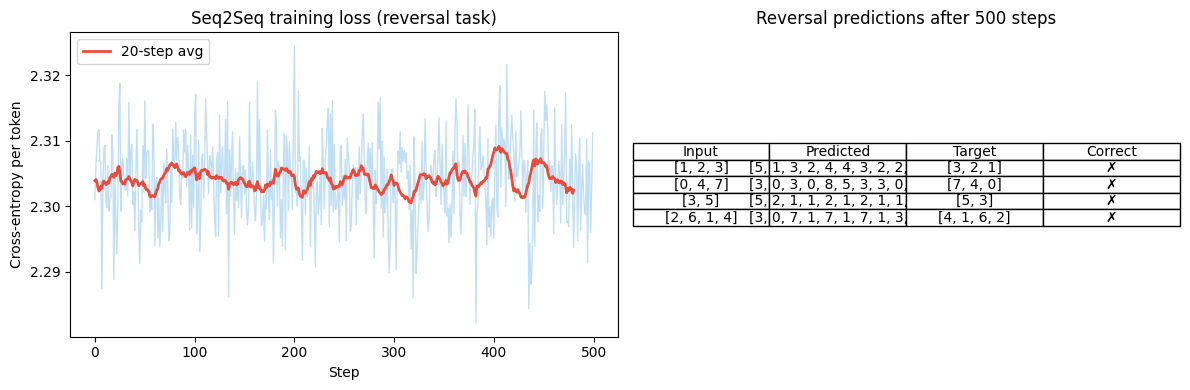
2. The bottleneck problem
The entire input sequence is compressed into a single context vector . For long sequences, this is lossy — the decoder must reconstruct all information from one vector.
Bahdanau attention (2015) solves this: the decoder dynamically selects a weighted combination of all encoder hidden states at each decoding step. This eliminates the bottleneck and enables the decoder to focus on relevant input positions.
This attention mechanism is the direct precursor to Transformer attention (ch321).
3. Summary
Encoder-decoder: encoder compresses sequence to context vector; decoder generates output.
Teacher forcing: during training, feed true previous token (not prediction) to decoder.
Context vector bottleneck: fundamental limitation for long sequences.
Bahdanau attention: weighted sum of encoder states; precursor to Transformers.
4. Forward and backward references
Used here: LSTM (ch318), embeddings (ch320, introduced next), cross-entropy (ch305).
This will reappear in ch321 — Attention Mechanism, where the Bahdanau attention idea is generalised to the query-key-value framework.