Prerequisites: ch021 (The History of Numbers)
You will learn:
The Peano axioms: what it means to define the natural numbers from scratch
Induction as a computational process
Summation formulas and their derivation
How iteration and recursion mirror the successor function
Environment: Python 3.x, numpy, matplotlib
1. Concept
The natural numbers are the first number system — the one built into human intuition from childhood. But “intuition” is not a mathematical definition. Giuseppe Peano gave a rigorous definition in 1889 using five axioms.
The key idea: you do not need to explain what a natural number is — you only need to define the rules they follow. The rules determine everything.
Common misconception: “0 is not a natural number.” Depends on convention. In computer science and most modern mathematics, 0 ∈ ℕ. In some older traditions, ℕ starts at 1. This book uses 0 ∈ ℕ.
Another misconception: “Mathematical induction is proof by example.” It is not. Induction proves a statement for all natural numbers simultaneously, via the successor structure.
2. Intuition & Mental Models
Think of ℕ as a program: There is a starting value (0), and a next() function (the successor). Every natural number is reachable by calling next() enough times from 0. Nothing else is in ℕ.
0 → next → 1 → next → 2 → next → 3 → ...Induction as loop invariant: Mathematical induction is exactly the reasoning behind loop correctness proofs. You prove a property holds at step 0, and you prove that if it holds at step it holds at step . Then it holds for all steps — just as a loop invariant guarantees correctness for all iterations.
Recursion mirrors the Peano axioms: A recursive function has a base case (0) and a recursive case (n+1 defined in terms of n). This is not a coincidence — it is the same structure.
(Recall from ch006 — Discrete vs Continuous Thinking: natural numbers are the paradigmatic discrete structure.)
3. Visualization
# --- Visualization: Triangular numbers and the sum 1+2+...+n ---
import numpy as np
import matplotlib.pyplot as plt
import matplotlib.patches as mpatches
plt.style.use('seaborn-v0_8-whitegrid')

def triangular(n):
    """Return the nth triangular number T(n) = n*(n+1)/2."""
    return n * (n + 1) // 2

fig, axes = plt.subplots(1, 2, figsize=(12, 5))

# Plot 1: triangular numbers as dot arrangements
ax = axes[0]
ax.set_aspect('equal')
ax.set_title('Triangular Numbers as Dot Arrays')
colors = plt.cm.viridis(np.linspace(0, 0.85, 6))
x_offset = 0
for n in range(1, 6):
    for row in range(n):
        for col in range(row + 1):
            ax.scatter(x_offset + col - row/2, -row, color=colors[n-1], s=80, zorder=3)
    ax.text(x_offset, -(n-1) - 1.2, f'T({n})={triangular(n)}', ha='center', fontsize=9)
    x_offset += n + 1
ax.set_xlim(-1, x_offset)
ax.set_ylim(-7, 1)
ax.axis('off')

# Plot 2: cumulative sums vs formula
ax = axes[1]
N_MAX = 20
ns = np.arange(0, N_MAX + 1)
cumsum = np.cumsum(ns)              # iterative
formula = ns * (ns + 1) // 2       # closed form

ax.plot(ns, cumsum, 'o-', label='Cumulative sum: Σk', color='steelblue', linewidth=2)
ax.plot(ns, formula, '--', label='Formula: n(n+1)/2', color='crimson', linewidth=2)
ax.set_xlabel('n')
ax.set_ylabel('Sum')
ax.set_title('Sum 1+2+...+n: Iterative vs Closed Form')
ax.legend()

plt.tight_layout()
plt.show()

# Verify they match
assert np.array_equal(cumsum, formula), "Mismatch!"
print("Iterative and formula agree for all n in [0, 20].")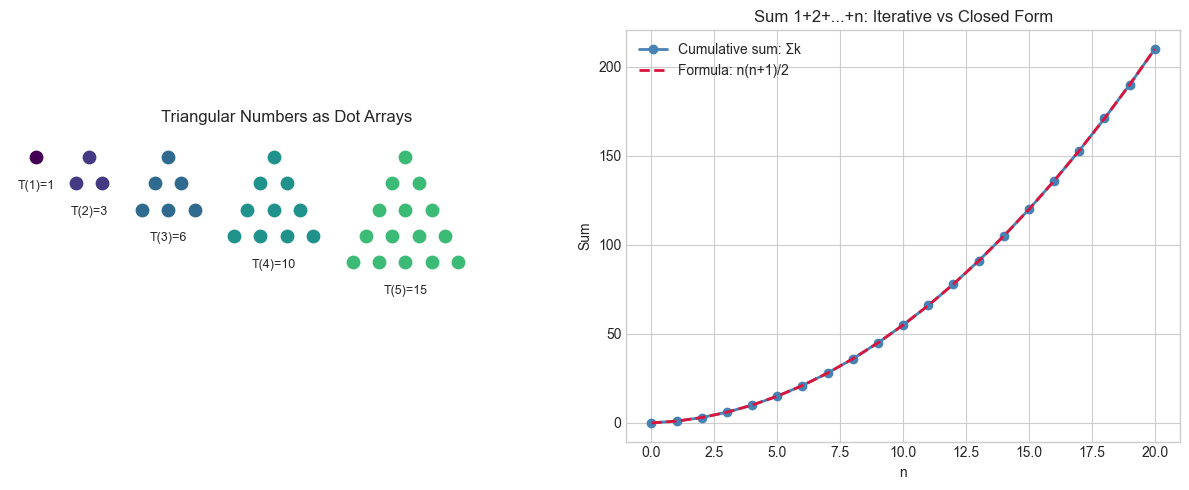
Iterative and formula agree for all n in [0, 20].
4. Mathematical Formulation
Peano Axioms (informal version):
Every has a successor
0 is not the successor of any natural number
If then (successor is injective)
Induction axiom: If a property holds for 0 and is preserved by the successor, it holds for all natural numbers.
Gauss’s sum formula:
Proof by induction:
Base: : . ✓
Step: Assume true for . Then . ✓
Sum of squares:
5. Python Implementation
# --- Implementation: Natural number arithmetic via Peano-style recursion ---

def peano_add(m, n):
    """
    Add two natural numbers using only the successor and predecessor operations.
    This directly mirrors the Peano recursive definition of addition:
      add(m, 0) = m
      add(m, S(n)) = S(add(m, n))

    Args:
        m: non-negative int
        n: non-negative int

    Returns:
        int: m + n
    """
    if n == 0:
        return m
    return peano_add(m, n - 1) + 1  # S(add(m, n-1))


def peano_multiply(m, n):
    """
    Multiply two natural numbers using Peano recursion:
      mul(m, 0) = 0
      mul(m, S(n)) = mul(m, n) + m

    Args:
        m: non-negative int
        n: non-negative int

    Returns:
        int: m * n
    """
    if n == 0:
        return 0
    return peano_multiply(m, n - 1) + m


def sum_natural(n):
    """
    Compute 1 + 2 + ... + n using the closed-form Gauss formula.

    Args:
        n: non-negative int

    Returns:
        int: n*(n+1)//2
    """
    return n * (n + 1) // 2


# Validation
import sys
sys.setrecursionlimit(500)

print("Peano addition tests:")
for a, b in [(3, 4), (0, 7), (10, 5)]:
    result = peano_add(a, b)
    assert result == a + b
    print(f"  peano_add({a}, {b}) = {result}  ✓")

print("\nPeano multiplication tests:")
for a, b in [(3, 4), (0, 7), (5, 5)]:
    result = peano_multiply(a, b)
    assert result == a * b
    print(f"  peano_multiply({a}, {b}) = {result}  ✓")

print("\nGauss sum tests:")
for n in [1, 5, 10, 100]:
    brute = sum(range(n + 1))
    formula = sum_natural(n)
    assert brute == formula
    print(f"  sum_natural({n}) = {formula}  ✓")
Peano addition tests:
peano_add(3, 4) = 7 ✓
peano_add(0, 7) = 7 ✓
peano_add(10, 5) = 15 ✓
Peano multiplication tests:
peano_multiply(3, 4) = 12 ✓
peano_multiply(0, 7) = 0 ✓
peano_multiply(5, 5) = 25 ✓
Gauss sum tests:
sum_natural(1) = 1 ✓
sum_natural(5) = 15 ✓
sum_natural(10) = 55 ✓
sum_natural(100) = 5050 ✓
6. Experiments
# --- Experiment 1: Performance of loop vs formula ---
# Hypothesis: closed-form formula is O(1); loop is O(n); gap grows with n
# Try changing: the values in ns

import time
import numpy as np
import matplotlib.pyplot as plt
plt.style.use('seaborn-v0_8-whitegrid')

ns = [10, 100, 1_000, 10_000, 100_000, 1_000_000]  # <-- modify this
loop_times = []
formula_times = []

REPS = 5  # average over REPS trials

for n in ns:
    t0 = time.perf_counter()
    for _ in range(REPS):
        _ = sum(range(n + 1))
    loop_times.append((time.perf_counter() - t0) / REPS)

    t0 = time.perf_counter()
    for _ in range(REPS):
        _ = n * (n + 1) // 2
    formula_times.append((time.perf_counter() - t0) / REPS)

fig, ax = plt.subplots(figsize=(9, 4))
ax.loglog(ns, loop_times, 'o-', label='Loop O(n)', color='crimson')
ax.loglog(ns, formula_times, 's-', label='Formula O(1)', color='steelblue')
ax.set_xlabel('n')
ax.set_ylabel('Time (seconds)')
ax.set_title('Loop vs Closed-Form: Time Complexity')
ax.legend()
plt.tight_layout()
plt.show()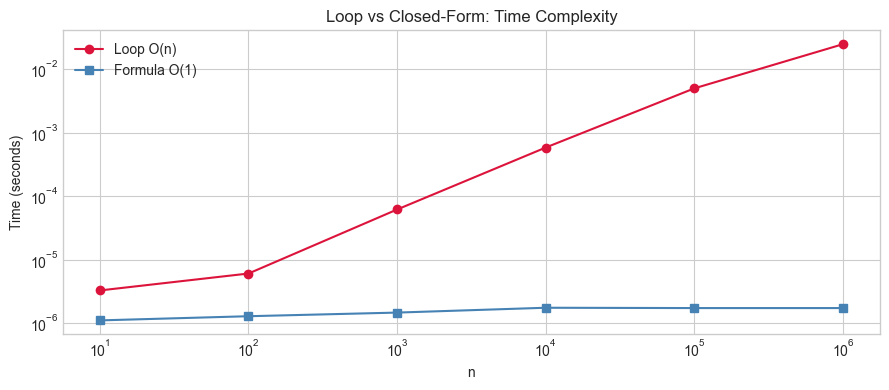
# --- Experiment 2: Figurate numbers generalize triangular numbers ---
# Hypothesis: square, pentagonal numbers follow the same recursive pattern
# Try changing: sides (3=triangular, 4=square, 5=pentagonal, 6=hexagonal)

SIDES = 5  # <-- modify this (try 3, 4, 5, 6)

def figurate(n, s):
    """Return nth s-gonal number."""
    return n * ((s - 2) * n - (s - 4)) // 2

ns = range(1, 15)
vals = [figurate(n, SIDES) for n in ns]

print(f"First 14 {SIDES}-gonal numbers: {vals}")
print(f"Differences: {[vals[i+1]-vals[i] for i in range(len(vals)-1)]}")
First 14 5-gonal numbers: [1, 5, 12, 22, 35, 51, 70, 92, 117, 145, 176, 210, 247, 287]
Differences: [4, 7, 10, 13, 16, 19, 22, 25, 28, 31, 34, 37, 40]
7. Exercises
Easy 1. Compute using both the loop and the Gauss formula. Verify they agree. (Expected: 1275)
Easy 2. Verify the sum-of-squares formula for by comparing to a brute-force loop.
Medium 1. Implement fibonacci(n) using the recursive Peano-style definition (base cases 0 and 1, recursive case ). Then implement a memoized version. Compare the number of function calls for each.
Medium 2. Prove (by induction, in code comments) that . Then verify it computationally for .
Hard. The Collatz conjecture says: for any , repeatedly applying (if even) or (if odd) eventually reaches 1. Implement this, measure the stopping time for all , and plot the distribution. No one has proved this conjecture.
8. Mini Project
# --- Mini Project: Pascal's Triangle ---
# Problem: Pascal's Triangle encodes the binomial coefficients C(n,k).
#          It also encodes triangular numbers, powers of 2, Fibonacci numbers,
#          and the Sierpinski gasket.
# Task: Build, display, and explore Pascal's Triangle up to row N.

import numpy as np
import matplotlib.pyplot as plt
plt.style.use('seaborn-v0_8-whitegrid')

def build_pascal(n_rows):
    """
    Build Pascal's triangle as a list of rows.

    Args:
        n_rows: int, number of rows

    Returns:
        list of lists of ints
    """
    # TODO: implement. Row 0 is [1], Row 1 is [1,1],
    # Row k[i] = Row k-1[i-1] + Row k-1[i] (with 0 padding)
    pass

N_ROWS = 12  # <-- try 16, 32, 64
triangle = build_pascal(N_ROWS)

if triangle is not None:
    # Print as text
    for i, row in enumerate(triangle):
        print(' '.join(f'{v:4d}' for v in row).center(80))

    # Visualize with modular coloring (Sierpinski pattern)
    # Color cell (i, j) by triangle[i][j] % MOD
    MOD = 2  # <-- try 3, 5, 7
    max_row = len(triangle)
    fig, ax = plt.subplots(figsize=(10, 8))
    for i, row in enumerate(triangle):
        for j, val in enumerate(row):
            color = 'black' if val % MOD == 0 else 'white'
            x = j - i / 2
            y = -i
            ax.scatter(x, y, color=color, s=200, marker='s', zorder=3)
    ax.set_aspect('equal')
    ax.axis('off')
    ax.set_title(f"Pascal's Triangle mod {MOD} (black = divisible by {MOD})")
    plt.tight_layout()
    plt.show()
9. Chapter Summary & Connections
The natural numbers are defined by the Peano axioms: a starting point (0) and a successor function. All arithmetic is built from these.
Mathematical induction is the natural numbers’ proof technique — it mirrors loop invariants in programming.
Closed-form summation formulas (Gauss, sum of squares) replace O(n) loops with O(1) computation.
Figurate numbers (triangular, square, pentagonal) are the natural numbers arranged in geometric patterns.
Forward connections:
Induction reappears in ch028 (Prime Numbers) as the basis for sieve algorithms — we reason over all naturals.
The successor structure underlies recursion in algorithms; this reappears in ch025 (Recursion and Mathematical Functions).
Modular coloring of Pascal’s triangle previews ch031 (Modular Arithmetic).
Backward connection:
This chapter grounds ch021’s abstract “ℕ” in a concrete computational definition.
Going deeper: Peano arithmetic is the formal system underlying most of classical mathematics. Gödel’s incompleteness theorems (1931) prove that Peano arithmetic cannot prove all true statements about natural numbers — look up “Gödel incompleteness” when you want a foundational shock.