Prerequisites: ch022 (Natural Numbers), ch021 (History of Numbers)
You will learn:
How integers extend naturals by introducing additive inverses
Signed integer representation in computers (two’s complement)
Integer division, floor division, and the division algorithm
Why integer overflow is a real danger and how Python handles it differently
Environment: Python 3.x, numpy, matplotlib
1. Concept
The integers extend the natural numbers by adding additive inverses: for every , there exists such that . This makes closed under subtraction — the operation that could not handle.
Integers are the mathematical home of:
Signed quantities (debt, temperature below zero, altitude below sea level)
The division algorithm (quotient and remainder)
Modular arithmetic (the subject of ch031)
Number theory (primes, GCDs, Diophantine equations)
Critical distinction: In Python, int is mathematically exact and arbitrarily large. In C, Java, and most compiled languages, int is a fixed-width binary type — it overflows. This difference has caused real-world bugs and security vulnerabilities.
Common misconception: “Integer division in Python works like in C.” It does not. Python’s // is floor division (rounds toward ); C’s / on integers truncates toward zero. They differ on negative numbers.
2. Intuition & Mental Models
Think of ℤ as a signed number line: ℕ is a ray from 0 rightward. ℤ extends that ray leftward to . The key new feature is symmetry around 0.
Two’s complement as a clock: Computer hardware stores integers in fixed-width binary. A 4-bit two’s complement register holds values . Adding 1 to 7 gives -8 — it wraps around like a clock. (This wrapping is modular arithmetic — see ch031.)
Division algorithm intuition: gives quotient 3 and remainder 2. Think of stacking 5-block towers from 17 blocks: you get 3 full towers with 2 left over.
(Recall from ch022: natural numbers are closed under addition and multiplication but not subtraction. Integers restore that closure.)
3. Visualization
# --- Visualization: Two's complement overflow and Python's arbitrary integers ---
import numpy as np
import matplotlib.pyplot as plt
plt.style.use('seaborn-v0_8-whitegrid')

fig, axes = plt.subplots(1, 2, figsize=(13, 5))

# --- Plot 1: Two's complement wrapping (8-bit signed: -128 to 127) ---
ax = axes[0]
BITS = 8
# Simulate 8-bit signed integers
vals = np.arange(0, 256, dtype=np.int32)
twos_comp = vals.copy()
twos_comp[twos_comp >= 128] -= 256  # map [128,255] to [-128,-1]

ax.plot(vals, twos_comp, color='steelblue', linewidth=2)
ax.axhline(0, color='gray', linewidth=0.5)
ax.axvline(127, color='crimson', linestyle='--', linewidth=1, label='Max positive (127)')
ax.axvline(128, color='darkorange', linestyle='--', linewidth=1, label='Overflow → -128')
ax.set_xlabel('Bit pattern (unsigned interpretation)')
ax.set_ylabel('Signed value')
ax.set_title("8-bit Two's Complement: Overflow Wraps Around")
ax.legend(fontsize=8)

# --- Plot 2: Python's arbitrary-precision vs C-like int64 ---
ax = axes[1]
ns = range(0, 70)
python_vals = [2**n for n in ns]  # exact
int64_max = 2**63 - 1
# Simulate int64 overflow (just mark where it would overflow)
safe_ns = [n for n in ns if 2**n <= int64_max]
overflow_ns = [n for n in ns if 2**n > int64_max]

ax.semilogy(safe_ns, [2**n for n in safe_ns], 'o-', color='steelblue',
            label='Safe in int64', markersize=3)
if overflow_ns:
    ax.axvline(min(overflow_ns), color='crimson', linestyle='--', linewidth=1.5,
               label=f'int64 overflows at 2^{min(overflow_ns)}')
ax.set_xlabel('n')
ax.set_ylabel('2^n (log scale)')
ax.set_title('Python int: Arbitrary Precision\n(No Overflow — Ever)')
ax.legend(fontsize=8)

plt.tight_layout()
plt.show()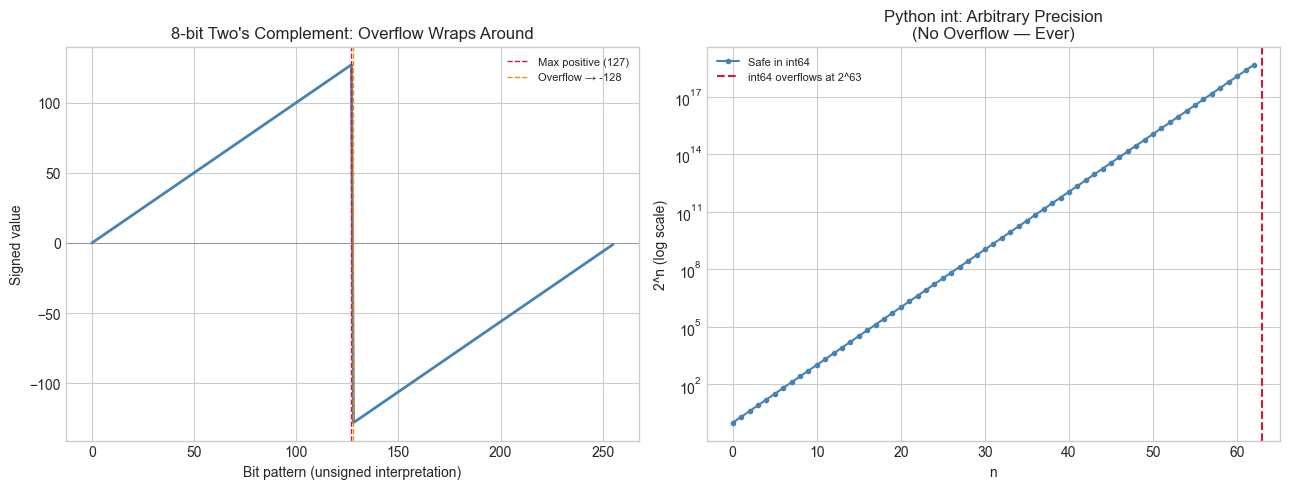
4. Mathematical Formulation
Definition:
The Division Algorithm: For any and with , there exist unique such that:
is the quotient:
is the remainder:
Example: :
Check: ✓
Two’s complement (n-bit): Value of bit string :
5. Python Implementation
# --- Implementation: Division algorithm, GCD, two's complement ---

def division_algorithm(a, b):
    """
    Compute quotient q and remainder r such that a = q*b + r, 0 <= r < b.

    Args:
        a: int (dividend)
        b: int (divisor, must be positive)

    Returns:
        (q, r): tuple of ints
    """
    assert b > 0, "Divisor must be positive"
    q = a // b   # Python floor division
    r = a % b    # Python modulo (always non-negative when b > 0)
    assert a == q * b + r, "Division algorithm invariant violated"
    return q, r


def gcd_euclidean(a, b):
    """
    Greatest common divisor via the Euclidean algorithm.
    Based on: gcd(a, b) = gcd(b, a mod b), with gcd(a, 0) = a.

    Args:
        a, b: non-negative ints

    Returns:
        int: gcd(a, b)
    """
    while b:
        a, b = b, a % b
    return a


def to_twos_complement(n, bits=8):
    """
    Return two's complement bit representation of integer n in `bits` bits.

    Args:
        n: int in range [-2^(bits-1), 2^(bits-1) - 1]
        bits: int, word width

    Returns:
        str: binary string of length `bits`
    """
    if n < 0:
        n = (1 << bits) + n  # add 2^bits to negative number
    return format(n, f'0{bits}b')


# Tests
import math

print("Division algorithm:")
for a, b in [(17, 5), (-13, 5), (0, 7), (100, 3)]:
    q, r = division_algorithm(a, b)
    print(f"  {a} = {q} × {b} + {r}")

print("\nGCD (Euclidean):")
for a, b in [(48, 18), (100, 75), (17, 13), (2024, 1984)]:
    g = gcd_euclidean(a, b)
    assert g == math.gcd(a, b)
    print(f"  gcd({a}, {b}) = {g}  ✓")

print("\nTwo's complement (8-bit):")
for n in [0, 1, 127, -1, -128, -13]:
    print(f"  {n:5d} → {to_twos_complement(n)}")

print("\nPython arbitrary precision:")
big = 2 ** 1000
print(f"  2^1000 has {len(str(big))} decimal digits")
Division algorithm:
17 = 3 × 5 + 2
-13 = -3 × 5 + 2
0 = 0 × 7 + 0
100 = 33 × 3 + 1
GCD (Euclidean):
gcd(48, 18) = 6 ✓
gcd(100, 75) = 25 ✓
gcd(17, 13) = 1 ✓
gcd(2024, 1984) = 8 ✓
Two's complement (8-bit):
0 → 00000000
1 → 00000001
127 → 01111111
-1 → 11111111
-128 → 10000000
-13 → 11110011
Python arbitrary precision:
2^1000 has 302 decimal digits
6. Experiments
# --- Experiment 1: Python // vs C-style truncation for negative numbers ---
# Hypothesis: Python floor division and C truncation diverge exactly when a/b is negative
# Try changing: a and b

import math

print("Python // (floor division) vs C-style truncation:")
print(f"{'a':>6} {'b':>4}  {'Python a//b':>12}  {'C-style trunc(a/b)':>20}  {'Same?':>6}")
print('-' * 60)

test_pairs = [(7, 3), (-7, 3), (7, -3), (-7, -3),
              (10, 4), (-10, 4), (10, -4), (-10, -4)]

for a, b in test_pairs:
    python_result = a // b
    c_result = int(a / b)  # C-style truncation toward zero
    same = "✓" if python_result == c_result else "✗ DIFFER"
    print(f"{a:>6} {b:>4}  {python_result:>12}  {c_result:>20}  {same:>6}")
Python // (floor division) vs C-style truncation:
a b Python a//b C-style trunc(a/b) Same?
------------------------------------------------------------
7 3 2 2 ✓
-7 3 -3 -2 ✗ DIFFER
7 -3 -3 -2 ✗ DIFFER
-7 -3 2 2 ✓
10 4 2 2 ✓
-10 4 -3 -2 ✗ DIFFER
10 -4 -3 -2 ✗ DIFFER
-10 -4 2 2 ✓
# --- Experiment 2: Euclidean algorithm step count ---
# Hypothesis: inputs near consecutive Fibonacci numbers require the most steps
# Try changing: N (search space)
import matplotlib.pyplot as plt
plt.style.use('seaborn-v0_8-whitegrid')

N = 50  # <-- modify this

def gcd_steps(a, b):
    """Count steps in Euclidean algorithm."""
    steps = 0
    while b:
        a, b = b, a % b
        steps += 1
    return steps

# Build heatmap of step counts
counts = np.zeros((N, N), dtype=int)
for a in range(1, N + 1):
    for b in range(1, N + 1):
        counts[a-1, b-1] = gcd_steps(a, b)

fig, ax = plt.subplots(figsize=(7, 6))
im = ax.imshow(counts, origin='lower', cmap='viridis',
               extent=[1, N, 1, N], aspect='auto')
plt.colorbar(im, ax=ax, label='Steps')
ax.set_xlabel('b')
ax.set_ylabel('a')
ax.set_title(f'Euclidean Algorithm Steps for a,b in [1,{N}]')
plt.tight_layout()
plt.show()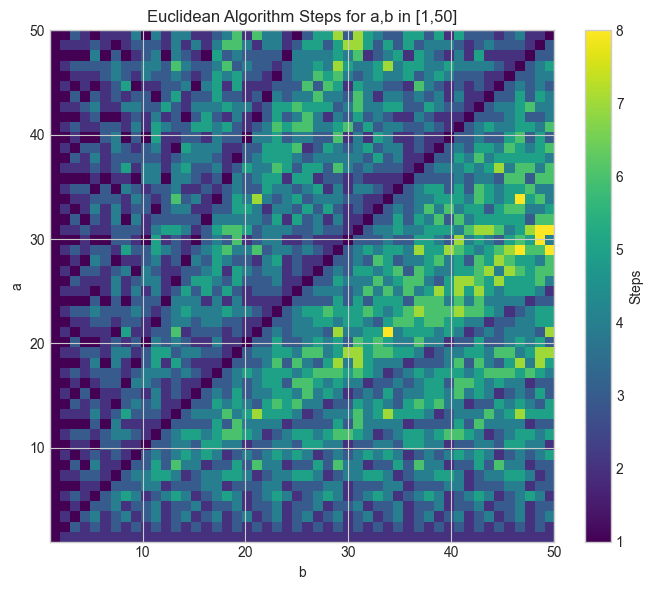
7. Exercises
Easy 1. Compute -17 // 5 and -17 % 5 in Python, then verify the division algorithm identity: -17 = q*5 + r. (Expected: q=-4, r=3)
Easy 2. Write a function sign(n) that returns -1, 0, or 1 using only integer arithmetic (no conditionals, if possible). (Hint: think about -n // (abs(n) + 1))
Medium 1. The Extended Euclidean Algorithm finds integers such that . Implement it. Test with (should give gcd=5).
Medium 2. Explain and demonstrate why numpy’s integer arrays overflow while Python’s int does not. Write code that creates a numpy int8 array, adds to it until it overflows, and plots the wrapped values.
Hard. The Ariane 5 rocket exploded in 1996 due to an integer overflow (a 64-bit float was converted to a 16-bit integer). Simulate this failure: generate a float that fits in float64 but overflows int16, and demonstrate what a real system might compute incorrectly. Write a safe conversion function that raises an error instead of overflowing.
8. Mini Project
# --- Mini Project: RSA Key Generation (Simplified) ---
# Problem: RSA encryption's security rests entirely on integer arithmetic.
#          Even a toy version requires GCD, modular inverse, and prime testing.
# Task: Implement mini-RSA with small primes and encrypt/decrypt a message.

def is_prime(n):
    """Trial-division primality test."""
    if n < 2: return False
    for i in range(2, int(n**0.5) + 1):
        if n % i == 0: return False
    return True

def mod_inverse(e, phi):
    """
    Compute the modular inverse of e mod phi (i.e., d such that e*d ≡ 1 mod phi).
    Uses extended Euclidean algorithm.

    Args:
        e: int
        phi: int

    Returns:
        int: d such that (e * d) % phi == 1
    """
    # TODO: implement using extended Euclidean algorithm
    pass

# Choose small primes
p, q = 61, 53  # In real RSA, these would be 2048-bit primes
assert is_prime(p) and is_prime(q)

n = p * q                    # modulus
phi = (p - 1) * (q - 1)      # Euler's totient
e = 17                        # public exponent (must be coprime to phi)

d = mod_inverse(e, phi)

if d is not None:
    # Encrypt: c = m^e mod n
    # Decrypt: m = c^d mod n
    message = 42
    ciphertext = pow(message, e, n)
    decrypted = pow(ciphertext, d, n)

    print(f"p={p}, q={q}, n={n}, φ(n)={phi}")
    print(f"Public key:  (e={e}, n={n})")
    print(f"Private key: (d={d}, n={n})")
    print(f"Message:     {message}")
    print(f"Ciphertext:  {ciphertext}")
    print(f"Decrypted:   {decrypted}")
    print(f"Round-trip:  {'✓' if decrypted == message else '✗'}")
9. Chapter Summary & Connections
Integers extend ℕ with additive inverses, closing the set under subtraction.
The division algorithm guarantees unique quotient and remainder for any integer division — this is the foundation of all modular arithmetic.
Python’s
intis arbitrary-precision; numpy and C integers are fixed-width and overflow. The difference matters in every numerical application.The Euclidean algorithm computes GCDs in steps — one of the oldest non-trivial algorithms.
Forward connections:
The division algorithm is the basis of ch031 (Modular Arithmetic) —
a mod bis exactly the remainder .GCD and modular inverse are the core of RSA encryption, previewed here and revisited computationally in ch033 (Applications of Modulo in Programming).
Two’s complement overflow directly causes the floating-point issues examined in ch037 (Precision and Floating Point Errors).
Backward connection:
The Peano successor function from ch022 implicitly defines addition; the division algorithm is a derived property of that construction.
Going deeper: The Extended Euclidean Algorithm and Bezout’s identity underpin all of modern public-key cryptography. Chapter 5 of “Introduction to Algorithms” (CLRS) covers integer algorithms rigorously.