Prerequisites: ch023 (Integers), ch021 (History of Numbers)
You will learn:
How rationals extend integers by closing under division
Exact rational arithmetic with Python’s
FractionclassCantor’s argument that rationals are countably infinite
Density of ℚ in ℝ — and its surprising limitation
Environment: Python 3.x, numpy, matplotlib, fractions
1. Concept
Rational numbers are all numbers expressible as where and . They were invented to solve the problem that integers cannot represent the result of most divisions.
Key properties:
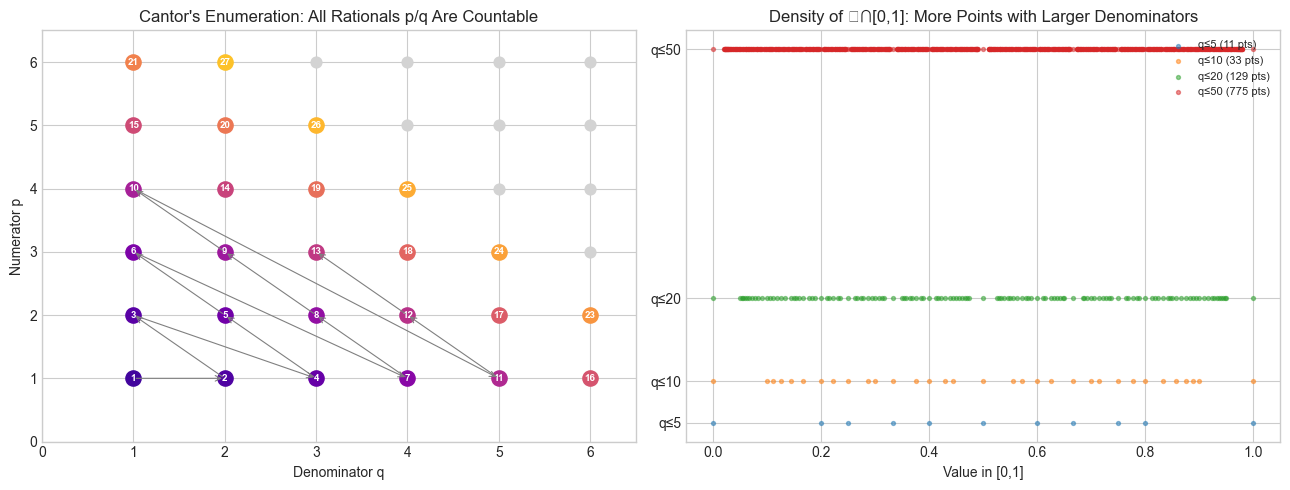
ℚ is dense: between any two distinct rationals, there is another rational
ℚ is countably infinite: despite density, we can list all rationals one-by-one
ℚ has gaps: most real numbers (including √2, π, e) are not rational
Common misconception: “Since rationals are dense, they fill the number line.” They do not. The gaps between rationals are filled by irrationals — and there are vastly more irrationals than rationals.
Practical consequence: Computers using rational arithmetic (Fraction) are exact but slow. Computers using floating-point are fast but approximate. Every numerical system makes this tradeoff.
2. Intuition & Mental Models
Think of rationals as exact measurements: If you have a measuring tape with only integer markings, you cannot measure 1.5 meters. Add rational numbers and every measurement expressible as a fraction becomes representable.
Cantor’s diagonalization (visual): Rationals can be arranged in a 2D grid (rows = numerators, columns = denominators) and listed by traversing diagonals. This proves they are countable — surprsingly, despite being dense.
Density without coverage: Imagine painting only the rational points on a number line. You’d paint an infinite number of points, but the total “length” you paint is zero. The painted points are dense but measure-zero — they cover no interval.
(Recall from ch021: ℚ is the level where ÷ achieves closure — the operation that ℤ couldn’t close.)
3. Visualization
# --- Visualization: Cantor enumeration of rationals and density on [0,1] ---
import numpy as np
import matplotlib.pyplot as plt
from fractions import Fraction
plt.style.use('seaborn-v0_8-whitegrid')

fig, axes = plt.subplots(1, 2, figsize=(13, 5))

# Plot 1: Cantor's diagonal traversal of the rational grid
ax = axes[0]
N_MAX = 6
order = []
diagonal = 2
while len(order) < 25:
    for num in range(1, diagonal):
        den = diagonal - num
        if den > 0:
            order.append((num, den))
    diagonal += 1

# Plot grid
for p in range(1, N_MAX + 1):
    for q in range(1, N_MAX + 1):
        ax.scatter(q, p, color='lightgray', s=60, zorder=1)

# Highlight diagonal traversal
colors = plt.cm.plasma(np.linspace(0.1, 0.9, len(order)))
for i, (p, q) in enumerate(order):
    if p <= N_MAX and q <= N_MAX:
        ax.scatter(q, p, color=colors[i], s=120, zorder=3)
        ax.annotate(str(i+1), (q, p), ha='center', va='center',
                    fontsize=7, color='white', fontweight='bold')

# Draw diagonal arrows
for i in range(min(len(order)-1, 12)):
    p1, q1 = order[i]
    p2, q2 = order[i+1]
    if p1 <= N_MAX and q1 <= N_MAX and p2 <= N_MAX and q2 <= N_MAX:
        ax.annotate('', xy=(q2, p2), xytext=(q1, p1),
                    arrowprops=dict(arrowstyle='->', color='gray', lw=0.8))

ax.set_xlabel('Denominator q')
ax.set_ylabel('Numerator p')
ax.set_title("Cantor's Enumeration: All Rationals p/q Are Countable")
ax.set_xlim(0, N_MAX + 0.5)
ax.set_ylim(0, N_MAX + 0.5)

# Plot 2: Density of rationals on [0,1]
ax = axes[1]
for max_denom in [5, 10, 20, 50]:
    rats = set()
    for q in range(1, max_denom + 1):
        for p in range(0, q + 1):
            rats.add(float(Fraction(p, q)))
    y_level = max_denom / 10
    ax.scatter(sorted(rats), [y_level]*len(rats),
               s=8, alpha=0.5, label=f'q≤{max_denom} ({len(rats)} pts)')

ax.set_xlabel('Value in [0,1]')
ax.set_yticks([0.5, 1, 2, 5])
ax.set_yticklabels(['q≤5', 'q≤10', 'q≤20', 'q≤50'])
ax.set_title('Density of ℚ∩[0,1]: More Points with Larger Denominators')
ax.legend(fontsize=8, loc='upper right')

plt.tight_layout()
plt.show()
C:\Users\user\AppData\Local\Temp\ipykernel_14064\1760945774.py:65: UserWarning: Glyph 8474 (\N{DOUBLE-STRUCK CAPITAL Q}) missing from font(s) Arial.
plt.tight_layout()
c:\Users\user\OneDrive\Documents\book\.venv\Lib\site-packages\IPython\core\pylabtools.py:170: UserWarning: Glyph 8474 (\N{DOUBLE-STRUCK CAPITAL Q}) missing from font(s) Arial.
fig.canvas.print_figure(bytes_io, **kw)
4. Mathematical Formulation
Definition:
Two fractions and represent the same rational iff . In lowest terms: divide both by .
Arithmetic rules:
Mediant: The mediant of and is — lies strictly between them if .
Density: For any with : and .
5. Python Implementation
# --- Implementation: Rational arithmetic from scratch, then via Fraction ---
from fractions import Fraction
import math

class Rational:
    """
    Exact rational number p/q in reduced form.

    Invariant: q > 0, gcd(|p|, q) = 1
    """

    def __init__(self, p, q):
        assert q != 0, "Denominator cannot be zero"
        if q < 0:
            p, q = -p, -q  # keep denominator positive
        g = math.gcd(abs(p), q)
        self.p = p // g
        self.q = q // g

    def __add__(self, other):
        return Rational(self.p * other.q + other.p * self.q,
                        self.q * other.q)

    def __mul__(self, other):
        return Rational(self.p * other.p, self.q * other.q)

    def __sub__(self, other):
        return Rational(self.p * other.q - other.p * self.q,
                        self.q * other.q)

    def __truediv__(self, other):
        return Rational(self.p * other.q, self.q * other.p)

    def __eq__(self, other):
        return self.p == other.p and self.q == other.q

    def __float__(self):
        return self.p / self.q

    def __repr__(self):
        return f"{self.p}/{self.q}" if self.q != 1 else str(self.p)


# Tests
a = Rational(1, 3)
b = Rational(1, 6)
print(f"{a} + {b} = {a + b}   (expected: 1/2)")
print(f"{a} * {b} = {a * b}   (expected: 1/18)")
print(f"{a} / {b} = {a / b}   (expected: 2)")

# Cross-validate with Python's Fraction
fa, fb = Fraction(1,3), Fraction(1,6)
assert float(a + b) == float(fa + fb)
assert float(a * b) == float(fa * fb)
print("\nAll Rational operations match Fraction.  ✓")

# Demonstrate density
def mediant(p, q, r, s):
    """Mediant of p/q and r/s."""
    return Fraction(p + r, q + s)

print("\nMediant sequence between 1/3 and 1/2:")
lo, hi = Fraction(1, 3), Fraction(1, 2)
for _ in range(5):
    m = mediant(lo.numerator, lo.denominator, hi.numerator, hi.denominator)
    print(f"  mediant({lo}, {hi}) = {m}")
    lo = m
1/3 + 1/6 = 1/2 (expected: 1/2)
1/3 * 1/6 = 1/18 (expected: 1/18)
1/3 / 1/6 = 2 (expected: 2)
All Rational operations match Fraction. ✓
Mediant sequence between 1/3 and 1/2:
mediant(1/3, 1/2) = 2/5
mediant(2/5, 1/2) = 3/7
mediant(3/7, 1/2) = 4/9
mediant(4/9, 1/2) = 5/11
mediant(5/11, 1/2) = 6/13
6. Experiments
# --- Experiment 1: Rational vs float accumulated error ---
# Hypothesis: summing 1/n in Fraction accumulates no rounding error; float does
# Try changing: N

from fractions import Fraction

N = 200  # <-- modify this
errors = []
running_fraction = Fraction(0)
running_float = 0.0

for n in range(1, N + 1):
    running_fraction += Fraction(1, n)
    running_float += 1.0 / n
    errors.append(abs(float(running_fraction) - running_float))

import matplotlib.pyplot as plt
plt.style.use('seaborn-v0_8-whitegrid')
fig, ax = plt.subplots(figsize=(9, 4))
ax.semilogy(range(1, N+1), errors, color='crimson')
ax.set_xlabel('n')
ax.set_ylabel('|Fraction - float| (log scale)')
ax.set_title(f'Accumulated Rounding Error in Σ 1/k, k=1..N (N={N})')
plt.tight_layout()
plt.show()

print(f"Final error: {errors[-1]:.3e}")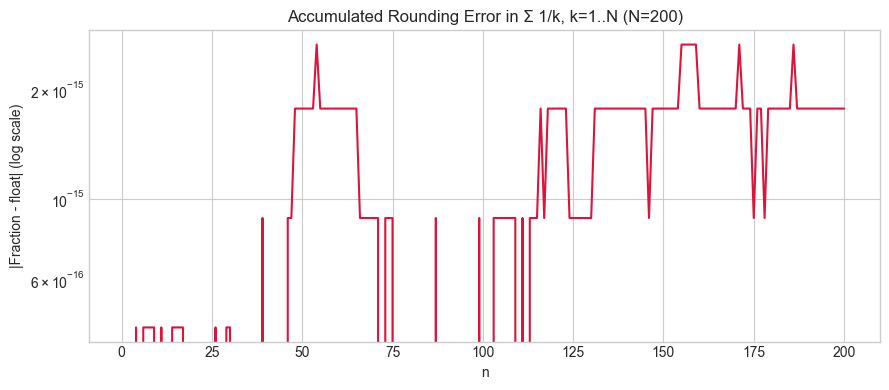
Final error: 1.776e-15
# --- Experiment 2: Farey sequences and their spacing ---
# Hypothesis: consecutive fractions in a Farey sequence F_n satisfy |p2/q2 - p1/q1| = 1/(q1*q2)
# Try changing: N_FAREY

from fractions import Fraction

N_FAREY = 7  # <-- modify this

def farey(n):
    """Generate Farey sequence F_n: all fractions p/q in [0,1] with q <= n."""
    return sorted(set(Fraction(p, q) for q in range(1, n+1)
                                     for p in range(0, q+1)))

F = farey(N_FAREY)
print(f"F_{N_FAREY}: {F[:10]}...  ({len(F)} terms)")

# Verify the neighbor property: for consecutive a/b, c/d: c*b - a*d = 1
violations = 0
for i in range(len(F) - 1):
    a, b = F[i].numerator, F[i].denominator
    c, d = F[i+1].numerator, F[i+1].denominator
    if c * b - a * d != 1:
        violations += 1

print(f"Farey neighbor property violations: {violations} (expected 0)")
F_7: [Fraction(0, 1), Fraction(1, 7), Fraction(1, 6), Fraction(1, 5), Fraction(1, 4), Fraction(2, 7), Fraction(1, 3), Fraction(2, 5), Fraction(3, 7), Fraction(1, 2)]... (19 terms)
Farey neighbor property violations: 0 (expected 0)
7. Exercises
Easy 1. Reduce the fraction 144/180 to lowest terms by hand and verify with Fraction(144, 180). (Expected: 4/5)
Easy 2. Implement a function is_between(a, b, c) that returns True if rational b is strictly between rationals a and c, using Fraction for exact comparison.
Medium 1. Implement a generator between(a, b) (where a, b are Fraction objects) that yields an infinite sequence of rationals, each strictly between a and b, with denominators growing no faster than . (Hint: use the mediant)
Medium 2. The harmonic series diverges. Using Fraction, compute exactly and find the smallest such that , , and .
Hard. Implement the Stern-Brocot tree as a binary tree data structure where each node contains a rational number and its left/right children are defined by mediants. Verify that every positive rational appears exactly once in the tree by searching for Fraction(p, q) for all .
8. Mini Project
# --- Mini Project: Exact Rational Calculator ---
# Problem: Floating-point arithmetic cannot be trusted for financial calculations
#          (e.g., splitting bills, currency conversion).
# Task: Build an exact calculator using Fraction that shows the float error
#       for each operation.

from fractions import Fraction

def rational_calc_demo(operations):
    """
    Run a sequence of arithmetic operations in both float and Fraction mode.
    Print the accumulated difference.

    Args:
        operations: list of (op_str, value) where op_str is '+', '-', '*', '/'
                    and value is a float
    """
    exact = Fraction(0)
    approx = 0.0

    ops = {'+': lambda a, b: a + b,
           '-': lambda a, b: a - b,
           '*': lambda a, b: a * b,
           '/': lambda a, b: a / b}

    print(f"{'Step':<6} {'Op':>3} {'Value':>10}  {'Exact':>20}  {'Float':>22}  {'Error':>12}")
    print('-' * 80)

    for step, (op_str, val) in enumerate(operations):
        fval = Fraction(val).limit_denominator(10**9)
        exact = ops[op_str](exact, fval)
        approx = ops[op_str](approx, val)
        error = abs(float(exact) - approx)
        print(f"{step+1:<6} {op_str:>3} {val:>10.6f}  {str(exact):>20}  {approx:>22.15f}  {error:>12.3e}")

    print(f"\nFinal exact: {float(exact):.15f}")
    print(f"Final float: {approx:.15f}")


# Simulate splitting a restaurant bill
operations = [
    ('+', 47.99),   # item 1
    ('+', 23.50),   # item 2
    ('+', 8.99),    # item 3
    ('*', 1.0875),  # tax 8.75%
    ('/', 3.0),     # split three ways
    ('*', 1.18),    # add 18% tip
]

rational_calc_demo(operations)
Step Op Value Exact Float Error
--------------------------------------------------------------------------------
1 + 47.990000 4799/100 47.990000000000002 0.000e+00
2 + 23.500000 7149/100 71.490000000000009 1.421e-14
3 + 8.990000 2012/25 80.480000000000004 0.000e+00
4 * 1.087500 43761/500 87.521999999999991 1.421e-14
5 / 3.000000 14587/500 29.173999999999996 3.553e-15
6 * 1.180000 860633/25000 34.425319999999992 7.105e-15
Final exact: 34.425319999999999
Final float: 34.425319999999992
9. Chapter Summary & Connections
Rationals are fractions , always reducible to a canonical lowest-terms form via GCD.
ℚ is dense: between any two rationals lies another — yet ℚ has measure zero in ℝ.
ℚ is countably infinite (Cantor’s diagonal argument); ℝ is uncountably infinite — most reals are irrational.
Python’s
Fractionclass provides exact rational arithmetic at the cost of performance.
Forward connections:
The gaps in ℚ lead directly to ch025 — Irrational Numbers, where we prove √2 ∉ ℚ.
Exact vs approximate arithmetic is central to ch037 — Precision and Floating Point Errors.
The Farey sequence and mediants reappear in continued fractions and rational approximation of irrationals.
Backward connection:
The GCD operation from ch023 (Integers) is the reduction mechanism that puts every rational in canonical form.
Going deeper: The p-adic numbers are an alternative extension of ℚ that completes it differently than ℝ does — look up “p-adic numbers” for a radically different direction from the same starting point.