Prerequisites: ch024 (Rational Numbers), ch023 (Integers)
You will learn:
The proof that √2 is irrational — one of mathematics’ most important proofs
Why irrationals cannot be stored exactly in any finite representation
Continued fractions as the best rational approximation of irrationals
The ubiquity of irrationals in geometry and algorithms
Environment: Python 3.x, numpy, matplotlib, fractions
1. Concept
An irrational number is a real number that cannot be written as for any integers . The first proven irrational was , discovered by the Pythagoreans around 500 BCE — a result so disturbing to their worldview that, according to legend, the discoverer was drowned.
Irrationals include:
(square roots of non-perfect-squares)
(ratio of circle circumference to diameter)
(base of natural logarithm)
(golden ratio)
Common misconception: “Irrationals are just numbers we haven’t found the fraction for yet.” Wrong. The proof that is irrational shows it is impossible to express it as a fraction — not merely unknown.
Practical consequence: No computer can store an irrational exactly. Every floating-point number is rational. When you write math.pi, you get a rational approximation with 15–17 significant digits.
2. Intuition & Mental Models
The diagonal of a unit square: A square with side 1 has diagonal . You can construct this length with a ruler and compass — you can draw it, measure it, hold it in your hand. But you cannot write it as a fraction. Geometry produces numbers that arithmetic cannot name.
Non-repeating, non-terminating decimals: Every rational has a decimal expansion that either terminates or repeats (e.g., , ). Irrationals never terminate and never repeat. This is an if-and-only-if characterization.
Continued fractions as best rational approximations: The fraction is a famous approximation of . But is far better. Continued fractions give the optimal sequence of rational approximations to any irrational — no fraction with a smaller denominator is closer.
(Recall from ch024: ℚ is dense in ℝ — but despite this density, most real numbers are irrational.)
3. Visualization
# --- Visualization: Rational approximations converging to √2 and π ---
import numpy as np
import matplotlib.pyplot as plt
from fractions import Fraction
plt.style.use('seaborn-v0_8-whitegrid')

def continued_fraction_convergents(coeffs):
    """
    Compute convergents of a continued fraction [a0; a1, a2, ...].

    Args:
        coeffs: list of int continued fraction coefficients

    Returns:
        list of Fraction: convergents p_k/q_k
    """
    convergents = []
    p_prev, p_curr = 1, coeffs[0]
    q_prev, q_curr = 0, 1
    convergents.append(Fraction(p_curr, q_curr))

    for a in coeffs[1:]:
        p_prev, p_curr = p_curr, a * p_curr + p_prev
        q_prev, q_curr = q_curr, a * q_curr + q_prev
        convergents.append(Fraction(p_curr, q_curr))

    return convergents

# √2 = [1; 2, 2, 2, 2, ...]
sqrt2_coeffs = [1] + [2] * 15
sqrt2_convergents = continued_fraction_convergents(sqrt2_coeffs)

# π ≈ [3; 7, 15, 1, 292, 1, 1, 1, 2, ...]
pi_coeffs = [3, 7, 15, 1, 292, 1, 1, 1, 2, 1, 3, 1, 14]
pi_convergents = continued_fraction_convergents(pi_coeffs)

fig, axes = plt.subplots(1, 2, figsize=(13, 5))

for ax, convergents, true_val, name, color in [
    (axes[0], sqrt2_convergents, np.sqrt(2), '√2', 'steelblue'),
    (axes[1], pi_convergents,   np.pi,      'π',  'crimson')
]:
    errors = [abs(float(c) - true_val) for c in convergents]
    denoms = [c.denominator for c in convergents]

    ax.semilogy(range(len(errors)), errors, 'o-', color=color, linewidth=2)
    for i, (c, e) in enumerate(zip(convergents, errors)):
        if i < 8:
            ax.annotate(f'{c}', (i, e), textcoords='offset points',
                        xytext=(5, 5), fontsize=7, color='gray')

    ax.axhline(1e-15, color='gray', linestyle=':', linewidth=1,
               label='float64 precision limit')
    ax.set_xlabel('Convergent index k')
    ax.set_ylabel(f'|convergent - {name}|')
    ax.set_title(f'Continued Fraction Convergents to {name}')
    ax.legend(fontsize=8)

plt.tight_layout()
plt.show()

print("Best approximations to π:")
for c in pi_convergents[:6]:
    print(f"  {c} = {float(c):.10f}  (error: {abs(float(c)-np.pi):.2e})")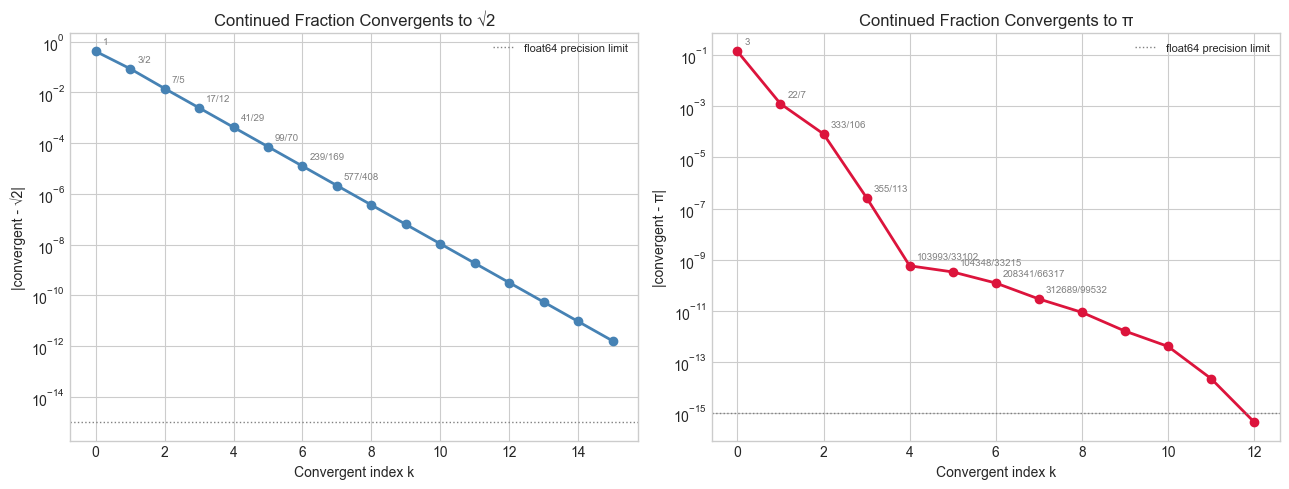
Best approximations to π:
  3 = 3.0000000000  (error: 1.42e-01)
  22/7 = 3.1428571429  (error: 1.26e-03)
  333/106 = 3.1415094340  (error: 8.32e-05)
  355/113 = 3.1415929204  (error: 2.67e-07)
  103993/33102 = 3.1415926530  (error: 5.78e-10)
  104348/33215 = 3.1415926539  (error: 3.32e-10)
4. Mathematical Formulation
Proof that √2 is irrational (proof by contradiction):
Assume in lowest terms (so ).
Then , so .
This means is even, so is even. Write .
Then , so , so is even.
But then both and are even — contradicting .
Continued fraction representation: Any real has a continued fraction expansion:
denoted . is rational iff this expansion is finite. — the simplest infinite continued fraction.
Best approximation theorem: The convergents of the continued fraction of satisfy: no fraction with is closer to than .
5. Python Implementation
# --- Implementation: Continued fraction expansion and irrationality test ---
import math
from fractions import Fraction

def to_continued_fraction(x, max_terms=20, tol=1e-10):
    """
    Compute the continued fraction expansion of float x.

    Args:
        x: float
        max_terms: int, maximum number of coefficients
        tol: float, stop when fractional part is smaller than this

    Returns:
        list of int: continued fraction coefficients [a0, a1, a2, ...]
    """
    coeffs = []
    for _ in range(max_terms):
        a = int(x)         # floor
        coeffs.append(a)
        frac = x - a       # fractional part
        if frac < tol:
            break
        x = 1.0 / frac     # reciprocal of fractional part
    return coeffs


def is_likely_rational(x, max_denom=10000):
    """
    Heuristic: check if x is 'close enough' to a rational with small denominator.

    Args:
        x: float
        max_denom: int

    Returns:
        Fraction or None
    """
    f = Fraction(x).limit_denominator(max_denom)
    if abs(float(f) - x) < 1e-10:
        return f
    return None


print("Continued fraction expansions:")
test_vals = [
    (math.sqrt(2), '√2'),
    (math.pi, 'π'),
    (math.e, 'e'),
    ((1 + math.sqrt(5)) / 2, 'φ (golden ratio)'),
    (22/7, '22/7'),
    (355/113, '355/113'),
]
for val, name in test_vals:
    cf = to_continued_fraction(val, max_terms=10)
    rat = is_likely_rational(val)
    print(f"  {name:20s}: [{'; '.join(map(str, cf[:6]))}...]  rational? {rat}")
Continued fraction expansions:
√2 : [1; 2; 2; 2; 2; 2...] rational? None
π : [3; 7; 15; 1; 292; 1...] rational? None
e : [2; 1; 2; 1; 1; 4...] rational? None
φ (golden ratio) : [1; 1; 1; 1; 1; 1...] rational? None
22/7 : [3; 7...] rational? 22/7
355/113 : [3; 7; 16...] rational? 355/113
6. Experiments
# --- Experiment 1: The golden ratio has the 'worst' rational approximations ---
# Hypothesis: φ = [1;1,1,1,...] — all 1s — converges slowest to irrational
# Try changing: TARGET to other irrationals and compare convergence rate

import numpy as np
import matplotlib.pyplot as plt
plt.style.use('seaborn-v0_8-whitegrid')

phi = (1 + np.sqrt(5)) / 2  # golden ratio
TARGET = phi  # <-- try np.sqrt(2), np.pi, np.e

cf_coeffs = to_continued_fraction(TARGET, max_terms=20)
convs = continued_fraction_convergents(cf_coeffs)
errors = [abs(float(c) - TARGET) for c in convs]

fig, ax = plt.subplots(figsize=(9, 4))
ax.semilogy(errors, 'o-', color='purple')
ax.set_xlabel('Convergent index')
ax.set_ylabel('Approximation error (log scale)')
ax.set_title(f'Convergence of continued fraction to {TARGET:.6f}')
plt.tight_layout()
plt.show()

print(f"CF coefficients: {cf_coeffs}")
print("(All 1s = golden ratio — slowest possible convergence)")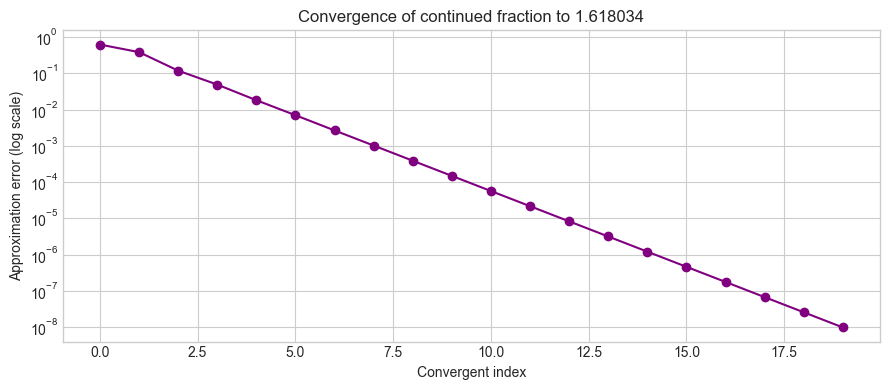
CF coefficients: [1, 1, 1, 1, 1, 1, 1, 1, 1, 1, 1, 1, 1, 1, 1, 1, 1, 1, 1, 1]
(All 1s = golden ratio — slowest possible convergence)
# --- Experiment 2: Verify √n is irrational iff n is not a perfect square ---
# Hypothesis: for non-perfect-square n, continued fraction of √n is periodic
# Try changing: N_MAX

N_MAX = 20  # <-- modify this

import math
print(f"{'n':>4}  {'Is perfect square?':>20}  {'CF coefficients':>40}")
print('-' * 70)
for n in range(2, N_MAX + 1):
    root = math.sqrt(n)
    is_perf = int(root) ** 2 == n
    cf = to_continued_fraction(root, max_terms=12)
    print(f"{n:>4}  {'Yes' if is_perf else 'No':>20}  {str(cf[:10]):>40}")
n Is perfect square? CF coefficients
----------------------------------------------------------------------
2 No [1, 2, 2, 2, 2, 2, 2, 2, 2, 2]
3 No [1, 1, 2, 1, 2, 1, 2, 1, 2, 1]
4 Yes [2]
5 No [2, 4, 4, 4, 4, 4, 4, 4, 4, 4]
6 No [2, 2, 4, 2, 4, 2, 4, 2, 4, 2]
7 No [2, 1, 1, 1, 4, 1, 1, 1, 4, 1]
8 No [2, 1, 4, 1, 4, 1, 4, 1, 4, 1]
9 Yes [3]
10 No [3, 6, 6, 6, 6, 6, 6, 6, 6, 6]
11 No [3, 3, 6, 3, 6, 3, 6, 3, 6, 3]
12 No [3, 2, 6, 2, 6, 2, 6, 2, 6, 2]
13 No [3, 1, 1, 1, 1, 6, 1, 1, 1, 1]
14 No [3, 1, 2, 1, 6, 1, 2, 1, 6, 1]
15 No [3, 1, 6, 1, 6, 1, 6, 1, 6, 1]
16 Yes [4]
17 No [4, 8, 8, 8, 8, 8, 8, 8, 8, 7]
18 No [4, 4, 8, 4, 8, 4, 8, 4, 8, 4]
19 No [4, 2, 1, 3, 1, 2, 8, 2, 1, 3]
20 No [4, 2, 8, 2, 8, 2, 8, 2, 8, 2]
7. Exercises
Easy 1. Use the same proof structure as the √2 proof to show that √3 is irrational. Write the steps as Python comments alongside numeric verification.
Easy 2. Compute the first 10 convergents of the golden ratio and verify they are consecutive Fibonacci ratios .
Medium 1. Implement a function decimal_expansion(numerator, denominator, n_digits) that computes the decimal expansion of p/q and detects the repeating cycle. Verify: 1/7 has period 6, 1/13 has period 6.
Medium 2. Find the best rational approximation to with denominator ≤ 1000 using continued fractions. How many correct decimal digits does it have?
Hard. Liouville’s theorem states that algebraic irrationals (like √2) cannot be approximated too well by rationals: for some constant depending on . Design a computational experiment that demonstrates this bound is sharp for √2 by checking all convergents up to denominator 106.
8. Mini Project
# --- Mini Project: π Approximation Benchmark ---
# Problem: Multiple historical formulas for π converge at different rates.
#          Which is best per computation unit?
# Task: Implement and benchmark 3 algorithms, plot their convergence.

import math
import numpy as np
import matplotlib.pyplot as plt
plt.style.use('seaborn-v0_8-whitegrid')

def leibniz_pi(n_terms):
    """Leibniz formula: π/4 = 1 - 1/3 + 1/5 - 1/7 + ..."""
    # TODO: implement. Returns approximation of π after n_terms.
    pass

def nilakantha_pi(n_terms):
    """Nilakantha series: π = 3 + 4/(2·3·4) - 4/(4·5·6) + ..."""
    # TODO: implement.
    pass

def wallis_pi(n_terms):
    """Wallis product: π/2 = (2/1)(2/3)(4/3)(4/5)(6/5)(6/7)..."""
    # TODO: implement.
    pass

N_TERMS = 1000
ns = range(1, N_TERMS + 1)

methods = [
    ('Leibniz', leibniz_pi, 'steelblue'),
    ('Nilakantha', nilakantha_pi, 'crimson'),
    ('Wallis', wallis_pi, 'green'),
]

fig, ax = plt.subplots(figsize=(10, 5))
for name, fn, color in methods:
    if fn(1) is not None:  # only plot implemented methods
        errors = [abs(fn(n) - math.pi) for n in ns]
        ax.semilogy(list(ns), errors, label=name, color=color, linewidth=1.5)

ax.set_xlabel('Number of terms')
ax.set_ylabel('|approximation - π|')
ax.set_title('π Approximation: Convergence Comparison')
ax.legend()
plt.tight_layout()
plt.show()
C:\Users\user\AppData\Local\Temp\ipykernel_7860\294740412.py:44: UserWarning: No artists with labels found to put in legend. Note that artists whose label start with an underscore are ignored when legend() is called with no argument.
ax.legend()
9. Chapter Summary & Connections
Irrational numbers cannot be expressed as — this is provably impossible, not merely unknown.
The proof that √2 is irrational is one of mathematics’ oldest and most elegant proofs by contradiction.
Every floating-point number is rational — irrationals are always approximated.
Continued fractions give the optimal sequence of rational approximations to an irrational.
Forward connections:
The inability to represent irrationals exactly is the root cause of floating-point error, explored in ch037 — Precision and Floating Point Errors.
The golden ratio φ reappears in ch029 — Number Patterns and in algorithm analysis (Fibonacci heap amortized costs).
Continued fractions reappear in ch046 — Computational Logarithms as a tool for log approximation.
Backward connection:
This chapter closes the gap opened in ch024: ℚ is dense but has holes, and those holes are filled by irrationals like √2, π, and e.
Going deeper: The Lindemann-Weierstrass theorem proves π and e are transcendental — not just irrational, but not roots of any polynomial with rational coefficients. This is strictly stronger than irrationality and was proved in the 1880s.