Prerequisites: ch056 (Visualization), ch058–060 (Function families)
You will learn:
Apply vertical and horizontal shifts, stretches, and reflections
Compose multiple transformations in the correct order
Understand transformations as changes to input or output
Connect to data normalization and feature scaling
Environment: Python 3.x, numpy, matplotlib
1. Concept
A function transformation modifies a known function by changing how inputs or outputs are processed before/after the function is applied.
Given a base function f(x), the family of transformations:
Vertical shift: f(x) + k — adds k to every output
Horizontal shift: f(x - h) — shifts graph right by h (left if h < 0)
Vertical stretch: a·f(x) — multiplies every output by a
Horizontal stretch: f(x/b) — stretches graph horizontally by factor b
Reflections: -f(x) (flip vertical), f(-x) (flip horizontal)
Key insight: Transformations to the input (inside the function) behave oppositely to what you expect:
f(x - 3) shifts right by 3 (not left)
f(2x) compresses horizontally (not stretches)
This counter-intuitive behavior is because you’re changing what input value produces the same output — it’s a re-parameterization of the domain.
2. Intuition & Mental Models
Physical analogy: Adjusting a camera. Zoom (horizontal stretch) changes how much of the scene is captured. Brightness (vertical stretch) amplifies all pixel values. Pan (shift) moves the field of view.
Computational analogy: Data normalization is a function transformation. Standardization transforms f(x) to (f(x) - μ)/σ — a vertical shift and stretch. Min-max scaling is similar. The transformation is applied to outputs, not the underlying function structure.
3. Visualization
# --- Visualization: All four transformation types ---
import numpy as np
import matplotlib.pyplot as plt
plt.style.use('seaborn-v0_8-whitegrid')

x = np.linspace(-4, 4, 500)
f = lambda x: np.sin(x)

fig, axes = plt.subplots(2, 2, figsize=(14, 10))

# Vertical shift
ax = axes[0, 0]
ax.plot(x, f(x), 'k--', linewidth=1.5, label='f(x)', alpha=0.5)
for k, color in [(-1, 'steelblue'), (0, 'gray'), (1.5, 'crimson')]:
    ax.plot(x, f(x) + k, color=color, linewidth=2, label=f'f(x)+{k}')
ax.set_title('Vertical Shift: f(x) + k'); ax.legend(fontsize=8); ax.set_xlabel('x')

# Horizontal shift
ax = axes[0, 1]
ax.plot(x, f(x), 'k--', linewidth=1.5, label='f(x)', alpha=0.5)
for h, color in [(-1.5, 'steelblue'), (0, 'gray'), (1.5, 'crimson')]:
    ax.plot(x, f(x - h), color=color, linewidth=2, label=f'f(x-{h})')
ax.set_title('Horizontal Shift: f(x-h)'); ax.legend(fontsize=8); ax.set_xlabel('x')

# Vertical stretch
ax = axes[1, 0]
ax.plot(x, f(x), 'k--', linewidth=1.5, label='f(x)', alpha=0.5)
for a, color in [(0.5, 'steelblue'), (1, 'gray'), (2, 'crimson'), (-1, 'darkgreen')]:
    ax.plot(x, a * f(x), color=color, linewidth=2, label=f'{a}·f(x)')
ax.set_title('Vertical Stretch: a·f(x)'); ax.legend(fontsize=8); ax.set_xlabel('x')

# Horizontal stretch (compression)
ax = axes[1, 1]
ax.plot(x, f(x), 'k--', linewidth=1.5, label='f(x)', alpha=0.5)
for b, color in [(0.5, 'steelblue'), (1, 'gray'), (2, 'crimson')]:
    ax.plot(x, f(x / b), color=color, linewidth=2, label=f'f(x/{b})')
ax.set_title('Horizontal Stretch: f(x/b)'); ax.legend(fontsize=8); ax.set_xlabel('x')

plt.suptitle('Function Transformations: Shift, Scale, Reflect', fontsize=13, fontweight='bold')
plt.tight_layout()
plt.show()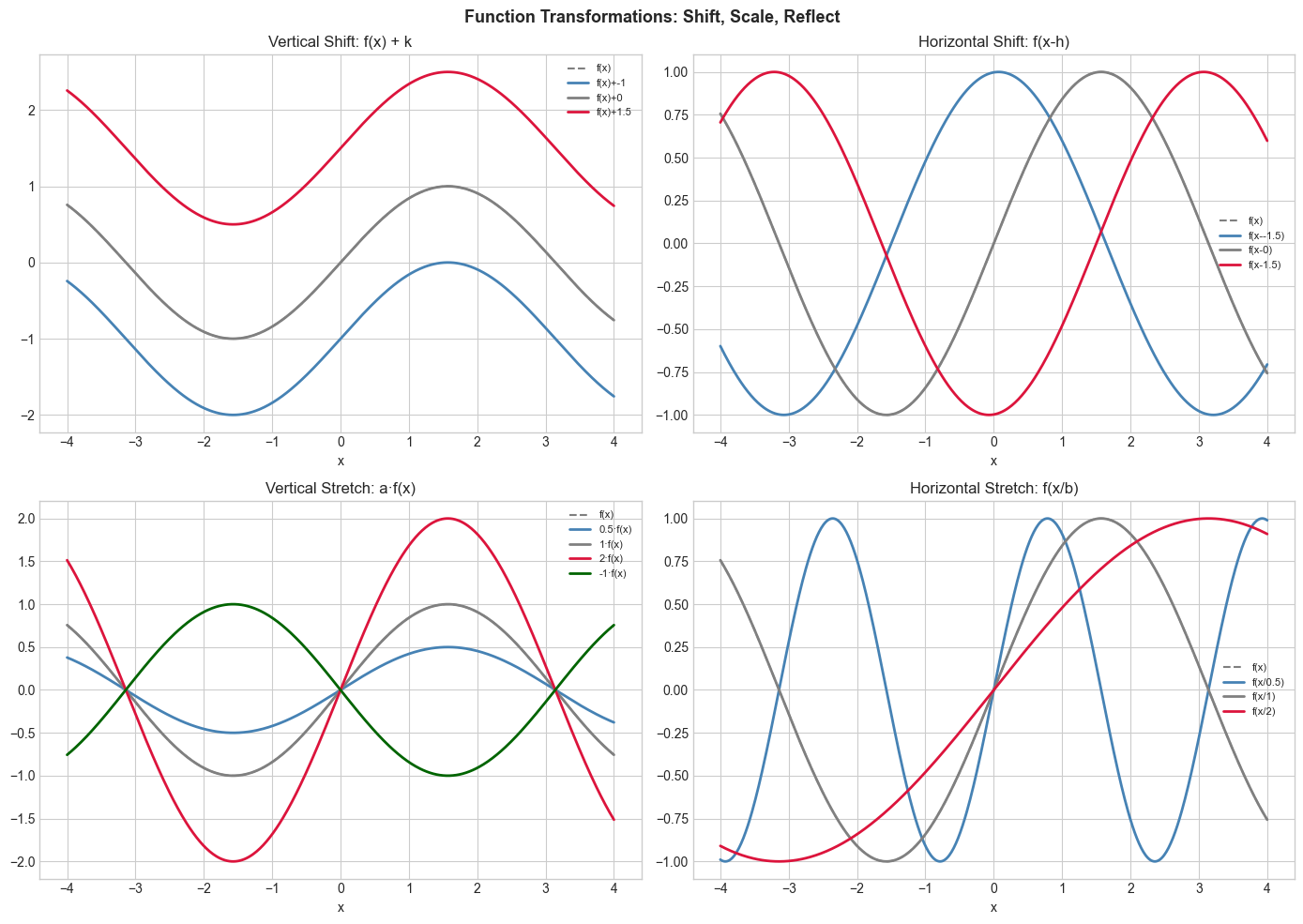
5. Python Implementation
# --- Implementation: Transformation composer ---
import numpy as np

class TransformedFunction:
    """Apply a sequence of transformations to a base function."""

    def __init__(self, f):
        self.f = f
        self.transforms = []  # list of (transform_fn, label)

    def vertical_shift(self, k):
        self.transforms.append((lambda y, k=k: y + k, f'+ {k}'))
        return self

    def vertical_scale(self, a):
        self.transforms.append((lambda y, a=a: a * y, f'× {a}'))
        return self

    def horizontal_shift(self, h):
        self.transforms.append((lambda x, h=h: x - h, f'x→x-{h}'))
        return self

    def reflect_vertical(self):
        self.transforms.append((lambda y: -y, 'reflect V'))
        return self

    def __call__(self, x):
        # Apply input transforms, then f, then output transforms
        result = x.copy() if hasattr(x, 'copy') else x
        for fn, label in self.transforms:
            result = fn(result)
        return self.f(result) if not self.transforms else result

# Demo: transform sin(x) → -2*sin(x - π/4) + 1
import numpy as np
x = np.linspace(-5, 5, 500)
base_f = np.sin

# Manual application of transformations
def transformed(x):
    return -2 * np.sin(x - np.pi/4) + 1

import matplotlib.pyplot as plt
plt.style.use('seaborn-v0_8-whitegrid')
fig, ax = plt.subplots(figsize=(10, 5))
ax.plot(x, np.sin(x), 'k--', linewidth=1.5, label='sin(x)', alpha=0.5)
ax.plot(x, transformed(x), color='steelblue', linewidth=2,
        label=r'$-2\sin(x - \pi/4) + 1$')
ax.set_title('Composed Transformation of sin(x)')
ax.set_xlabel('x'); ax.set_ylabel('f(x)'); ax.legend()
plt.tight_layout(); plt.show()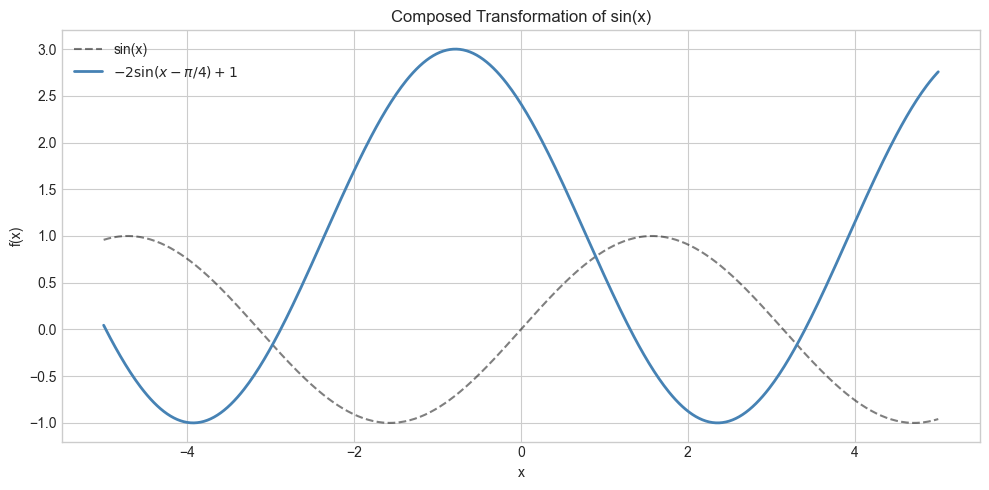
6. Experiments
Experiment 1: Apply transformations to f(x) = e^x. What does e^(x-2) + 3 look like compared to e^x? The exponential base is preserved — only the position shifts.
Experiment 2: Apply horizontal and vertical stretches in different orders to f(x) = x². Does order matter? (For the same function it shouldn’t, but try f(2x) + 1 vs 2f(x+1) — they are very different.)
7. Exercises
Easy 1. Write the transformed function g(x) = 3·f(2x - 1) + 4 for f(x) = x². Expand and simplify. What type of function is g?
Easy 2. If f(x) = |x|, describe the transformation that gives g(x) = -|x - 2| + 3. What is the vertex of g?
Medium 1. Implement normalize_function(f, x_samples) that transforms f so the output has mean 0 and std 1 over the given samples. This is function-level z-scoring.
Medium 2. Show that a horizontal shift h and vertical shift k are not interchangeable: plot f(x-2) + 1 and f(x-2+k) + k for k=1 and the same f. Explain the difference.
Hard. Prove algebraically that for f(x) = ax + b, f(cx + d) = a(cx+d) + b = acx + (ad+b). So the composition of linear functions is linear. Generalize: what transformations preserve the ‘linear function’ class?
9. Chapter Summary & Connections
Vertical transformations (shift, scale) modify the output; horizontal transformations modify the input
Input transformations behave counter-intuitively: f(x-h) shifts RIGHT by h
Multiple transformations compose in order: apply from innermost to outermost
Data normalization is a vertical transformation of f
Forward connections:
ch067 (Scaling and Shifting) deepens this with parameter families
Feature scaling in ch271 (Data and Measurement) applies these same transformations to data columns
ch169 (Eigenvalues) interprets matrix transformations as scaling + rotation