Prerequisites: ch058–069 (all function types and transformations)
You will learn:
Organize function types into parameterized families
Understand how a single template generates many functions
Connect to model selection: choosing the right function family
Build a classification system for common mathematical functions
Environment: Python 3.x, numpy, matplotlib
1. Concept
A function family is a set of functions sharing the same structural form, differentiated only by parameters.
Examples:
Power family: f(x) = xⁿ, parameterized by n
Exponential family: f(x) = aˣ, parameterized by base a
Sinusoidal family: f(x) = A·sin(ωx + φ), parameterized by amplitude A, frequency ω, phase φ
Logistic family: f(x) = L/(1 + e^(-k(x-x₀))), parameterized by L, k, x₀
Gaussian family: f(x) = (1/σ√2π)·e^(-(x-μ)²/2σ²), parameterized by μ, σ
Model selection is the problem of choosing which function family to use. Choose a family too simple (linear when the data is quadratic) and you underfit. Choose one too complex and you overfit.
The right family encodes your prior knowledge about the structure of the relationship you’re modeling.
2. Intuition & Mental Models
Physical analogy: Tool families. A screwdriver family: flat, Phillips, Torx — same concept, different parameterization. You choose the family based on the screw type, then pick the parameter (size).
Computational analogy: Class hierarchies. A Model base class with LinearModel, PolynomialModel, LogisticModel subclasses. Each subclass is a function family; the parameters are the fitted coefficients.
3. Visualization
# --- Visualization: Function families and their shapes ---
import numpy as np
import matplotlib.pyplot as plt
plt.style.use('seaborn-v0_8-whitegrid')

x = np.linspace(-4, 4, 500)
x_pos = np.linspace(0.01, 4, 500)

fig, axes = plt.subplots(2, 3, figsize=(16, 9))

# Power family
ax = axes[0, 0]
for n, color in zip([0.5, 1, 2, 3, 4], plt.cm.viridis(np.linspace(0, 1, 5))):
    ax.plot(x_pos, x_pos**n, color=color, linewidth=2, label=f'n={n}')
ax.set_title('Power Family: xⁿ'); ax.legend(fontsize=8); ax.set_ylim(0, 16)
ax.set_xlabel('x'); ax.set_ylabel('f(x)')

# Exponential family
ax = axes[0, 1]
for a, color in zip([0.5, 1, 2, np.e, 3], plt.cm.plasma(np.linspace(0, 1, 5))):
    ax.plot(x, a**x, color=color, linewidth=2, label=f'a={a:.2f}')
ax.set_title('Exponential Family: aˣ'); ax.legend(fontsize=8); ax.set_ylim(0, 10)
ax.set_xlabel('x'); ax.set_ylabel('f(x)')

# Sinusoidal family (varying frequency)
ax = axes[0, 2]
for omega, color in zip([0.5, 1, 2, 3], plt.cm.coolwarm(np.linspace(0, 1, 4))):
    ax.plot(x, np.sin(omega * x), color=color, linewidth=2, label=f'ω={omega}')
ax.set_title('Sinusoidal Family: sin(ωx)'); ax.legend(fontsize=8)
ax.set_xlabel('x'); ax.set_ylabel('f(x)')

# Logistic family (varying k)
ax = axes[1, 0]
for k, color in zip([0.5, 1, 2, 5], plt.cm.viridis(np.linspace(0, 1, 4))):
    ax.plot(x, 1/(1+np.exp(-k*x)), color=color, linewidth=2, label=f'k={k}')
ax.set_title('Logistic Family: 1/(1+e^{-kx})'); ax.legend(fontsize=8)
ax.set_xlabel('x'); ax.set_ylabel('σ(x)')

# Gaussian family (varying σ)
ax = axes[1, 1]
for sigma, color in zip([0.5, 1, 1.5, 2], plt.cm.plasma(np.linspace(0, 1, 4))):
    g = np.exp(-x**2/(2*sigma**2)) / (sigma * np.sqrt(2*np.pi))
    ax.plot(x, g, color=color, linewidth=2, label=f'σ={sigma}')
ax.set_title('Gaussian Family: N(0,σ)'); ax.legend(fontsize=8)
ax.set_xlabel('x'); ax.set_ylabel('f(x)')

# Polynomial family
ax = axes[1, 2]
for deg, color in zip([1, 2, 3, 5], plt.cm.coolwarm(np.linspace(0, 1, 4))):
    coeffs = np.ones(deg+1)
    y = np.polyval(coeffs, x/3)
    ax.plot(x, np.clip(y, -5, 5), color=color, linewidth=2, label=f'deg={deg}')
ax.set_title('Polynomial Family: Σxᵏ'); ax.legend(fontsize=8); ax.set_ylim(-5, 5)
ax.set_xlabel('x'); ax.set_ylabel('f(x)')

plt.suptitle('Function Families: Templates Parameterized by Constants', fontsize=13, fontweight='bold')
plt.tight_layout()
plt.show()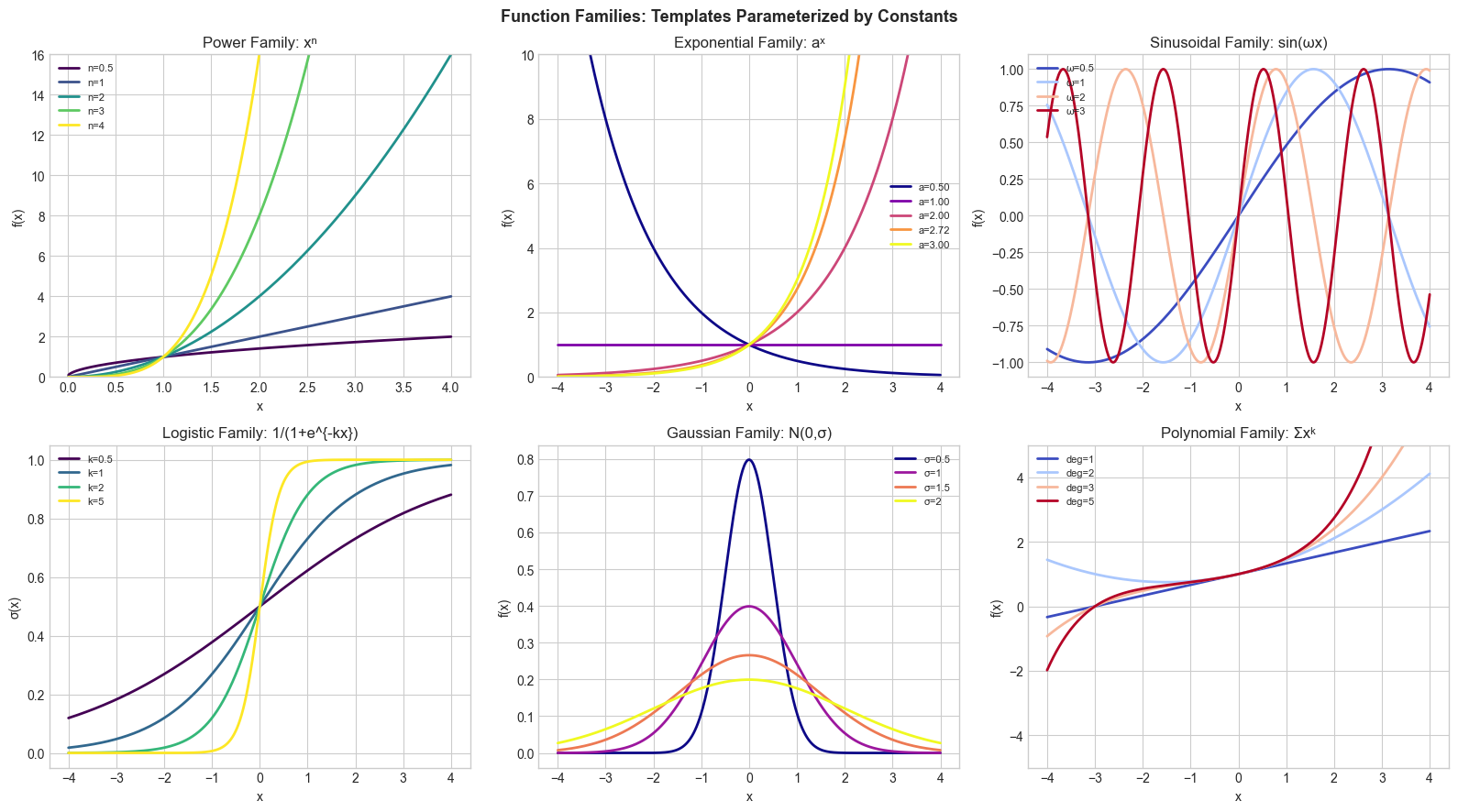
5. Python Implementation
# --- Implementation: Function family selector ---
import numpy as np

FUNCTION_FAMILIES = {
    'linear':      {'fn': lambda x, m, b: m*x + b,
                    'params': ['slope m', 'intercept b'],
                    'domain': 'all reals', 'bounded': False},
    'power':       {'fn': lambda x, n: x**n,
                    'params': ['exponent n'],
                    'domain': 'x>0 for non-integer n', 'bounded': False},
    'exponential': {'fn': lambda x, a, b: b * np.exp(a * x),
                    'params': ['rate a', 'scale b'],
                    'domain': 'all reals', 'bounded': 'lower only'},
    'logistic':    {'fn': lambda x, L, k, x0: L / (1 + np.exp(-k*(x-x0))),
                    'params': ['capacity L', 'growth k', 'midpoint x0'],
                    'domain': 'all reals', 'bounded': '(0, L)'},
    'sinusoidal':  {'fn': lambda x, A, omega, phi: A * np.sin(omega*x + phi),
                    'params': ['amplitude A', 'frequency ω', 'phase φ'],
                    'domain': 'all reals', 'bounded': '[-A, A]'},
    'gaussian':    {'fn': lambda x, mu, sigma: np.exp(-(x-mu)**2/(2*sigma**2)),
                    'params': ['mean μ', 'std σ'],
                    'domain': 'all reals', 'bounded': '(0, 1]'},
}

print("Available function families:")
for name, info in FUNCTION_FAMILIES.items():
    print(f"  {name:12s}: params={info['params']}, domain={info['domain']}")

# Model selection heuristic
def suggest_family(data_y, data_x=None):
    """Heuristic family suggestion based on data characteristics."""
    y = np.asarray(data_y)
    is_bounded = (y.min() >= 0) and (y.max() <= 1.01)
    is_monotone = np.all(np.diff(y) >= 0) or np.all(np.diff(y) <= 0)
    grows_fast = y[-1] / max(y[0], 1e-10) > 10

    if is_bounded and is_monotone: return 'logistic'
    if grows_fast and is_monotone: return 'exponential'
    if is_monotone: return 'power or linear'
    return 'sinusoidal or polynomial'

# Test
np.random.seed(0)
print("\nFamily suggestions:")
print("  Sigmoid-shaped data:", suggest_family(1/(1+np.exp(-np.linspace(-4,4,50)))))
print("  Exponential data:   ", suggest_family(np.exp(np.linspace(0,3,50))))
print("  Oscillating data:   ", suggest_family(np.sin(np.linspace(0,4*np.pi,50))))
Available function families:
linear : params=['slope m', 'intercept b'], domain=all reals
power : params=['exponent n'], domain=x>0 for non-integer n
exponential : params=['rate a', 'scale b'], domain=all reals
logistic : params=['capacity L', 'growth k', 'midpoint x0'], domain=all reals
sinusoidal : params=['amplitude A', 'frequency ω', 'phase φ'], domain=all reals
gaussian : params=['mean μ', 'std σ'], domain=all reals
Family suggestions:
Sigmoid-shaped data: logistic
Exponential data: exponential
Oscillating data: sinusoidal or polynomial
6. Experiments
Experiment 1: Generate data from a logistic curve with noise. Try fitting it with a linear, quadratic, and logistic model. Which gives the lowest error? Which generalizes best?
Experiment 2: For the sinusoidal family A·sin(ωx+φ), show that changing φ shifts the curve horizontally. What value of φ makes it equivalent to a cosine?
7. Exercises
Easy 1. Which function family would you use to model: (a) compound interest, (b) population with carrying capacity, (c) daily temperature over a year? Justify each.
Easy 2. The Gaussian family is parameterized by μ and σ. Write a function gaussian(mu, sigma) that returns a callable f(x). Use it to create three Gaussians and plot them.
Medium 1. Implement a FunctionFamily class that stores parameter names and a template function, provides a sample_member(param_dict) method returning a callable, and a plot_family(ax, param_grid) that overlays multiple members.
Medium 2. Given a dataset (x, y), implement a function that tests all 6 families in FUNCTION_FAMILIES by fitting parameters via grid search and returns the family with lowest residual sum of squares.
Hard. The exponential family in statistics (not the same as base-a exponentials) has the form f(x; θ) = h(x)·exp(θᵀT(x) - A(θ)). Show that the Gaussian, Bernoulli, and Poisson distributions are all members of this family by identifying h, T, and A for each.
9. Chapter Summary & Connections
A function family is a parameterized template: one formula, infinitely many functions
Model selection = choosing the right family; fitting = choosing the right parameters
Key families: power, exponential, logistic, sinusoidal, Gaussian, polynomial
Over-parameterized families lead to overfitting; under-parameterized to underfitting
Backward connection: Every function type in ch058–064 is a family with its own parameters.
Forward connections:
ch072 (Fitting Simple Models) fits parameters within a chosen family
ch286 (Regression) and ch293 (Classification) are formal model selection problems
Exponential families in statistics (ch282) use the same concept in probability