Advanced Calculus Experiment 4.
Gradient checking is one of the most practical debugging tools in deep learning. Any time you implement backpropagation (ch216) by hand, you should verify your analytical gradient against a numerical estimate. This experiment builds a production-quality gradient checker.
import numpy as np
import matplotlib.pyplot as plt

def numerical_gradient(f, x, h=1e-5):
    grad = np.zeros_like(x, dtype=float)
    it = np.nditer(x, flags=['multi_index'])
    while not it.finished:
        idx = it.multi_index
        x_plus  = x.copy(); x_plus[idx]  += h
        x_minus = x.copy(); x_minus[idx] -= h
        grad[idx] = (f(x_plus) - f(x_minus)) / (2*h)
        it.iternext()
    return grad

def gradient_check(f, analytical_grad_fn, x, threshold=1e-5):
    anal = analytical_grad_fn(x)
    numer = numerical_gradient(f, x)
    rel_err = np.linalg.norm(anal - numer) / (np.linalg.norm(anal) + np.linalg.norm(numer) + 1e-8)
    status = 'PASS' if rel_err < threshold else 'FAIL'
    return status, rel_err, anal, numer

print("Gradient checker ready.")
Gradient checker ready.
# Test 1: Simple quadratic
def f1(w): return np.sum(w**2) + 2*w[0]*w[1]
def grad_f1(w): return np.array([2*w[0] + 2*w[1], 2*w[1] + 2*w[0]])

x1 = np.array([1.5, -2.3])
status, err, anal, numer = gradient_check(f1, grad_f1, x1)
print(f"Test 1 (quadratic): {status}  rel_err={err:.2e}")

# Test 2: Buggy gradient (forgot normalisation factor)
def f2(w): return np.mean(w**2)
def buggy_grad_f2(w): return 2*w  # missing 1/n factor

status2, err2, anal2, numer2 = gradient_check(f2, buggy_grad_f2, x1)
print(f"Test 2 (buggy 1/n): {status2}  rel_err={err2:.2e}")
print("  Expected FAIL because analytical grad is missing 1/n factor")

# Correct version
def correct_grad_f2(w): return 2*w/len(w)
status3, err3, _, _ = gradient_check(f2, correct_grad_f2, x1)
print(f"Test 3 (corrected): {status3}  rel_err={err3:.2e}")
Test 1 (quadratic): PASS rel_err=1.39e-11
Test 2 (buggy 1/n): FAIL rel_err=3.33e-01
Expected FAIL because analytical grad is missing 1/n factor
Test 3 (corrected): PASS rel_err=6.15e-12
# Optimal step size h for gradient checking
f_test = lambda x: np.sin(x[0]) * np.exp(x[1])
grad_exact = lambda x: np.array([np.cos(x[0]) * np.exp(x[1]),
                                   np.sin(x[0]) * np.exp(x[1])])

x0 = np.array([1.2, 0.5])
true_g = grad_exact(x0)

h_vals = np.logspace(-14, -1, 50)
errors = [np.linalg.norm(numerical_gradient(f_test, x0, h=h) - true_g) for h in h_vals]

plt.figure(figsize=(8, 4))
plt.loglog(h_vals, errors, 'b-', lw=2)
plt.xlabel('Step size h'); plt.ylabel('Gradient error')
plt.title('Optimal h for Gradient Checking (central difference)')
plt.axvline(1e-5, color='red', ls='--', label='h=1e-5 (recommended)')
plt.legend(); plt.grid(True, which='both', alpha=0.3)
plt.tight_layout(); plt.savefig('ch234_grad_check.png', dpi=100); plt.show()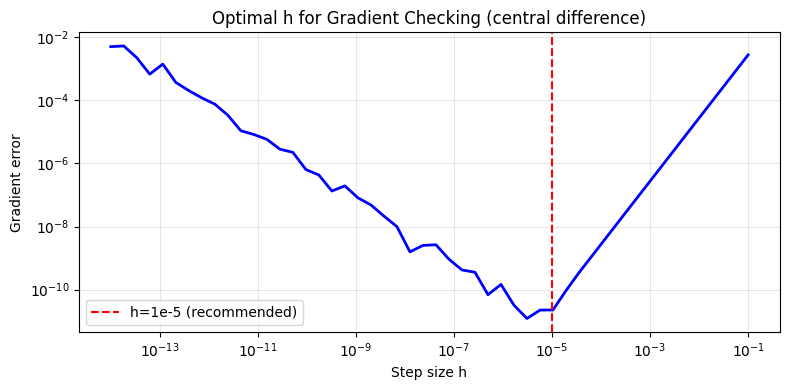
Summary
| Practice | Rule |
|---|---|
| Always gradient check new layers | Before training |
| Use h=1e-5 for float64 | Optimal for central difference |
| Relative error < 1e-5 | PASS threshold |
| Test all parameters | Not just a few |
Forward reference: ch291 — Optimisation Methods (Part IX) applies these debugging practices to real-world model training.