1. Why activation functions exist
Without nonlinearities, a depth- network collapses to a single matrix multiplication:
Activation functions are the source of expressive power (introduced in ch064–ch065). This chapter surveys the full family and analyses each choice’s effect on gradient flow.
2. The family
import numpy as np
import matplotlib.pyplot as plt


def sigmoid(z): return 1 / (1 + np.exp(-np.clip(z, -500, 500)))
def tanh(z): return np.tanh(z)
def relu(z): return np.maximum(0, z)
def leaky_relu(z, alpha=0.01): return np.where(z > 0, z, alpha * z)
def elu(z, alpha=1.0): return np.where(z > 0, z, alpha * (np.exp(np.clip(z, -500, 0)) - 1))
def gelu(z):
    """Gaussian Error Linear Unit — used in BERT, GPT."""
    return 0.5 * z * (1 + np.tanh(np.sqrt(2/np.pi) * (z + 0.044715 * z**3)))
def swish(z): return z * sigmoid(z)
def mish(z): return z * np.tanh(np.log1p(np.exp(np.clip(z, -500, 20))))

acts = [
    (sigmoid, 'Sigmoid', '#e74c3c'),
    (tanh, 'Tanh', '#e67e22'),
    (relu, 'ReLU', '#3498db'),
    (leaky_relu, 'Leaky ReLU (α=0.01)', '#2980b9'),
    (elu, 'ELU (α=1)', '#9b59b6'),
    (gelu, 'GELU', '#1abc9c'),
    (swish, 'Swish', '#2ecc71'),
]

z = np.linspace(-4, 4, 500)

fig, axes = plt.subplots(2, 1, figsize=(13, 10))

for fn, name, color in acts:
    axes[0].plot(z, fn(z), label=name, color=color, lw=2)

axes[0].axhline(0, color='black', alpha=0.3, lw=0.8)
axes[0].axvline(0, color='black', alpha=0.3, lw=0.8)
axes[0].set_title('Activation functions')
axes[0].set_ylabel('σ(z)')
axes[0].legend(ncol=2)
axes[0].set_ylim(-1.5, 3.5)

# Numerical derivatives
dz = z[1] - z[0]
for fn, name, color in acts:
    grad = np.gradient(fn(z), dz)
    axes[1].plot(z, grad, label=name, color=color, lw=2)

axes[1].axhline(0, color='black', alpha=0.3, lw=0.8)
axes[1].axhline(1, color='black', alpha=0.3, lw=0.8, linestyle='--')
axes[1].set_title("Activation function derivatives (gradient signal)")
axes[1].set_ylabel("dσ/dz")
axes[1].set_xlabel("z")
axes[1].legend(ncol=2)
axes[1].set_ylim(-0.1, 1.5)

plt.tight_layout()
plt.savefig('ch309_activations.png', dpi=120)
plt.show()

print("Key observations:")
print("  Sigmoid/Tanh: derivative peaks at ~0.25 / 1.0; saturates to 0 at extremes → vanishing gradients")
print("  ReLU: derivative is 1 for z>0, 0 for z<0 → dead neuron problem but no saturation")
print("  GELU/Swish: smooth, non-monotone; gradient non-zero even slightly left of 0")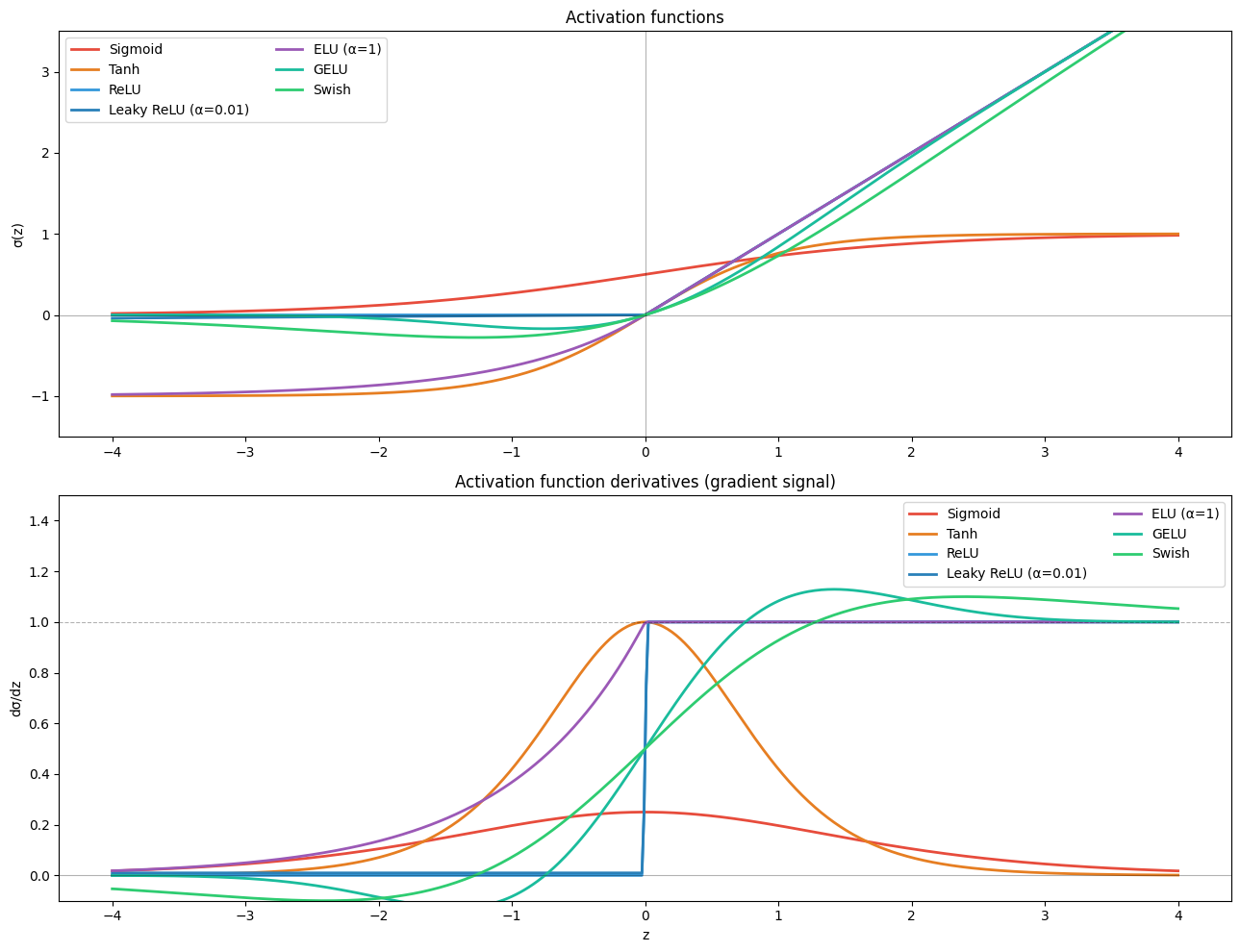
Key observations:
  Sigmoid/Tanh: derivative peaks at ~0.25 / 1.0; saturates to 0 at extremes → vanishing gradients
  ReLU: derivative is 1 for z>0, 0 for z<0 → dead neuron problem but no saturation
  GELU/Swish: smooth, non-monotone; gradient non-zero even slightly left of 0
3. Choosing an activation
| Activation | Gradient at saturation | Dead neurons | Recommended use |
|---|---|---|---|
| Sigmoid | ≈0 (saturates) | No | Output layer (binary prob) |
| Tanh | ≈0 (saturates) | No | Legacy; some RNNs |
| ReLU | Exact 0 for z<0 | Yes (dead) | Hidden layers, CNNs |
| Leaky ReLU | α (small) | Very rare | ReLU alternative |
| ELU | Negative mean, smooth | No | Slightly better than ReLU |
| GELU | Smooth near 0 | No | Transformers, BERT, GPT |
| Swish | Smooth, non-monotone | Rare | EfficientNet, modern CNNs |
Default choice: ReLU for CNNs and MLPs; GELU for Transformers.
4. The dead ReLU problem
A ReLU neuron is dead when for every sample in every batch. Its gradient is identically zero — it will never recover via gradient descent. This can happen if:
Learning rate is too large (a bad update pushes weights into the always-negative regime).
Biases are initialised too negatively.
Fix: Leaky ReLU, ELU, or careful learning rate scheduling.
5. Activation choice in the output layer
| Output type | Activation | Loss |
|---|---|---|
| Regression | None (linear) | MSE |
| Binary class | Sigmoid | BCE |
| Multiclass | Softmax | Categorical CE |
| Multi-label | Sigmoid (per class) | BCE |
6. Summary
Nonlinearity is mandatory; without it depth collapses to a single linear map.
Sigmoid/Tanh saturate → vanishing gradients. Use them only at output (binary/regression).
ReLU: simple, fast, but risks dead neurons. Default for hidden layers.
GELU/Swish: smooth, more expressive, preferred in modern Transformers.
Derivative shape determines gradient signal; a flat derivative region = dead zone.
7. Forward and backward references
Used here: sigmoid and activation functions (ch064–ch065), derivative (ch205), vanishing gradients (ch306), initialisation (ch308).
This will reappear in ch321 — Attention Mechanism, where the softmax activation is used to compute attention weights, and in ch322 — Transformers, where GELU is the standard hidden activation in the feed-forward sublayer.