1. The internal covariate shift problem
As weights update during training, the distribution of each layer’s inputs changes. Deeper layers must constantly adapt to a shifting input distribution — this slows training. Batch Normalisation (Ioffe & Szegedy, 2015) eliminates this by explicitly normalising each layer’s pre-activation to zero mean and unit variance during training.
2. The algorithm
For a mini-batch of pre-activations:
(scale) and (shift) are learnable parameters — the network can undo the normalisation if it helps. prevents division by zero.
(Mean and variance: ch249–ch250. Normalisation: ch285.)
3. Training vs inference
During training: use batch statistics , .
During inference: batch size may be 1 (no reliable batch statistics). Fix: maintain running averages , with exponential moving average during training. Use these at inference time:
import numpy as np
import matplotlib.pyplot as plt


class BatchNorm1D:
    """Batch normalisation for 1D activations, shape (features, batch)."""

    def __init__(self, n_features: int, eps: float = 1e-5, momentum: float = 0.1):
        self.gamma = np.ones(n_features)
        self.beta = np.zeros(n_features)
        self.eps = eps
        self.momentum = momentum
        # Running stats (for inference)
        self.running_mean = np.zeros(n_features)
        self.running_var = np.ones(n_features)
        self.cache = None

    def forward(self, Z: np.ndarray, training: bool = True) -> np.ndarray:
        """Z: shape (n_features, batch_size)"""
        if training:
            mu = Z.mean(axis=1, keepdims=True)
            var = Z.var(axis=1, keepdims=True)
            Z_hat = (Z - mu) / np.sqrt(var + self.eps)
            # Update running statistics
            self.running_mean = (1 - self.momentum) * self.running_mean + self.momentum * mu.ravel()
            self.running_var = (1 - self.momentum) * self.running_var + self.momentum * var.ravel()
            self.cache = (Z, Z_hat, mu, var)
        else:
            Z_hat = (Z - self.running_mean[:, None]) / np.sqrt(self.running_var[:, None] + self.eps)
        return self.gamma[:, None] * Z_hat + self.beta[:, None]

    def backward(self, dY: np.ndarray) -> tuple:
        """Returns (dZ, d_gamma, d_beta)."""
        Z, Z_hat, mu, var = self.cache
        B = Z.shape[1]
        d_gamma = (dY * Z_hat).sum(axis=1)
        d_beta = dY.sum(axis=1)
        dZ_hat = dY * self.gamma[:, None]
        std_inv = 1.0 / np.sqrt(var + self.eps)
        dZ = (1.0/B) * std_inv * (
            B * dZ_hat
            - dZ_hat.sum(axis=1, keepdims=True)
            - Z_hat * (dZ_hat * Z_hat).sum(axis=1, keepdims=True)
        )
        return dZ, d_gamma, d_beta


# Visualise: activations before and after BN across layers
rng = np.random.default_rng(0)

fig, axes = plt.subplots(2, 4, figsize=(14, 6))
n_features = 64

for col, batch_size in enumerate([8, 32, 128, 512]):
    Z = rng.normal(5, 3, (n_features, batch_size))  # shifted, scaled activations
    bn = BatchNorm1D(n_features)
    Z_out = bn.forward(Z, training=True)

    axes[0, col].hist(Z.ravel(), bins=40, color='#e74c3c', alpha=0.7, density=True)
    axes[0, col].set_title(f'Before BN (B={batch_size})')
    axes[0, col].set_xlim(-5, 15)

    axes[1, col].hist(Z_out.ravel(), bins=40, color='#3498db', alpha=0.7, density=True)
    axes[1, col].set_title(f'After BN (B={batch_size})')
    axes[1, col].set_xlim(-4, 4)

axes[0, 0].set_ylabel('Density (before BN)')
axes[1, 0].set_ylabel('Density (after BN)')
plt.suptitle('Batch Normalisation: distribution before/after, across batch sizes', fontsize=11)
plt.tight_layout()
plt.savefig('ch310_batchnorm.png', dpi=120)
plt.show()

print("Note: small batch sizes (B=8) give noisy estimates of mean/variance.")
print("For B<16, consider Layer Normalisation instead (used in Transformers — ch322).")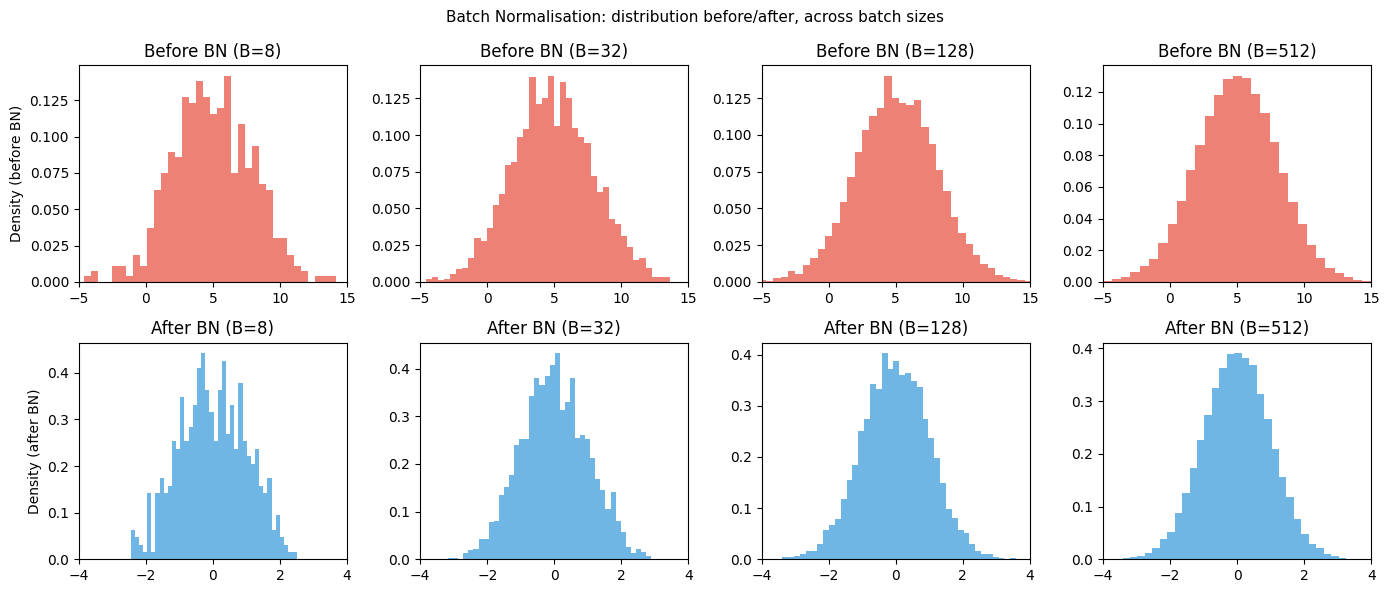
Note: small batch sizes (B=8) give noisy estimates of mean/variance.
For B<16, consider Layer Normalisation instead (used in Transformers — ch322).
4. Why BatchNorm accelerates training
Higher learning rates are stable: normalised activations prevent extreme gradients.
Reduced sensitivity to initialisation: the normalisation corrects for bad starting weights.
Slight regularisation effect: batch statistics introduce noise, similar to dropout.
5. Layer Norm vs Batch Norm
| Batch Norm | Layer Norm | |
|---|---|---|
| Normalises over | Batch dimension | Feature dimension |
| Works with batch size 1 | ✗ | ✓ |
| Standard use | CNNs, MLPs | Transformers, RNNs |
| Running stats needed | Yes | No |
Transformers (ch322) use Layer Norm because they process sequences of varying length, often one token at a time during inference.
6. Summary
BatchNorm normalises each feature to zero mean, unit variance within a mini-batch.
and are learnable: the network can restore any distribution it needs.
Training uses batch statistics; inference uses exponential moving average.
Enables higher LR, less sensitivity to init, slight regularisation.
For Transformers: use Layer Norm (normalise over features, not batch).
7. Forward and backward references
Used here: mean and variance (ch249–ch250), backpropagation (ch306), initialisation sensitivity (ch308).
This will reappear in ch322 — Transformers, where Layer Normalisation (same principle, different axis) is applied before each attention and feed-forward sublayer.